Anthropic explained how the new watermarks will work in texts generated by Claude and how easy they will be to detect. The company confirmed that it will use the SynthID-Text system and is preparing an API to detect this content.
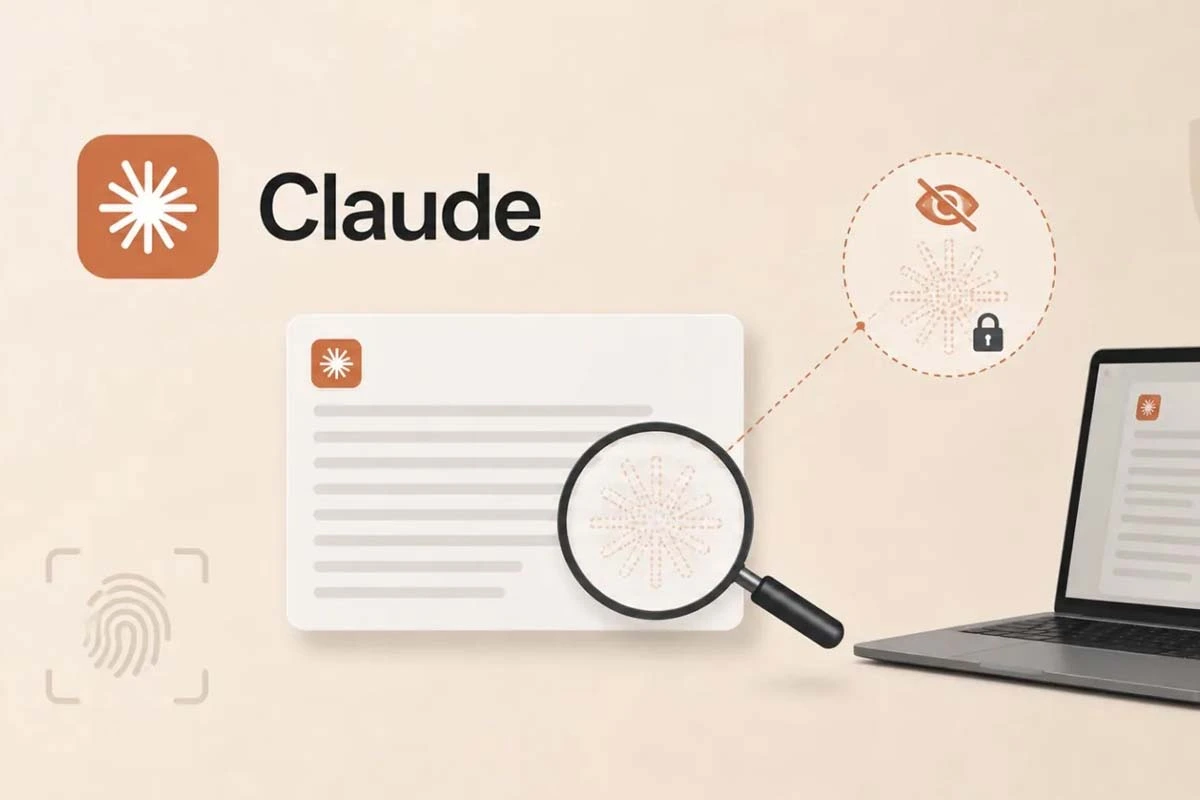
According to Anthropic, the watermark will be invisible to the reader and will not alter the quality of the responses. The system will leverage writing decisions that Claude makes when generating certain texts.
Anthropic explained how the new watermarks will work in texts generated by Claude
How Claude's watermarks will work
Anthropic explained that Claude can generate patterns in its responses by choosing between words that have similar meanings. For example, it can opt for terms like “overcast” and “grey.”
This pattern will be undetectable to the reader, but it can be identified by those who have a specific key to verify it.
The company clarified that the watermarking will not affect the quality of the texts. For a person, a response with a watermark will be indistinguishable from one without it.
How Claude's watermarks will work
What system will Anthropic use to detect Claude's texts
Anthropic will use the SynthID-Text system, developed by the Google DeepMind team and presented in 2024.
Additionally, the company plans to launch a watermark detection API to identify texts generated by Claude.
What system will Anthropic use to detect texts from Claude
Anthropic clarified that this mechanism is different from systems that analyze writing patterns to determine if content was created with AI.
Can the watermark be removed from a text generated by Claude?
The company acknowledged that it is possible to modify a text to hide the watermark. However, a light edit is unlikely to completely remove it.
In contrast, a complete rewrite, where all words are replaced, could remove it. Anthropic noted that, in that case, it can also be discussed whether the result can still be considered AI-generated text.
Can the watermark of a text generated by Claude be removed?
What happens if Claude only corrects or edits a text written by a person
The ability to detect a watermark will depend on how much text Claude has edited and the length of the original content.
If the chatbot's intervention was minor, almost all the words will still belong to the human author. In that scenario, there will be very little content to which the watermark can be associated.
What happens if Claude only corrects or edits a text written by a person
How Claude's watermarking will work in code
The codes will have fewer watermarks than other types of text. This is because Claude needs to produce functional code and has less room to choose between equally valid options.
However, the system could be used when there is an arbitrary choice between certain words or terms. An example is comments within the code.
Anthropic clarified that, by definition, the watermark will have a negligible effect on the produced code.
How Claude's watermarking will work in the code
Claude will not be the only chatbot with watermarked texts
Anthropic also noted that Claude will not be the only chatbot to incorporate this technology. According to the company, other major model developers have signed the same Code of Practices and will implement their own systems.
This measure is part of the response of artificial intelligence companies to the new demands for transparency. Anthropic explained that its decision is linked to the Transparency Code of the EU AI Act.