
Lost City of the Silk Road: archaeologists document a large metallurgical center in the mountains of Uzbekistan

Lost City of the Silk Road: archaeologists document a large metallurgical center in the mountains of Uzbekistan
Imagen de Editorial Team
porEditorial Team
Argentina

Researchers argue that the discovery forces a reevaluation of how the economy and exchange networks operated along the Silk Road.

Nuevo
Agregar La Derecha Diario en
Compartir:

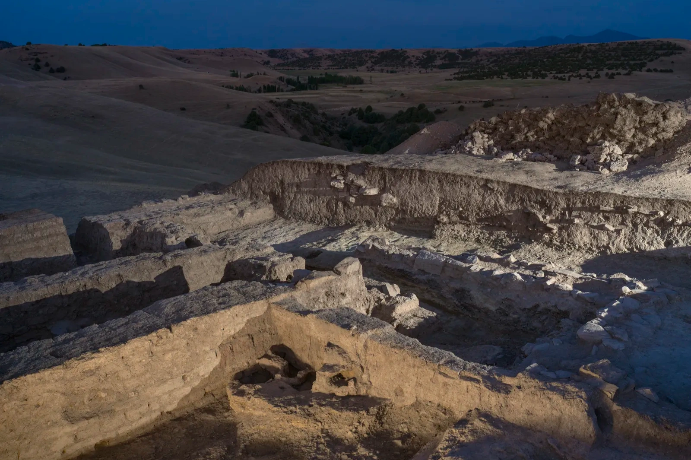
The traditional narrative of the Silk Road often focuses on major trading capitals, caravanserais, and famous oases. But recent research in the mountains of southeastern Uzbekistan has shifted the focus to something different: a high-altitude city that may have been an industrial engine, with evidence of large-scale metallurgy. The work, supported by remote scanning technology (Lidar) mounted on drones, allowed for the identification of urban traces, fortifications, and structures that were previously unknown.

The main site, known today as Tugunbulak, is believed to have occupied an area of approximately 120 hectares and to have functioned between the 6th and 10th/11th centuries. Researchers estimate that it could have housed a population “in the tens of thousands,” a size capable of rivaling historical centers in the region. The significance is not just in the size: in a fortified area, they found remnants of furnaces and slag suggesting iron or steel production, directly linking it to the economic circuits of the Silk Road.

The existence of this “iron city” in the heart of the mountain range raises questions about how power and production were organized in medieval Central Asia. According to researchers, the finding places industry and territorial control “far outside” traditional agricultural poles, complicating the idea that economic dynamism was concentrated only in the plains and oasis cities. In other words: it was not just a transit corridor; there were also productive centers with urban scale in remote locations.

What they found and why it matters: a fortified high-altitude city linked to metallurgy

The research took place in a high mountain landscape, with deep canyons and steep slopes, where urbanization seemed unlikely. The application of Lidar allowed researchers to “see” through the ground cover and map in detail structures, terraces, roads, and fortifications, outlining an urban pattern that is not easily detected from the ground. This mapping revealed a settlement larger than expected for an environment at 2,000 to 2,200 meters above sea level, comparable in height to other famous mountain sites, though in a different historical and cultural context.

Archaeologists May Have Found the Lost Iron City of the Silk Road in the Remote Highlands of UzbekistanWhat makes Tugunbulak unique is the industrial evidence. In a fortified structure with thick earthen walls, archaeologists found remnants of furnaces and kilns, interpreted as part of a facility where iron ore was processed to produce metal. The team is working on chemical analyses of the slag, a key byproduct, to accurately confirm the type of metal produced and its scale.

This industrial component is what “moves” the finding from local terrain to broader historical debate. If sustained production of iron or steel is confirmed, the site suggests that the Silk Road not only connected markets but also areas producing strategic inputs for tools, weapons, and construction. In the medieval context, having relevant metallurgy equates to having economic, logistical, and likely political power.

Two cities, two functions: industry and signs of early Islam in the region

The finding is not limited to a single city: alongside Tugunbulak appears Tashbulak, a nearby but smaller site. Researchers describe Tashbulak as much smaller, possibly with thousands of inhabitants, but with a cultural signal of enormous weight: a large cemetery with around 400 graves. This cemetery includes some of the oldest documented Muslim burials in the region, making it a marker of the early expansion of Islam in Central Asia.

The coexistence of both sites suggests a complex local network: a larger industrial city and another with particularly relevant social or religious functions. Researchers note that the cemetery “does not match” the size of the village, fueling the hypothesis of a special ideological or regional role for Tashbulak. Historically, this reinforces the idea that the Silk Road was also a corridor for religions, institutions, and cultural transformations, not just for goods.

Moreover, both sites compel us to think about the relationship between landscape and urbanism. The presence of planned and fortified cities at high altitudes indicates that there were economic and strategic reasons for settling there, even with logistical and climatic costs. These reasons may include control of routes, access to minerals, dominance of mountain passes, and defense capabilities.

What changes in the history of the Silk Road: industry outside the classic centers and new questions

For decades, the dominant narrative placed the economic heart in large hubs like Samarkand and other oasis cities. This finding suggests that part of the power and production could be “decentralized” towards mountainous areas, where metallurgy and livestock added value and surpluses. If Tugunbulak functioned as a metal hub, its role in supply chains may have been key to the regional economy, even if it was not as “visible” a commercial node as the famous cities.

A methodological agenda is also opened. The use of Lidar with drones shows that there may still be large hidden sites in difficult geographies, and that mountain archaeology can rewrite historical maps that seemed closed. The combination of remote scanning and targeted excavation allows for a shift from “discovery” to economic interpretation: how they lived, what they produced, how they defended themselves, and to what networks they were connected.

For now, the names “Tugunbulak” and “Tashbulak” are modern designations, and the link to a specific historical city remains a matter of research. Researchers indicated that they are working with historical sources to find matches that allow them to identify the original names and the exact political role of these centers. If this identification succeeds, the finding could solidify as one of the most important pieces for understanding industrialization and urbanism in the high areas of the Silk Road.


La Derecha Diario logo
ESX logoInstagram logoYouTube logoTikTok logoFacebook
ARGENTINABOLIVIAECUADORISRAELMEXICOURUGUAYDERECHA DIARIO TV
  • ES
    XInstagramYouTubeTikTokFacebook
  • DERECHA DIARIO TV
  • Secciones
  • ARGENTINA
  • BOLIVIA
  • ECUADOR
  • ISRAEL
  • MEXICO
  • URUGUAY
  • Países
  • La Derecha Diario logoLA DERECHA DIARIO
  • La Derecha Diario México logoLA DERECHA DIARIO MÉXICO
  • La Derecha Diario Uruguay logoLA DERECHA DIARIO URUGUAY
  • La Derecha Diario Ecuador logoLA DERECHA DIARIO ECUADOR
  • La Derecha Diario Bolívia logoLA DERECHA DIARIO BOLÍVIA
  • La Derechadiario República Dominicana logoLA DERECHADIARIO REPÚBLICA DOMINICANA
  • La Derecha Diario Israel logoLA DERECHA DIARIO ISRAEL
  • La Derecha Diario Estados Unidos logoLA DERECHA DIARIO ESTADOS UNIDOS
  • Temas
  • GUERRA EN IRÁN
  • El Diario
  • QUIENES SOMOS
  • AUTORES
  • PUBLICIDAD
  • DONAR
La Derecha Diario logo
TwitterInstagramYouTubeTikTokFacebook
Derecha Diario TV

Nosotros

  • Quienes Somos
  • Autores
  • Donar

Privacidad

  • Protección de datos
  • Canales
  • Sitemap
  • RSS

Contacto

  • info@derechadiario.com.ar
PUBLICIDAD

Noticias relacionadas

Kicillof does not adhere to the new VTV system and complicates life for the people of Buenos Aires.

Kicillof does not adhere to the new VTV system and complicates life for the people of Buenos Aires.

Who are the two goalkeepers that excite Boca for this transfer market?

Who are the two goalkeepers that excite Boca for this transfer market?

De la Espriella will seek an alliance with SpaceX to bring rural internet to Colombia.

De la Espriella will seek an alliance with SpaceX to bring rural internet to Colombia.

France imposed a million-euro fine on Shein for serious violations against consumers.

France imposed a million-euro fine on Shein for serious violations against consumers.

More radicalized than ever: a Democratic candidate with ties to Al Qaeda won a key primary in New Jersey.

More radicalized than ever: a Democratic candidate with ties to Al Qaeda won a key primary in New Jersey.

Republicans gain strength in the elections to end the reign of terror of the Democrats in California.

Republicans gain strength in the elections to end the reign of terror of the Democrats in California.