In addition to the grain harvest, another factor that could strengthen reserves is the return of private financing. According to official estimates, companies and provinces could place over USD 3.2 billion in debt abroad, something that just a few months ago was practically impossible for Argentina due to the inherited financial deterioration.
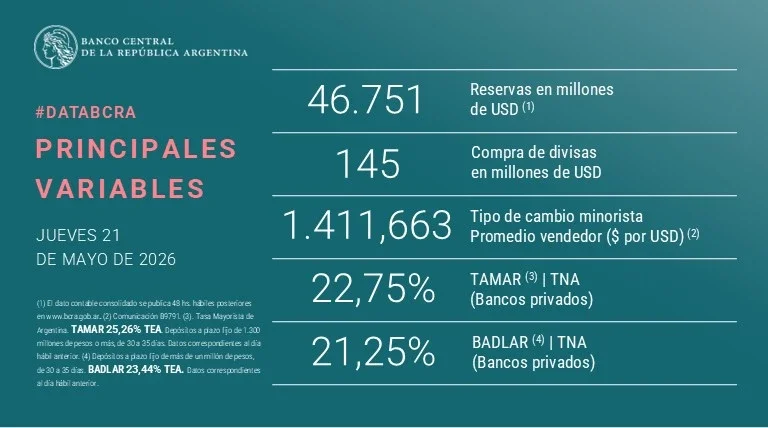
The Central Bank of the Argentine Republic closed another day with a positive balance and consolidated an unprecedented trend in recent years of the Argentine economy. The entity led by Santiago Bausiliadded USD 145 million this Thursday and reached 92 consecutive rounds with net currency purchases, amid the economic stabilization process driven by the government of Javier Milei.
With this new result, the annual accumulated purchases now amount to USD 8.851 billion, equivalent to 88.5% of the annual target set by the economic team. This figure reflects a sustained strengthening of international reserves after years marked by extreme controls, uncontrolled issuance, and the constant loss of dollars under Kirchnerist administrations.
The summary of the day.
Since the start of the new monetary scheme in January, the Central Bank has managed to maintain a strong buying presence in the foreign exchange market. April was the month of highest accumulation, with USD 2.769 billion added to the reserves, while in May, USD 1.696 billion were added.
In the Ministry of Finance, they assert that the bulk of the liquidation from the agro-export sector has not yet entered, so they expect an even greater acceleration in the flow of currencies in the coming weeks. This would allow for an expansion of the reserve accumulation margin and reinforce the exchange rate stability achieved by the Government.
International reserves closed the day at USD 46.751 billion, just below the maximum recorded during the Milei administration. The record for the current management was reached in February when they hit USD 46.905 billion, the highest level since 2018.
Central Bank of the Argentine Republic.
Meanwhile, the dollar showed signs of retreat again. The wholesale exchange rate fell by $7.50 and closed at $1,389.50, its lowest value since May 12. The blue dollar and the Banco Nación retail dollar also retreated.
With a fiscal surplus and a more restrictive monetary policy, the ruling party aims to consolidate a phase of financial stability that allows for sustaining the inflationary slowdown and deepening the economic recovery during the second half of the year.