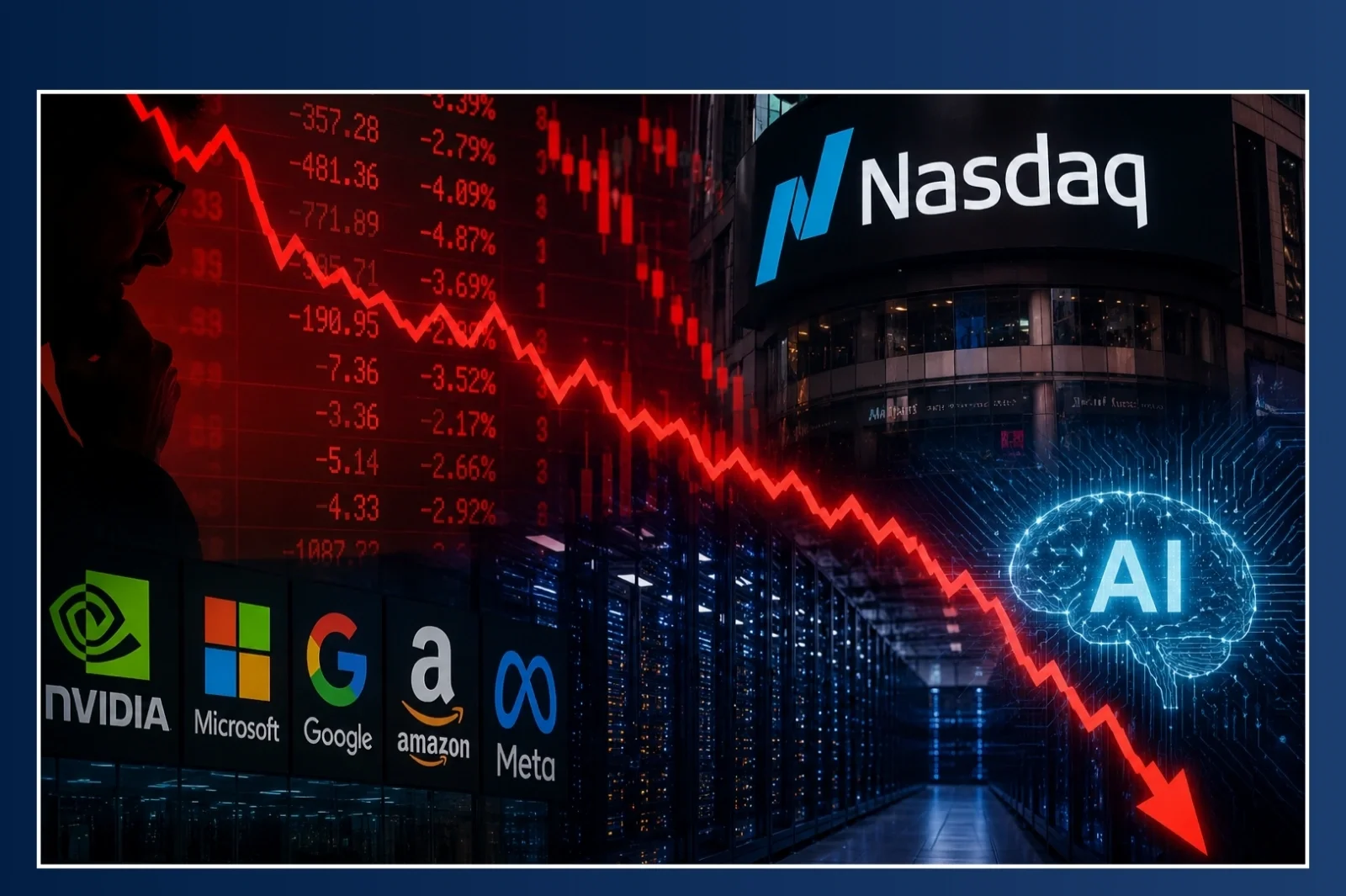

The Nasdaq suffered its largest daily point drop in history on Friday, June 5. And while the media tends to focus on the news of the day, what is truly interesting is to ask what the market is telling us behind that movement.
In recent years, stocks linked to artificial intelligence have seen one of the largest rises in modern history. Nvidia has become one of the most valuable companies on the planet. Microsoft, Google, Amazon, and Meta announced multi-billion dollar investments in data centers. Companies like OpenAI and Anthropic reached valuations that just a few years ago seemed impossible.
The narrative is well-known: artificial intelligence will change the economy, increase productivity, and transform the way we work. And that is probably true.
However, there is one fact that should catch the attention of any investor: More than half of the total value of the S&P 500 is concentrated in companies that are trading at more than ten times their annual sales. Historically, such valuations were reserved for exceptional companies. Today, we are no longer talking about a few isolated firms. We are talking about a huge part of the U.S. market.
The list includes names like Nvidia, Apple, Microsoft, Alphabet, Broadcom, Oracle, AMD, Micron, Tesla, and dozens of other companies.
What does this mean?
It means that the market is not only expecting growth. It expects extraordinary growth for many years. When a company trades at such multiples, it is no longer enough to execute well. It has to meet almost perfect expectations.
And that is precisely the problem.
Current prices reflect enormous confidence that the artificial intelligence revolution will generate gigantic profits in the future. But one thing is for a technology to change the world, and quite another is for all the investments made around that technology to generate the expected returns.
Financial history is full of examples
Internet changed the world forever. However, many of the most popular companies from the dot-com bubble ended up disappearing. Telecommunications indeed transformed the global economy, but companies like Lucent Technologies, Global Crossing, or WorldCom destroyed enormous amounts of capital because investments grew much faster than demand.