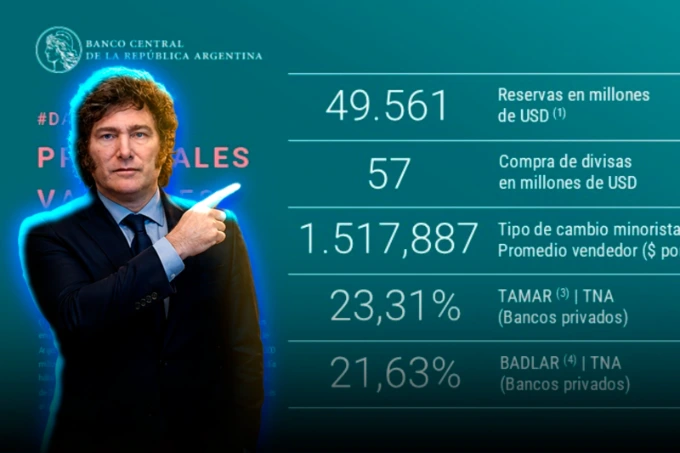

At the center of the macroeconomic defense driven by the government of Javier Milei, the Central Bank of the Argentine Republic (BCRA) completed this Tuesday August 11, 2026 the largest purchase of foreign currency in the official exchange market so far this month, acquiring a total of USD 57 million for its international reserves.
In a currency trading session where USD 510 million was traded (with USD 515.6 million recorded in cash according to other sectoral records), the monetary authority strategically absorbed 11% (specifically 11.1%) of the traded volume.
With this magnificent operation, the accumulated buyer balance for August rose to USD 181 million, allowing the total foreign currency purchases accumulated by the libertarian management in the year 2026 to comfortably surpass the barrier of USD 13.500 million, reaching the exact figure of USD 13.508 million.
Additionally, the BCRA extended its remarkable streak of ten consecutive sessions with a positive balance in the market. To dispel any doubts sown by opposition sectors, the president of the entity, Santiago Bausili, was emphatic regarding the recent tension over interest rates, officially declaring: "The reserves and liquidity are at adequate levels".
Despite the fact that the pace of reserve accumulation in August is averaging USD 26 million per day —below the USD 103 million recorded in July, USD 68 million in June, and USD 137 million in May—, Tuesday's session demonstrated a strong recovery in the official flow of income.
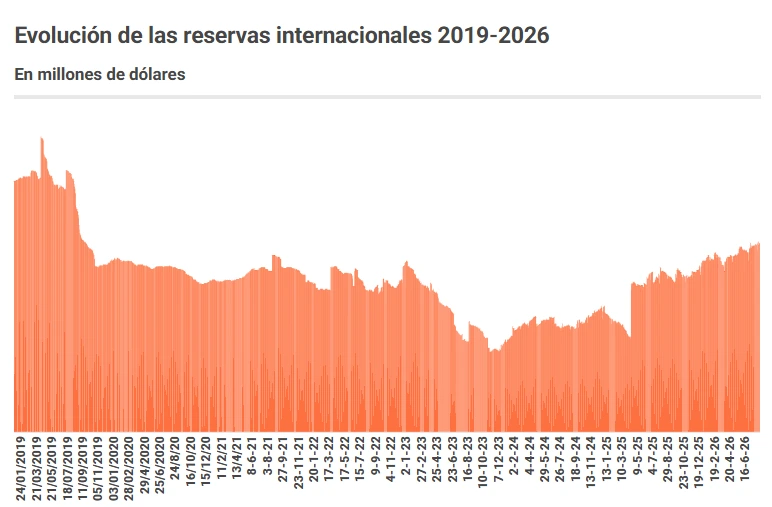
This consolidated the gross international reserves in the area of USD 49.561 million (with USD 49.651 million recorded according to the exchange balance sheet), remaining firmly above the key floor of USD 49.000 million.
This remarkable stability was achieved in an international scenario where gold advanced slightly by 0.20%, the global dollar remained stable, the euro fell 0.03%, the yuan showed no variations, the yen dropped 0.05%, and the pound rose just 0.01%.

The rigorous discipline of the economic plan has had a direct impact on the domestic exchange market, which has shown clear signs of easing.