
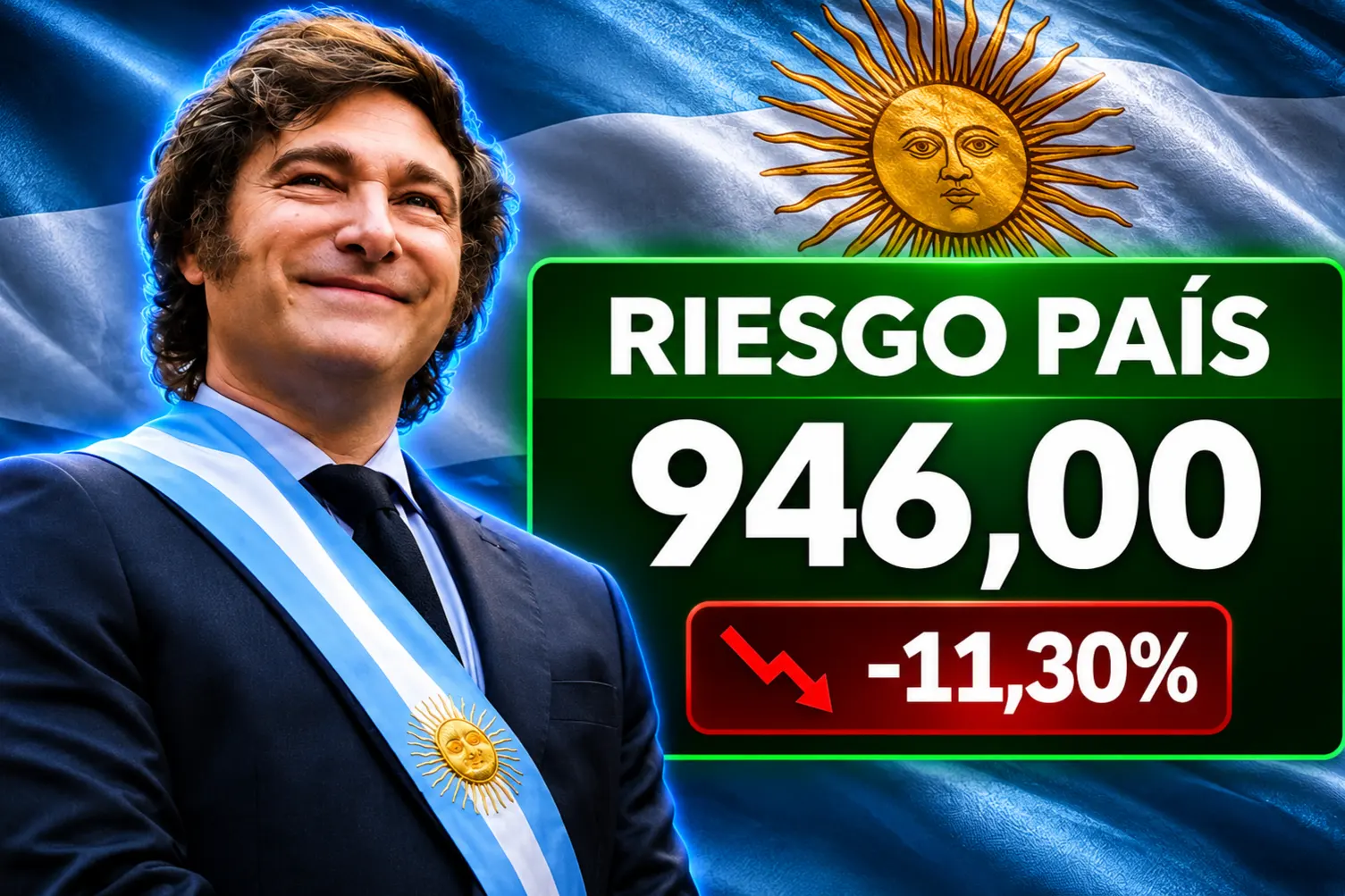

The country risk of Argentina registered a sharp drop this Friday and fell back below 1,000 basis points, in a new sign of recovery for Argentine financial assets during the management of President Javier Milei.
The indicator prepared by JP Morgan decreased to 946 basis points, representing a drop of 121 units compared to Thursday's close, when it ended at 1,067 points. The variation corresponds to a decline of nearly 11%.
The improvement was accompanied by a recovery of dollar-denominated sovereign bonds, which had recorded an average rebound of 2.1% during the previous trading day on the Buenos Aires Stock Exchange. This Friday, Argentine Global bonds, which operate under foreign legislation, were up an average of 2.8% in New York.
The movement represents relief for Milei's government, which seeks to regain Argentina's access to international credit markets and gradually reduce the cost of financing sovereign debt.
Additionally, the 946 points constitute the lowest level since November 19, after the indicator reached 1,139 points intraday earlier this week, its highest record since October 2, 2025.
Argentine bonds drove the drop in country risk
The decline in the indicator was directly related to the recovery of Argentine debt prices. Country risk measures the difference between the yield demanded by investors to buy Argentine sovereign bonds and the yield offered by U.S. Treasury securities.
Therefore, when the prices of Argentine bonds rise, the yield they offer decreases, and consequently, the risk premium demanded by the market to finance the country can be reduced.
The recovery of sovereign bonds reflects an improvement in investor expectations regarding Argentina's ability to pay and the evolution of its economic program.
Nonetheless, the movement occurred on a particular day for international markets. Wall Street resumed operations after the Thanksgiving holiday, but with reduced hours due to Black Friday, which affected trading volumes.
The Treasury achieved a rollover of 104.87% in the last auction
The recovery of the bonds also occurred after the Treasury Secretariat reported a favorable outcome in the last short-term debt auction.
The agency allocated instruments worth $26.71 trillion, against offers received of $29.16 trillion. Thus, the Treasury achieved a rollover of 104.87% on the maturities it had to face that day.

The result means that the government managed to refinance all of its immediate commitments and obtain additional financing without the need to resort to issuing pesos to cover those maturities.
The strategy is part of the debt management scheme promoted by Luis Caputo's economic team, which seeks to maintain fiscal balance and avoid monetary pressures arising from state financing.