The proposal aims to make connectivity a national priority, as a concrete tool to expand access to education, work, commerce, digital services, and innovation. In countries with a complex geography like Colombia, the lack of internet in rural areas not only deepens inequalities: it also limits productive development and leaves entire communities at a disadvantage in the face of global technological advancement.
The Colombian presidential candidateAbelardo de la Espriella announced that if he reaches the Presidency on June 21, he will promote an alliance with SpaceX to develop a rural internet network that allows connecting the most remote areas of the country and bringing technological opportunities to millions of citizens who are still off the digital map today.
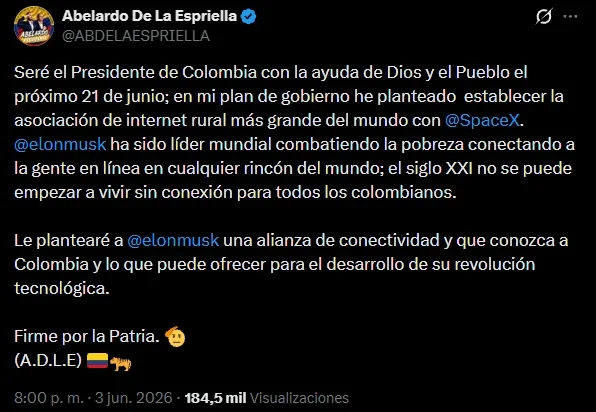
Through his social media, De la Espriella assured that he will be the president of Colombia “with the help of God and the People” and stated that his government plan includes establishing “the largest rural internet partnership in the world” alongside the company founded by Elon Musk.
Abelardo's announcement on his X social media account.
The leader highlighted the role of the tech entrepreneur in the expansion of global connectivity and emphasized that Musk “has been a world leader fighting poverty by connecting people online in every corner of the world.” In this regard, he argued that the 21st century cannot begin to be lived with millions of Colombians without connection, especially in rural and remote regions away from major urban centers.
De la Espriella also announced that he will seek to directly propose a connectivity alliance to Elon Musk so that the entrepreneur can see “the Colombia” that can offer conditions for the development of a technological revolution. With that message, the candidate attempted to establish a modernization agenda based on investment, digital infrastructure, and cooperation with international private sector actors.
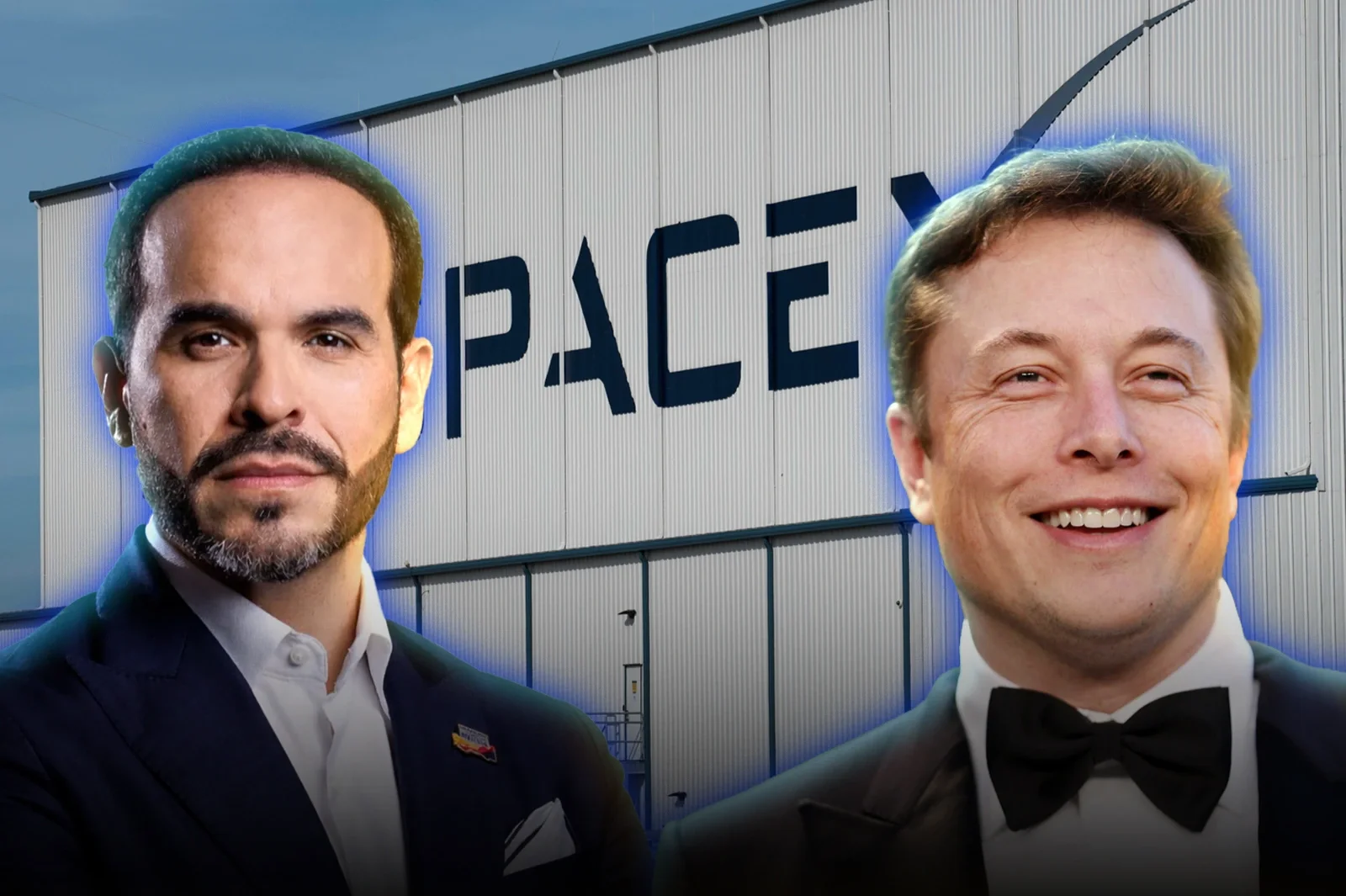
Abelardo de la Espriella, candidate of the Colombian right.
The initiative falls within a broader vision of development, where technology appears as a key factor to integrate historically marginalized territories. For De la Espriella, access to the internet must stop being an advantage concentrated in large cities and become a tool for productive inclusion throughout the country.
De la Espriella closed his message with his usual slogan, “Firm for the Homeland,” and laid out one of the most ambitious technological axes of his campaign: to bring Colombia closer to a new stage of connectivity, development, and digital integration, from which Gustavo Petro's socialism has distanced it.