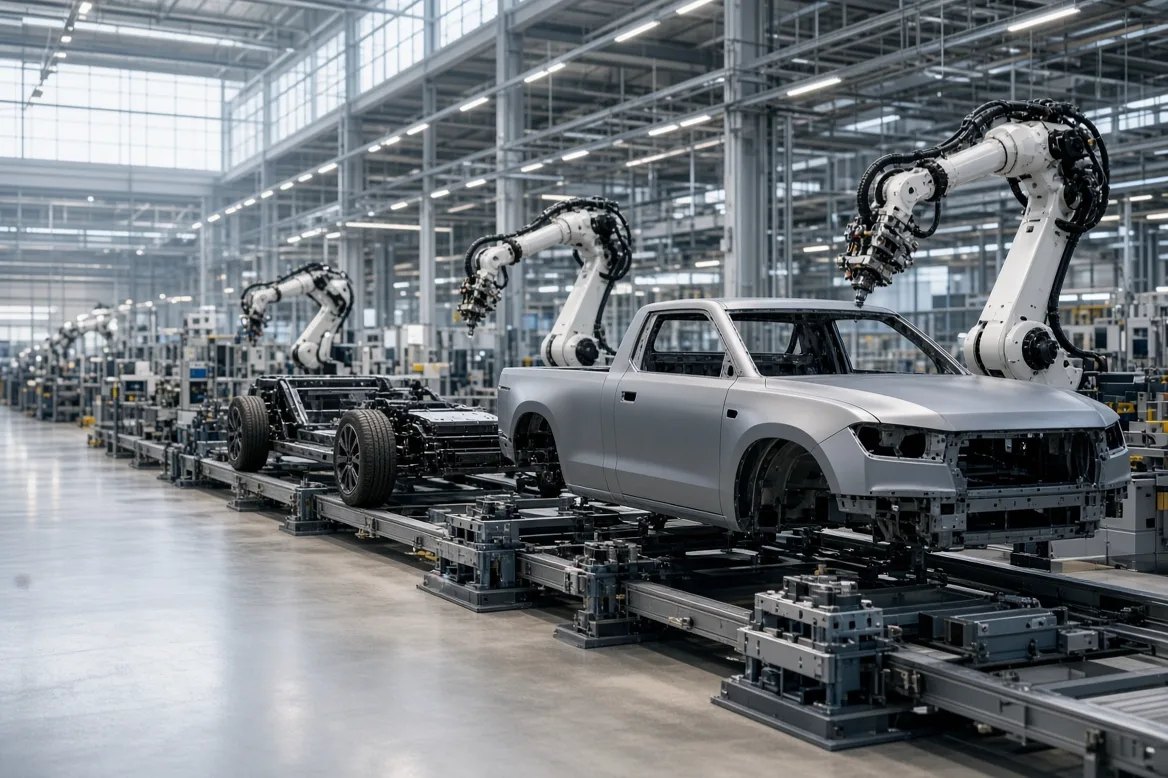
Ford confirmed this Thursday that the deep renovation of its assembly plant in Louisville, Kentucky, is on schedule. The $2 billion investment, announced two years ago, aims to turn the factory into a center capable of producing a new generation of affordable electric vehicles.
The first model to come out of this renovated line will be the Fathom, a fully electric mid-size truck with a projected price below $30,000. This is the first vehicle built on the company's new universal platform.
According to the automaker, prototypes of the Fathom are expected to begin assembly in the first quarter of 2027. Units destined for customers will arrive later that same year. Production-level tooling is already being tested before starting that phase.
The challenge for Ford is considerable. Its previous attempts in the electric segment affected profitability, while Chinese competitors and Tesla achieved high volumes and positive margins. To close that gap, the company abandoned the mobile assembly line system that Henry Ford established over a century ago.

A new production scheme
Instead, it adopted the “universal production system” developed by an internal team led by Alan Clarke, an executive who previously worked at Tesla. This scheme is based on a three-branch assembly tree.
Ford will use large single-piece aluminum unicastings, a technique that drastically reduces the number of components and was popularized by Tesla. The front and rear of the vehicle are assembled separately in two of the branches. In the third, the structural battery is built along with seats, consoles, and carpets.
At the end of the line, the three sections come together to form the complete vehicle. The company estimates that with this method, it will be able to assemble the Fathom 15% faster in net terms than the models previously manufactured in Louisville.
As part of the reconstruction, Ford nearly tripled the density of Wi-Fi coverage within the plant, reaching 1,080 access points. This infrastructure ensures the high-bandwidth, low-latency connectivity needed for software quality controls.
Training and next steps
Some employees have already been training for months in the new system at the company’s new model development center in Allen Park, Michigan. The transition involves not only changes in machinery but also in processes and operational mindset.
With the Fathom, Ford aims to demonstrate that it can manufacture an attractive and affordable electric vehicle in the United States, without relying on the traditional schemes that have dominated the industry for decades.