This week, British MP Rupert Lowe submitted a report to Westminster that his country had been avoiding for a generation. The Rape Gang Inquiry Report —an independent investigation, enriched by testimonies from survivors, whistleblowers, and families— documents the organized sexual exploitation of girls, overwhelmingly white and working-class, at the hands of predominantly Muslim gangs of Pakistani origin, over decades and across the territory. The motion that Lowe presented to the House on June 16 summarizes it with a bluntness that no longer admits euphemisms: many victims "were let down not only by their abusers but by the very institutions meant to protect them."
That is the heart of the matter, and it is important to establish it before proceeding. The crime of rapists is atrocious, but it is not a novelty in human history: there have always been predators. What is truly scandalous, what turns this case into a civilizational wound, is the behavior of the State that was supposed to protect those girls and chose not to. That is why the motion ends with a demand that should shame an entire ruling class: that "no consideration of political sensitivity, community relations, or fear of offending should ever again take precedence over the protection of children."
The Scale of Horror
The report —218 pages— estimates that the abuses affected at least 149 districts, nearly 40% of the country, and describes a method repeated to the point of exhaustion: girls as young as eleven or twelve contacted by young men who gained their trust, then intoxicated, drugged, transported by taxi from one town to another, gang-raped, filmed to extort them, insulted as "white trash" and "kuffar." It collects testimonies of a cruelty that is difficult to transcribe.
We must be honest with the numbers, because that is where a bad article falls apart: the most resonant figures that circulated —250,000 victims, between 87% and 95% of perpetrators being predominantly Muslim— are estimates from the report itself, debated and debatable, and the document admits that there is no precise count "because the British State never recorded it." But that fact, far from alleviating the scandal, exacerbates it: they did not count the victims because they did not want to know how many there were.
This Was Already Proven
None of this is a fantasy of the "far right," as it was dismissed for years. It has been documented in official investigations for over a decade.
In Rotherham, Alexis Jay's report (2014) established that around 1,400 girls were sexually exploited between 1997 and 2013 by gangs mostly of British-Pakistani origin. She wrote it without anesthesia: the staff felt "nervousness about identifying the ethnic origin of the perpetrators for fear of appearing racist," and some received explicit instructions not to do so. In Telford, another investigation counted over a thousand victims in four decades, with a horror of its own name: Lucy Lowe, 16, murdered along with her mother and sister by the taxi driver who had abused her since she was 14.
And in June 2025, the national audit by Baroness Louise Casey made denial unsustainable: the authorities "dodged" the issue of the ethnic origin of the perpetrators, and where there was local data, "Asian men are overrepresented as perpetrators." The concealment was so profound that one of its central recommendations was simply to start mandatorily recording the ethnicity and nationality of suspects. Until yesterday, Britain preferred not to know.
This Is Not Old History
No one should comfort themselves thinking this is a closed past. Just this June, in West Yorkshire, a cascade of sentences mirrored the files from twenty years ago. In Bradford, fifteen men were sentenced to 188 years in prison for 88 counts of rape against a single teenager, abused between 2007 and 2011, from ages 14 to 18. In neighboring Kirklees, twenty people received a total of 277 years for abusing three girls —one as young as 12— between the nineties and the two thousands.
And in Sheffield, just this week, an Iraqi asylum seeker received 29 years for grooming, transporting, and raping seven girls aged between 12 and 16 in Doncaster. Cases like this appear almost every week. And almost always with the same prologue: girls whom, at first, no one wanted to listen to.
The Anatomy of Cover-Up
A conspiracy was not needed. It was enough for a ruling class to calculate that being accused of racism was worse than allowing the continued raping of poor girls. The underlying question —why certain closed, poorly integrated communities organized into clans produced these networks— was proscribed for an entire generation. And it is worth remembering who led the British Crown Prosecution Service when, in 2009, that same service decided not to prosecute the leader of the Rochdale network: Keir Starmer, now Prime Minister.
Only now, cornered by public pressure, is the State daring to ask the question. On April 13, 2026, it finally opened a statutory national public inquiry —three years of duration, £65 million— required for the first time to examine how the ethnicity, religion, and culture of the perpetrators influenced the crimes and the response of the institutions. Everything comes too late, with thousands of childhoods already destroyed, and only because uncomfortable figures for the establishment made silence unsustainable.
The Reflection, Live
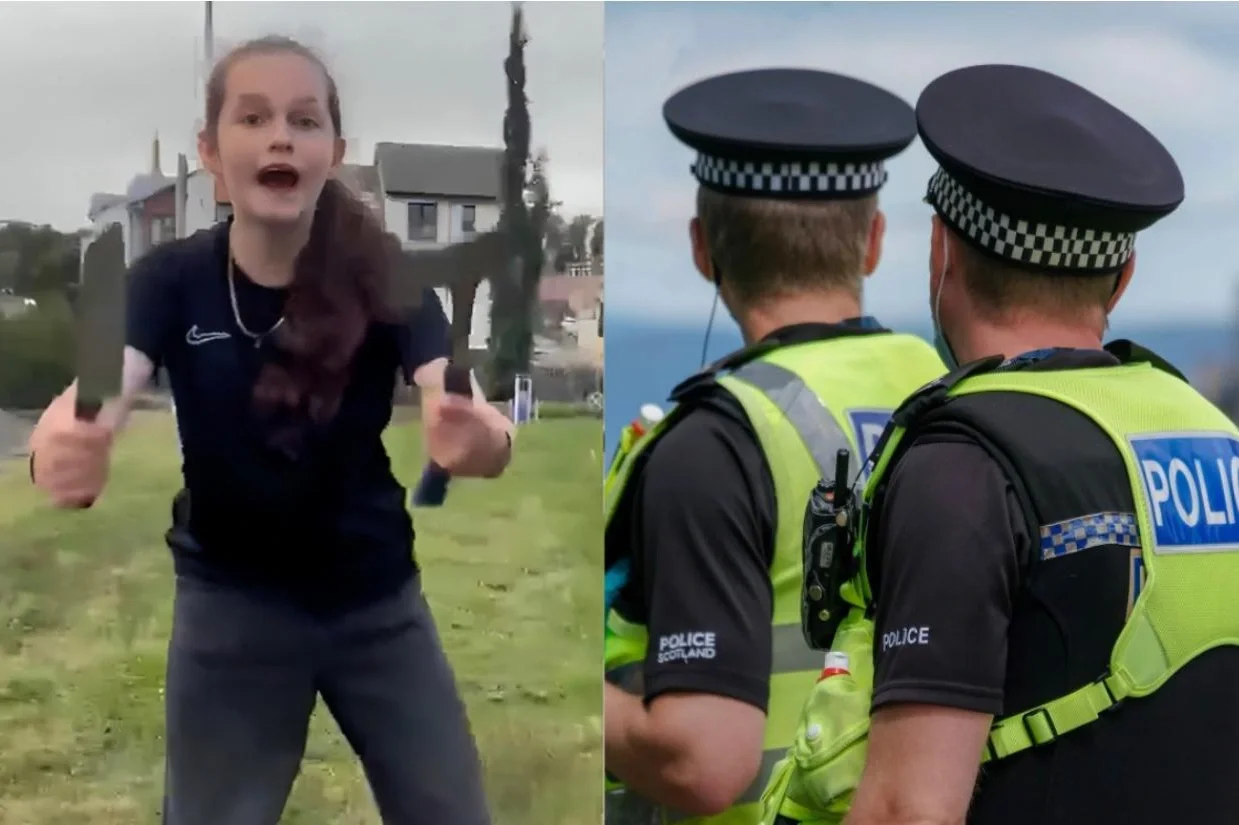
That this reflection remains intact was proven, just a few weeks ago, by a case that traveled the world. In August 2025, a forty-four-second video showed a twelve-year-old Scottish girl, on a street in Dundee, raising a knife and an axe in front of the man filming her. The police, the politicians, and the "serious" press did not investigate anything: within hours they decided that the threat was her. She was charged with possession of weapons. The adult was not touched. Ten months later, a court reversed the narrative: on June 11, 2026, it found the perpetrator —a 22-year-old Bulgarian— guilty of harassing and assaulting her; he was the one who pushed her, called her sister to hit her, and only then did the girl pull out the axe. The police themselves ended up admitting that what they had disseminated "did not reflect the situation."
The perpetrator in Dundee was not even part of a grooming gang —he was another adult immigrant— and that is why the case is so revealing: it shows that the reflection is deeper than any gang. When a member of the group that progressivism shields appears on the scene and a white, poor, and disconnected victim, the entire machinery inverts the roles. That girl was punished twice: for breaking the script that defaults the immigrant as victim, and for being who she was. She learned at twelve years old, with an axe in hand, the same lesson as the girls from Rotherham: your word does not matter, you are alone.
Only One Side Is Allowed to Fight
The most obscene thing is the contrast. The same State that for a decade archived reports of raped girls was incredibly quick, surgical, and relentless in pursuing anyone who publishes an uncomfortable post or goes out to protest. There is plenty of state energy: it is just reserved for the citizen who breaks the consensus, not for the perpetrator that the consensus protects. In this cultural war, only one side is allowed to fight.
There also emerges the double standard that no feminist campaign confesses. The "believe women" mantra applies as long as the accuser does not contradict any intersectional hierarchy of the comfortable progressive world. It did not apply to the girls from Rotherham, nor to the neighborhood mothers, nor to a girl with an axe in Dundee. Ayaan Hirsi Ali said this week, with a harshness worth quoting: dominant feminism "shouts when the target is culturally safe and goes silent when the perpetrators come wrapped in the prohibitions of the language of diversity."
A movement that was born as a universal moral insurgency, refusing to compromise in naming abuse, ended up worrying "first about community cohesion… and only later, if at all, about the girls at the school gate." Its verdict is damning and hard to refute: when a movement created to protect women is unable to shout for girls because their abusers turn out to be politically uncomfortable, one can only conclude that it is dead.
The Mirror of the West
Let it be clear what Britain teaches, because it exceeds the islands. It was not incompetence: it was ideology. When the left comes to power, it does not merely fail; it imposes silence, manufactures the narrative, persecutes those who contradict it, and turns the lie by omission into state policy. Political correctness is not a courtesy of good manners: once it becomes official doctrine, it inverts the victim and the executioner and signs the death warrant of the weakest. A society that decides there are unutterable truths, data that cannot be collected, and crimes that cannot be named does not become more just: it becomes complicit.
That is why this is a mirror, and it is worth looking into it. Defense begins with the gesture that Britain prohibited for thirty years: naming things. And in that realm —the one of daring to say aloud what the consensus wants to silence— the great gladiator of the West today is not Trump, tied to his domestic pragmatism, nor Bolsonaro, already out of the game. It is Javier Milei. His greatest merit is not a fiscal figure: it is having placed the cultural battle at the center, having stood up to the world —in Davos, before the very global elite that in Britain looks the other way— to call by name wokism, collectivism, and the moral cowardice that sustains it. And he does not do it out of personal whim: he does it because an entire society chose him for that.
That is the difference worth emphasizing, and of which we should be proud. Britain, faced with the discomfort of the truth, chose not to see, and the price was paid by thousands of girls. Argentina chose the opposite: it chose to look, to name, and to stand firm. That is why today, in the midst of the moral decomposition of the West, a country that until yesterday was synonymous with decadence has transformed into a beacon: the place from where it is once again said aloud what progressivism had prohibited even thinking. It is not an electoral anecdote; it is, perhaps, our greatest contribution to the world at this hour. Because in the end, it all comes down to a single truth —the one that Britain betrayed for thirty years and the one we chose to defend—: no sensitivity, no fear of the wrong word, can be worth more than a girl.