The singularity as a narrative: promise, enthusiasm, and limits of discourse
Hassabis's phrase about being “at the foothills of the singularity” serves as a symbol of the moment the tech industry is experiencing. The singularity has become a powerful idea because it condenses the expectation of an artificial intelligence capable of accelerating its own development and transforming the economy, science, and daily life.But it is also a notion laden with speculation, difficult to measure, and often used to fuel enthusiasm around products or investments.
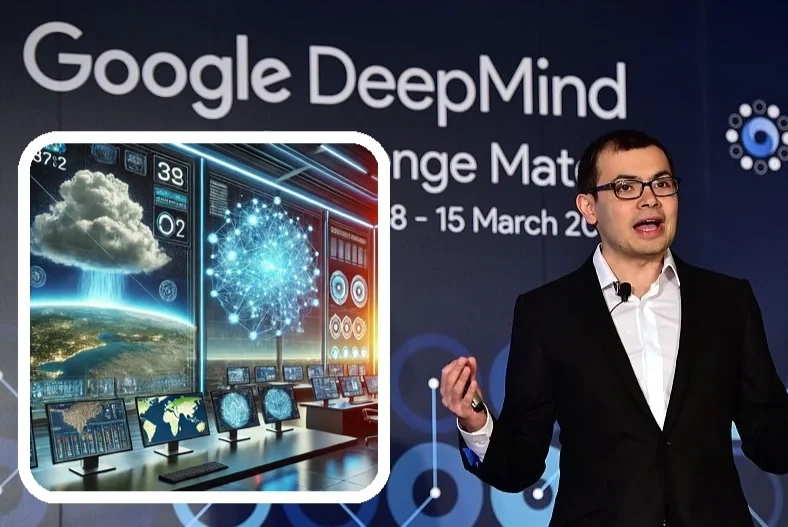
During the opening keynote of Google I/O, Demis Hassabis, CEO of Google DeepMind, made a statement intended to create impact: “We are currently at the foothills of the singularity”. The statement refers to the theoretical moment when artificial intelligence would rapidly surpass human intelligence and drastically transform the world.However, the context in which he made this remark opened up a more complex discussion: he was not only talking about hypothetical futures but also about concrete scientific applications like WeatherNext.
Hassabis was wrapping up a segment dedicated to scientific AI, which centered around a video about Google's weather prediction system. WeatherNext was presented as a tool capable of providing early warnings for extreme events, such as the impact of Hurricane Melissa in Jamaica last year.If that software allowed people to evacuate earlier, reinforce their homes, or make better decisions in the face of the storm, it represents a huge advancement, although not necessarily proof that the singularity is near.
The scene highlighted a central tension in the current debate about artificial intelligence. On one hand, there are tools designed to solve specific scientific problems, such as weather prediction, computational biology, or complex data analysis.On the other hand, there is growing expectation for agentic systems based on language models that, one day, could conduct complete research with minimal human intervention.
WeatherNext: the AI that doesn't promise the future but can improve decisions today
WeatherNext represents the most tangible and verifiable side of artificial intelligence applied to science. Unlike grand statements about machines capable of surpassing humans, this type of tool has a concrete function: processing weather data and improving the anticipation of dangerous phenomena.In that sense, its value lies not in announcing an abstract revolution, but in providing better alerts in situations where every hour can save lives.
Weather prediction is one of the fields where AI can have a direct impact. Hurricanes, severe storms, floods, and heatwaves require models that are increasingly fast, accurate, and capable of interpreting enormous volumes of data.If WeatherNext can better anticipate trajectories, intensity, or risk areas, it can help governments, emergency teams, and vulnerable populations prepare with greater lead time.
This type of application showcases a less spectacular but more socially significant artificial intelligence. It does not need to “do science” on its own or replace researchers to produce value: it is sufficient to improve a critical task that already exists.The question, then, is not just how long it will be until superintelligent AI, but what concrete problems current AI can solve more efficiently than traditional methods.
The contrast with WeatherNext is precisely what makes the scene interesting. An improved weather alert can be a huge scientific and humanitarian achievement, but it does not automatically equate to an AI that surpasses general human intelligence.The risk of grandiose discourse is that it overshadows real advancements by presenting them as inevitable steps toward a total transformation that is still unproven.
At the same time, it is true that scientific AI is advancing rapidly. Current systems already help formulate hypotheses, analyze literature, explore chemical combinations, improve physical models, and accelerate experiments.But there is still a relevant difference between assisting human scientists and autonomously replacing the entire research process, from the original question to experimental validation.
Agentic AI and autonomous science: the debate ahead
The second approach mentioned in the debate is that of agentic systems based on language models. These systems aim for something more ambitious: not just answering questions, but planning tasks, executing steps, correcting errors, consulting tools, and advancing projects with increasing autonomy.This vision fuels the idea that AI could become a central engine of scientific progress, even participating in its own improvement.
The expectation around recursive self-improvement is supported by that horizon. The hypothesis is that if AI systems start to improve AI itself, the process could accelerate increasingly as those systems become more capable.This scenario is at the center of many discussions about singularity, safety, governance, and the limits of scientific automation.
Pushmeet Kohli, Chief Scientist at Google Cloud, summarized this direction with a significant phrase: “We are moving towards an AI that not only facilitates science but begins to do science”. This statement marks a shift in stage: artificial intelligence would no longer be just a sophisticated calculator or a lab assistant, but an active participant in the generation of knowledge.