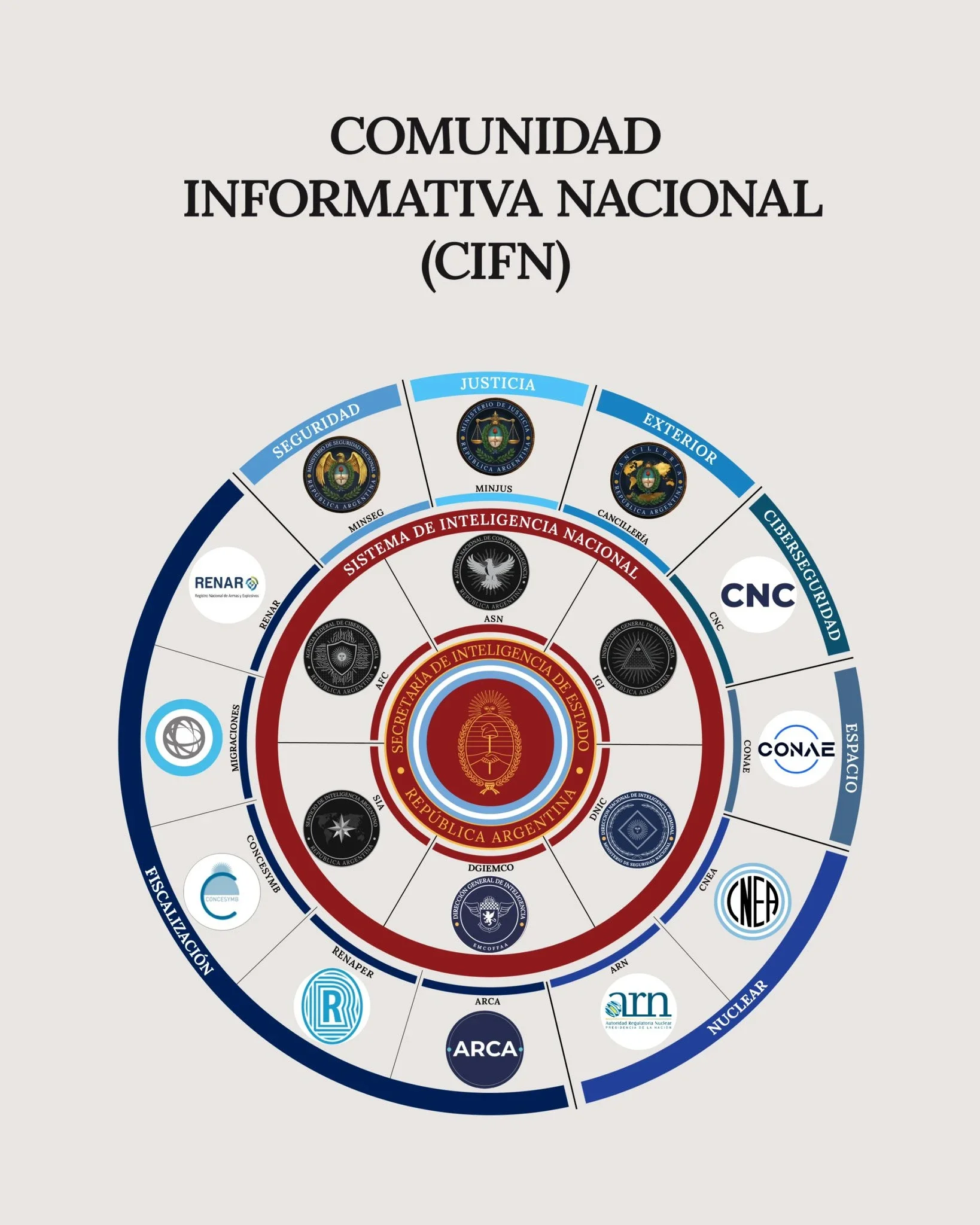

The Government of Javier Milei presented the National Informative Community (CIFN), a framework for coordinating the intelligence system that is managed by the State Intelligence Secretariat (SIDE).
The initiative integrates and organizes the flow of information among various state agencies with the aim of improving the capacity to anticipate risks, confront threats, and detect strategic opportunities, replicating successful models like that of the United States.
Through a statement released on the social network X, SIDE explained the scope of the system: “The National Informative Community (CIFN), coordinated by SIDE, allows different state agencies to share information quickly, securely, and in an organized manner.”
In that same vein, the agency added: “Thanks to the exchange, dispersed information can be transformed into useful intelligence to anticipate and confront risks, threats, and identify opportunities.”

How the CIFN is Structured
The framework presented by the Government is organized into different levels, with a central core and several rings of articulation.
At the center is the State Intelligence Secretariat (SIDE), which will function as the main node of the system, responsible for collecting, processing, and coordinating strategic information.
The second level corresponds to the National Intelligence System, composed of agencies specialized in intelligence and counterintelligence tasks.
Among them are the Argentine Intelligence Service (SIA), the Federal Cyber Intelligence Agency (AFC), the National Counterintelligence Agency (ANC), the General Inspectorate of Intelligence (IGI), the National Criminal Intelligence Directorate (DNIC), and the General Directorate of Intelligence of the Joint Chiefs of Staff (DGIEMCO).
Outside of this core is a third level composed of ministries and technical agencies that, while not part of the espionage system, generate key information for national security.