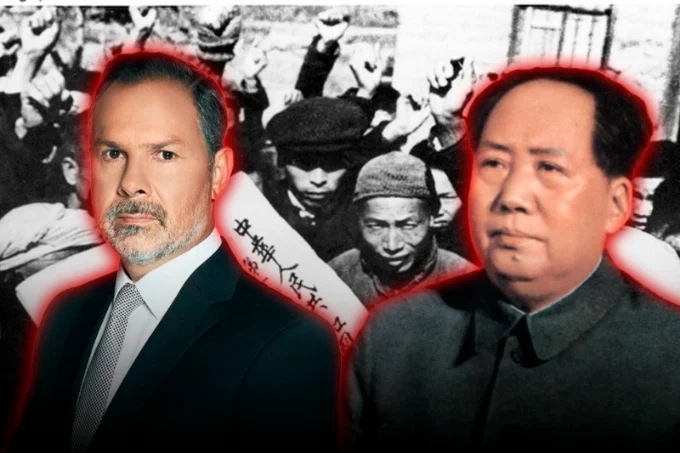

The systematic use of television screens for ideological propaganda and the advocacy of collectivist regimes has reached a new milestone of media distortion in Argentina. The most recent and scandalous episode in this line occurred after the return from China of the host of the C5N channel, "Gato" Sylvestre. After touring the Communist Party museum in Beijing, the presenter openly praised the economic structure of the Asian country, comparing the development of that power with Argentina's political trajectory and urging to question why Argentina did not deepen the path of socialism.
The peak of the controversy lies in the fact that C5N defended the Great Leap Forward and the forced collectivization policy of the Maoist regime. Referring to the disastrous agrarian reform instituted by dictator Mao Zedong, Sylvestre claimed in a celebratory tone that "it was a serious agrarian reform that lifted millions of Chinese out of poverty", openly dismissing the allegations about the massive mortality caused by that process.
During his television intervention, Sylvestre drew a direct parallel between Mao Zedong and former president Perón, stating that the country should have deepened the statist path adopted by Beijing. The host recalled that after the founding of the People's Republic of China on October 1, 1949, the communist regime launched its first five-year plan in 1952, a planning instrument that had already been implemented in Argentina under Perón with state production of cars and airplanes.
He also contrasted the present of China —which under its 15th five-year plan discusses artificial intelligence and new technologies— with the national stagnation, posing the question: "How did Argentina get left behind? How did we fall behind? How are we still wrapped up in disputes, debates that are useless while other countries advance at an accelerated pace?".

However, the narrative presented on the Kirchnerist channel clashes head-on with historical truth and the chilling figures documented by rigorous historiography. Far from being a model of prosperity, the Great Leap Forward (1958–1962) triggered the Great Chinese Famine, the worst in human history, with estimates of deaths from hunger ranging from 15 to 55 million people.