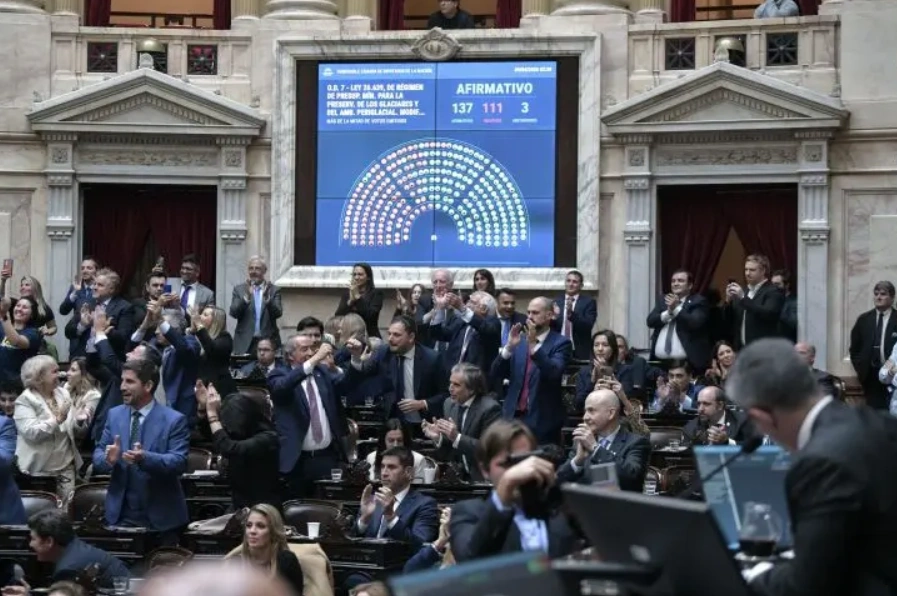

Glacier law: a real breakthrough within structural limits

Glacier law: a real breakthrough within structural limits

Most read in Argentina

The chats that could complicate Mauro Icardi after Wanda Nara's complaint

  1. The Spanish Supreme Court rejects VOX's request and allows nearly 200,000 naturalized foreigners to vote under the Grandchildren's Law

  2. Oil fell to US$90 and hits its lowest point in over two months

  3. Weather in the AMBA: when the rains may arrive during the visit of Pope Leo XIV

  4. Argentina takes the United Kingdom to the International Tribunal for the Law of the Sea: arguments against British exploitation in the Falklands

Imagen de Editorial Team
porEditorial Team
Argentina

A law that improves predictability and orders the framework without exhausting the substantive debate

Add La Derecha Diario on
Share:

The reform of the Glacier Act is not a point of arrival. It is a move in the right direction within a system that, by definition, continues to operate under political, bureaucratic and coercive restrictions. And understanding that is key to not overacting either in enthusiasm or in criticism

.

For years, existing regulations functioned as a classic example of how a bad law can block development without actually improving environmental protection. Under broad and diffuse definitions, productive activity ended up being restricted even in areas where there was no significant water impact. It wasn't protection. It was arbitrariness

.

The reform introduces an important change. It defines more precisely what should be protected and what should not be protected. That, in institutional terms, is no less. To reduce discretion is to begin to limit the scope of politics to intervene without judgment. It is, in short, to order.

But we should not lose sight of the general framework. The underlying problem doesn't go away. What changes is the way it is managed. The State remains the actor that decides, regulates, enables or restricts. The difference is that it now does so with clearer criteria. It's not full freedom. It's an improvement within the same framework.

In this sense, the emphasis on federalism introduces another relevant element. The fact that provinces - owners of natural resources - play a greater role is a step towards decentralization. And decentralization, in contexts of high concentration of power, is often preferable

.

However, decentralizing is not completely deregulating. It's redistributing power within the same political system. There are still decisions taken from state structures, although closer to the territory. It's better, yes. But this is not the same as transferring the decision to the individual or to the fully private sphere

.

Where change is most tangible is in the enabling of productive activities. The possibility of developing mining or hydrocarbon exploitation in areas that do not fulfill verifiable water functions corrects an obvious distortion. For years, strategic projects were paralyzed not by real risks, but by regulatory uncertainty.

And here a key conceptual point appears. Development is not the problem. Arbitrariness is. Civilization advances when the individual can transform their environment to achieve their ends. Blocking that possibility under fuzzy criteria doesn't protect anything: it simply freezes opportunities

.

The reaction of certain environmental sectors confirms this tension. Not just one law is being discussed. A vision of the world is discussed. On the one hand, the idea that the environment must be managed with criteria that allow its responsible productive use. On the other, a concept that tends to immobilize, prohibit and replace individual decisions

with political offices.

The inclusion of environmental impact assessments, however, maintains the system's DNA. There are still instances of state control that condition private action. In some cases they may order. In others, they can become new barriers. That ambiguity does not disappear with the reform

.

Therefore, the central point is not to fall into the false dichotomy between “everything changed” or “nothing changed”. Something important changed, but within very clear structural limits. It's a breakthrough. It's not a breakup.

And it probably couldn't be anything else. Political systems don't disarm overnight. They are transformed gradually, in layers, correcting excesses, reducing distortions and expanding

margins of action.

Glacier reform fits that logic exactly. It doesn't eliminate interventionism. It makes it less arbitrary. It does not enshrine full freedom. But it reduces specific obstacles that blocked it.

In a country used to regressing, that is already a political fact. And also a sign.

Because sometimes change doesn't start with big statements. It begins when the margin of decision ceases to be completely captured by politics and begins - even if little by little - to return to the terrain where it always should have been: that of individuals

.

La Derecha Diario on X

  1. TENÉS QUE CERRAR EL VATICANO, DIOS HACE ESO: Apenas terminó el discurso del Papa León XIV ante más de 1.300.000 fieles, comenzó a lloviznar suavemente sobre la multitud, pese a que el pronóstico indicaba una probabilidad de lluvia de apenas el 1 al 10%.

    19 min ago

  2. LA MISA VIP DE KICILLOF: Mientras cientos de miles de fieles esperaban durante horas para ver al Papa León XIV en la Basílica de Luján, las organizaciones sociales favorecidas por el inútil de Kicillof ingresaban primero.

    29 min ago

  3. CAOS EN ESPAÑA: Sindicalistas de extrema izquierda intentaron bloquear el ingreso de trabajadores a Mercamadrid durante la huelga general. La Policía Nacional tuvo que intervenir para contener a los manifestantes y mantener abierto el comercio.

    39 min ago

La Derecha Diario logo
TwitterInstagramYouTubeTikTokFacebook
Derecha Diario TV

Nosotros

  • Quienes Somos
  • Autores
  • Donar

Privacidad

  • Protección de datos
  • Canales
  • Sitemap
  • RSS

Contacto

  • info@derechadiario.com.ar
PUBLICIDAD
La Derecha Diario logo
ESX logoInstagram logoYouTube logoTikTok logoFacebook
ARGENTINAUNITED STATESECUADORISRAELMEXICOURUGUAY
DERECHA DIARIO TV
  • ES
    XInstagramYouTubeTikTokFacebook
  • DERECHA DIARIO TV
  • Sections
  • ARGENTINA
  • UNITED STATES
  • ECUADOR
  • ISRAEL
  • MEXICO
  • URUGUAY
  • Countries
  • La Derecha Diario logoLA DERECHA DIARIO
  • La Derecha Diario México logoLA DERECHA DIARIO MÉXICO
  • La Derecha Diario Uruguay logoLA DERECHA DIARIO URUGUAY
  • La Derecha Diario Ecuador logoLA DERECHA DIARIO ECUADOR
  • La Derecha Diario Israel logoLA DERECHA DIARIO ISRAEL
  • La Derecha Diario Estados Unidos logoLA DERECHA DIARIO ESTADOS UNIDOS
  • Topics
  • GUERRA EN IRÁN
  • The Newspaper
  • QUIENES SOMOS
  • AUTORES
  • PUBLICIDAD
  • DONAR

Related news

Russia expelled a Moldovan diplomat in response to a similar measure from Chisinau

Russia expelled a Moldovan diplomat in response to a similar measure from Chisinau

Milei personally thanked the security forces for the historic operation to welcome Pope Leo XIV

Milei personally thanked the security forces for the historic operation to welcome Pope Leo XIV

More than a million faithful gathered in Palermo to receive Pope Leo XIV

More than a million faithful gathered in Palermo to receive Pope Leo XIV

The Republican Party does not learn: John Thune was reelected as the leader of the majority bloc in the US Senate

The Republican Party does not learn: John Thune was reelected as the leader of the majority bloc in the US Senate

The impeachment promoted by the Democrats and RINO Congressman Thomas Massie against Pete Hegseth in Congress has failed

The impeachment promoted by the Democrats and RINO Congressman Thomas Massie against Pete Hegseth in Congress has failed

At 76 years old, Marcos Camino, founder of Los Palmeras, committed suicide

At 76 years old, Marcos Camino, founder of Los Palmeras, committed suicide