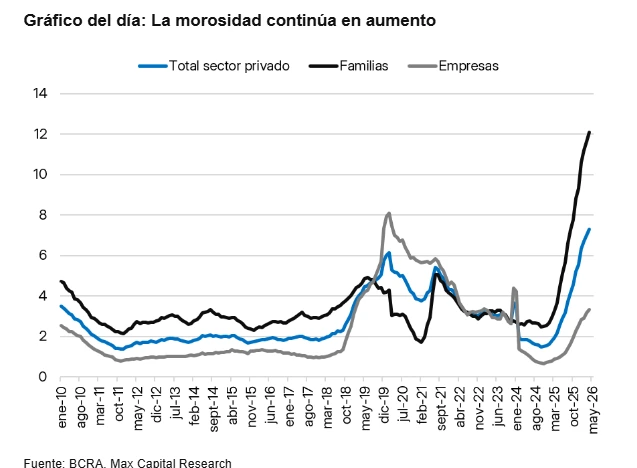
The increase in delinquency does not reflect a widespread financial crisis: the problem is mainly concentrated in a small sector, which are the fintechs, that lend to higher-risk profiles
Fintechs are, in a way, something like “aggressive investors”: they lend to people whom traditional banks would not lend to, but they do so at outrageous rates. So high that, at least in theory, they compensate for the higher probability of default.
That is why it should not be surprising that the delinquency rate of fintechs is almost four times that of banks. And that does not necessarily mean that there is a systemic problem. It means that different types of institutions serve different segments of the market, with different risk strategies.
One is more conservative and operates with larger amounts: traditional banking.
The other is more aggressive, more frugal, and operates with smaller amounts: fintechs.
Why the problem does not imply a systemic financial crisis
It is also important to mention that Argentina does not have a developed market for derivatives associated with these fintech loans. Therefore, there are no sophisticated financial mechanisms that could amplify this phenomenon and turn it into a systemic problem, in case some fintechs actually went bankrupt.
In other words: there is not much room for a domino effect within the financial market.
On the other hand, from a philosophical point of view, it is also not evident that intervention is necessary. These are voluntary agreements between private parties. There are suppliers and demanders, and the loan conditions are relatively transparent. When a person applies for a loan on these platforms, the interest rate and the amount of the installments generally appear prominently. It does not seem reasonable to argue that the contract is misleading. Each individual is responsible for their own financial decisions.
The more interventionist will argue that it is necessary to limit this type of credit. The problem is that, for higher-risk individuals, there are basically two options in economic terms:
Either they are lent at rates high enough to compensate for the extremely high risk of default.
Or they are simply not lent to.
There is not much magic behind this. And both fintechs and many individuals voluntarily choose to participate in that market. And who are we to interfere in the middle of such agreements?
The worst-case scenario, as we have seen, would not be catastrophic either: some fintech may miscalculate its risk-return equation, granting loans to people who ultimately do not repay their debts and/or charging a rate that does not adequately cover the risk premium. In that case, the company will have to restructure its liabilities, absorb losses, or simply disappear. That would not be a systemic crisis. It would be the normal functioning of a market in which some companies manage risk better than others.
The real risks of a market still maturing
We must also understand that we are facing a relatively new market and operation. Never before in history have we had the ability to access a loan almost instantly, with a click from a device we carry in our pocket. This means that these companies are still learning to lend better and, fundamentally, to manage risk better. In the transition, there may be deviations.
And there is another significant factor: the immediacy of these loans introduces additional risks that traditional bank loans have to a lesser extent. For example, the possibility of requesting credit compulsively to finance impulsive behaviors, such as sports betting. The expansion of digital gambling coincides temporally with the growth of fintech loans, and the combination of both phenomena can create a vicious cycle of accelerated over-indebtedness. Online betting platforms allow gambling 24 hours a day. Fintechs and virtual wallets, at the same time, allow access to credit in a matter of seconds. The friction disappears. And that can turn fintech credit into the financial fuel for certain addictive behaviors.
These are, probably, real problems worth discussing.
But they are fundamentally microeconomic problems. Specific to a sector in full maturation.
And confusing them with a supposed macroeconomic crisis of the Argentine economy is simply wrong. And in many cases, directly malicious.
For at least the past year, various journalists, politicians, and analysts have been warning about a supposed problem with private sector delinquency. Read: individuals who are having trouble repaying their debts.
The opposition narrative is textbook, algorithmic in nature: every piece of data, relevant or not, that can be used to criticize the government is utilized. And with the most pessimistic reading possible. This has been no exception.
The “problem”
As observed, the delinquency rate —that is, the proportion of portfolios with overdue payments— has been increasing since the beginning of 2025, reaching 7.7%, according to data from the BCRA.
The ultra-left opposition narrative (Kirchnerism + Left Front) is that this rise in delinquency would be a consequence of a “very bad” economic situation: simply put, people would not be able to pay their debts on time because their incomes would have deteriorated.
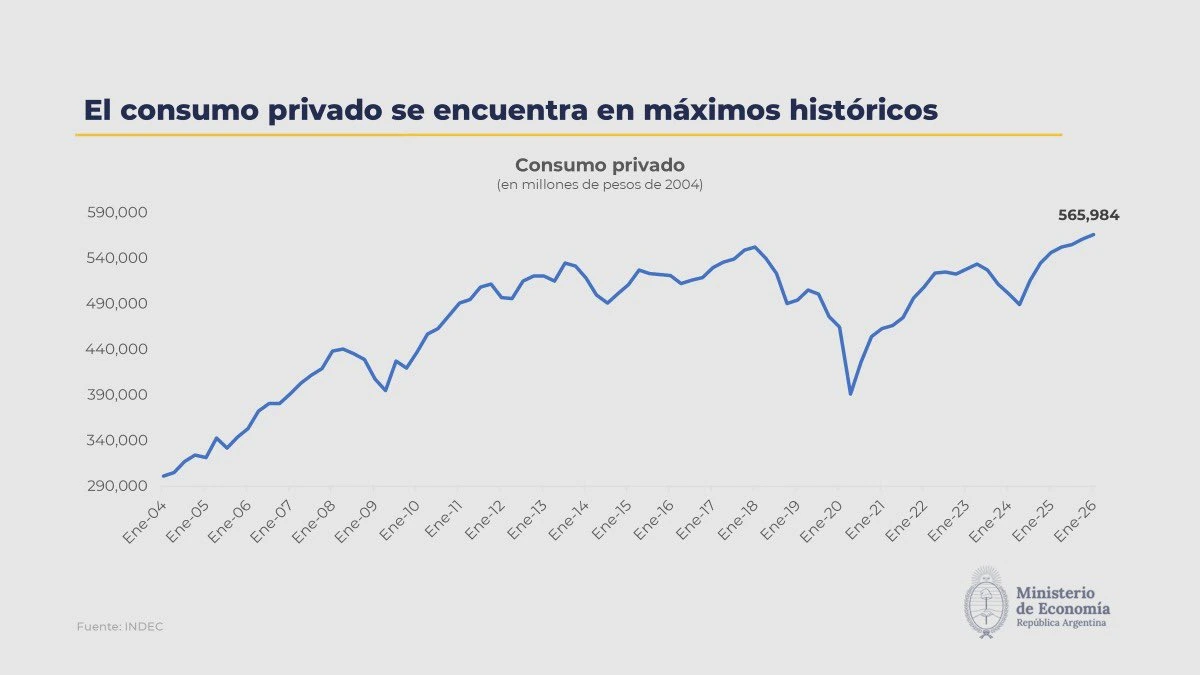
This explanation is inconsistent for several reasons. But the main one is quite simple: both private consumption and GDP are at historic highs. It is difficult to maintain, at the same time, that the economy is collapsing and that both variables are at their peaks.
It is true that the temporary rise in interest rates last year did not exactly help improve the problem. On the contrary, but rates have dropped drastically since then. Moreover, the rise in rates in the second half of 2025 occurred due to the famous “Kuka risk”: the possibility of Kirchnerism winning the legislative elections, a scenario that pushed millions of Argentines to dollarize, “forcing” the BCRA to raise rates and face the currency run. In other words, the direct culprits of the nominal turbulence have basically been the Kirchnerists. The history of episodes of currency stress associated with Peronism in electoral contexts is, at this point, a stylized fact of the Argentine economy (see 2019, 2025).
Where delinquency is really concentrated
Having clarified that, we can focus on the most interesting part. What is often omitted is the composition of that delinquency:
Traditional banking, which concentrates approximately 91% of credit, has less than 8% of its portfolios in delinquency.
Fintechs, which represent only 9% of credit, have a much higher delinquency rate: around 32%.
This changes the reading quite a bit. The “delinquency problem” does not seem to be a systemic phenomenon of the Argentine financial system, as these ultra-left figures try to make it seem. Rather, it is concentrated mainly in the fintech segment.
What characterizes that fintech segment?
Loans of relatively low amounts —in many cases, less than a million pesos— granted to individuals with a much higher credit risk. That is, people to whom traditional banks would not lend directly due to their scoring.
And this point is fundamental: to a large extent, delinquency is higher precisely because fintechs lend to segments that banks previously would not lend to. People with worse credit scoring. Ergo, a higher probability of default.
It is a deliberate, intentional strategy on the part of these companies. And not necessarily a phenomenon explained by a nationwide macroeconomic deterioration.
In fact, the business model of many fintechs consists precisely of taking on greater risk in exchange for charging much higher rates. One does not have to look too hard to find credit offers aimed at people with compromised credit histories.
The rates are adaptive and adjust to the individual history. For certain risk profiles, they can exceed 300% annually and even reach 900%, as is the case with the individual in the photo.
We are talking about rates several times higher than those of a traditional personal loan (x10 in the example above). And therein lies the issue.