
Scientists create 16 new viruses using artificial intelligence

Scientists create 16 new viruses using artificial intelligence
Imagen de Editorial Team

Most read in Argentina

The chats that could complicate Mauro Icardi after Wanda Nara's complaint

  1. The Spanish Supreme Court rejects VOX's request and allows nearly 200,000 naturalized foreigners to vote under the Grandchildren's Law

  2. Oil fell to US$90 and hits its lowest point in over two months

  3. Weather in the AMBA: when the rains may arrive during the visit of Pope Leo XIV

  4. Argentina takes the United Kingdom to the International Tribunal for the Law of the Sea: arguments against British exploitation in the Falklands

porEditorial Team
Argentina

A team from Stanford and the Arc Institute has succeeded in having AI models design never-before-seen functional bacteriophages capable of attacking resistant bacteria, although the advancement also raises alarms about potential uses

Add La Derecha Diario on
Share:

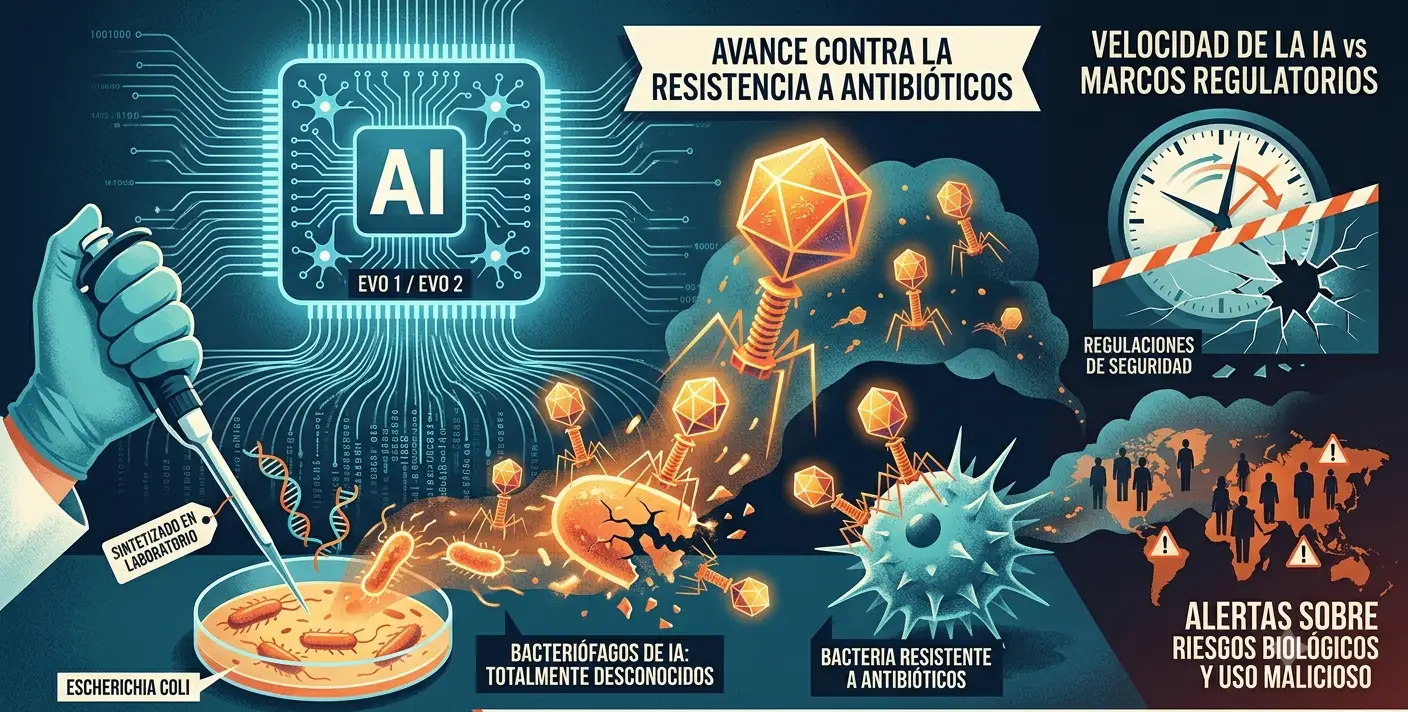
For the first time, an artificial intelligence system generated completely unknown viruses capable of infecting and destroying certain types of bacteria. The finding, published this week in the journal Science, opens a promising avenue to tackle antibiotic resistance, but at the same time raises alarms about the pace at which technology advances ahead of regulations.

For years, researchers have managed to synthesize viruses from scratch. These viruses are used to test antivirals, vaccines, and to study the behavior of these microorganisms. However, they were almost always copies or variants of already known pathogens. Now, scientists from Stanford University and the Arc Institute have succeeded in having an AI design simple, functional, and never-before-seen viruses based on the genetic information of millions of organisms present in nature.

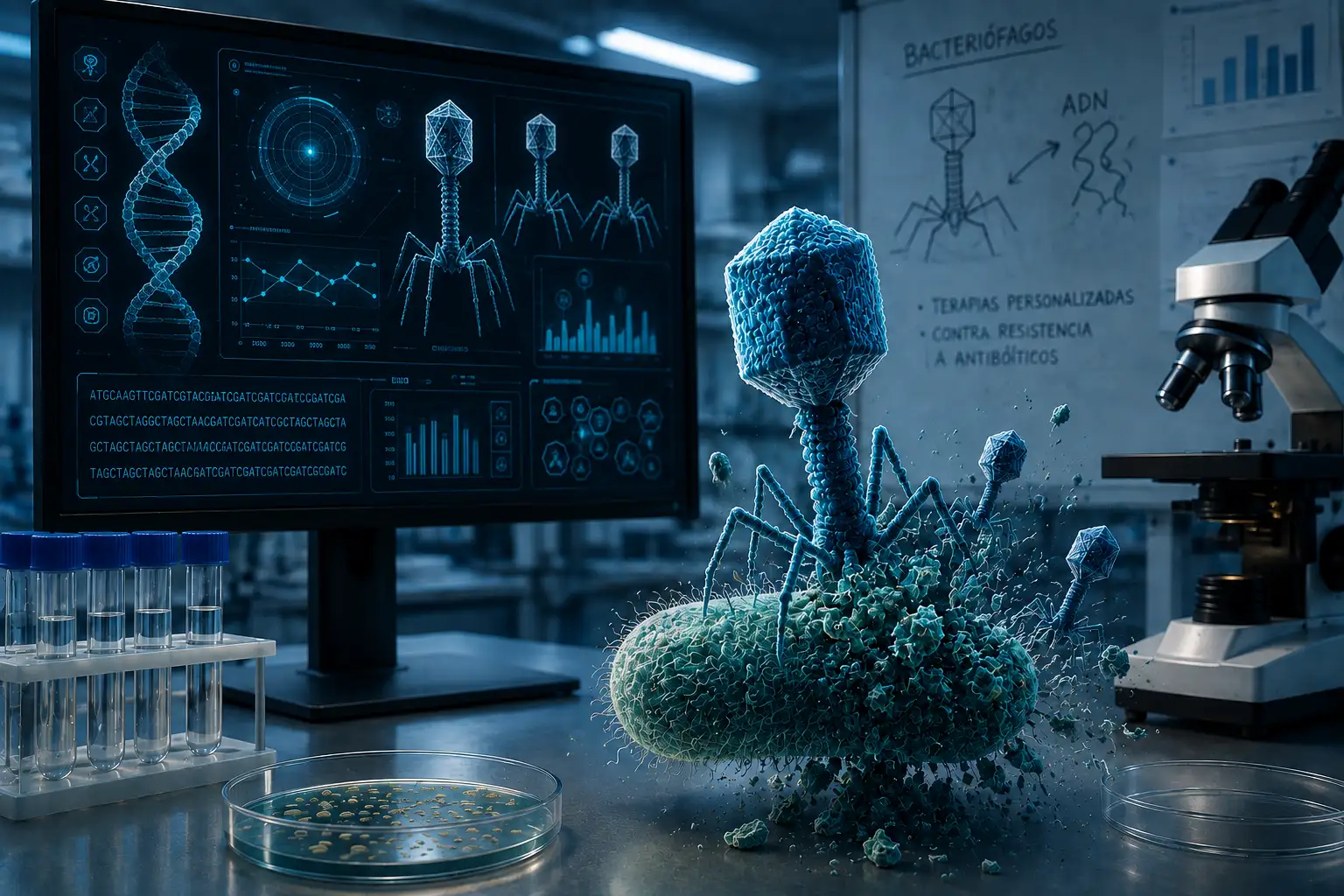
The work focused on bacteriophages, viruses that only infect bacteria and have relatively small genomes, making them easy to synthesize and manipulate in the laboratory. These microorganisms are considered an interesting alternative to traditional antibiotics, especially against resistant infections.

The models used were Evo 1 and Evo 2, foundational algorithms trained with millions of genomes from animals, plants, microbes, bacteria, and viruses. The goal of this training was for the artificial intelligence to learn complex evolutionary patterns: how genes are organized, which sequences are conserved, and what biological constraints allow an organism to remain functional.

Scientists Used AI to Create 16 New Viruses

From Model to Laboratory

The bacteriophage Phi X-174, which infects the bacterium Escherichia coli, was chosen as a reference. The aim was not to reproduce it, but to use it as a guide for the algorithms to generate thousands of new genomes with an architecture compatible with the infection of that bacterium. The resulting viruses maintained the functional organization necessary to recognize the bacterium, insert their DNA, replicate it, and assemble new viral particles, but the specific sequences differed significantly from those of natural bacteriophages.

Next, the genomes created by the AI were evaluated, and the 300 most promising were selected based on criteria such as gene organization and the presence of regulatory elements. These genomes were synthesized molecule by molecule in the laboratory and introduced into E. coli bacteria to check if they resulted in functional viruses.


La Derecha Diario on X

  1. NETANYAHU, BASADO CONTRA EL ANTISEMITISMO: "Los romanos intentaron borrarnos. Los nazis intentaron exterminarnos... ¿Dónde están ellos hoy? ¿Dónde estamos nosotros hoy? Estamos aquí, más fuertes que nunca".

    1 min ago

  2. ARGENTINA NUNCA SERÁ MUSULMANA: Más de un millón de fieles cristianos participaron del histórico encuentro juvenil con el papa León XIV en Palermo, en una multitudinaria demostración de fe que reafirma las profundas raíces cristianas de la Argentina y su defensa de la tradición católica.

    11 min ago

  3. AVANZA EL TRUMPISMO: Caleb Orr, exsubsecretario de Estado para Asuntos Económicos Internacionales, será el nuevo vicejefe de Gabinete de Donald Trump, luego de que Stephen Miller fuera ascendido a jefe de Gabinete de la Casa Blanca. Orr, economista de origen texano y experto en política fiscal, tiene tan solo 32 años y es uno de los principales defensores de la agenda trumpista. Actualmente se desempeñaba como asesor especial de la Casa Blanca para asuntos económicos.

    21 min ago

  4. TRUMP DESTROZÓ A LA BBC EN PLENA CONFERENCIA: El presidente estadounidense arremetió contra el medio estatal británico tras identificar a uno de sus periodistas. "¿La fake BBC? ¿Los que pusieron inteligencia artificial en mi boca? ¿Los que ahora enfrentan una demanda de 5.000 millones de dólares y no saben qué hacer?".

    31 min ago

  5. BASURA: PACO OLVEIRA ATACÓ A LOS SACERDOTES QUE SE ACERCARON A MILEI: El "cura kirchnerista" y porrero que había prohibido a los votantes de Milei acudir a su comedor criticó las fotografías de religiosos con funcionarios del Gobierno. "La tradición judeocristiana no tiene absolutamente nada que ver con este gobierno. [...] Estoy hasta las narices del paz y amor".

    41 min ago

La Derecha Diario logo
TwitterInstagramYouTubeTikTokFacebook
Derecha Diario TV

Nosotros

  • Quienes Somos
  • Autores
  • Donar

Privacidad

  • Protección de datos
  • Canales
  • Sitemap
  • RSS

Contacto

  • info@derechadiario.com.ar
PUBLICIDAD
La Derecha Diario logo
ESX logoInstagram logoYouTube logoTikTok logoFacebook
ARGENTINAUNITED STATESECUADORISRAELMEXICOURUGUAY
DERECHA DIARIO TV
  • ES
    XInstagramYouTubeTikTokFacebook
  • DERECHA DIARIO TV
  • Sections
  • ARGENTINA
  • UNITED STATES
  • ECUADOR
  • ISRAEL
  • MEXICO
  • URUGUAY
  • Countries
  • La Derecha Diario logoLA DERECHA DIARIO
  • La Derecha Diario México logoLA DERECHA DIARIO MÉXICO
  • La Derecha Diario Uruguay logoLA DERECHA DIARIO URUGUAY
  • La Derecha Diario Ecuador logoLA DERECHA DIARIO ECUADOR
  • La Derecha Diario Israel logoLA DERECHA DIARIO ISRAEL
  • La Derecha Diario Estados Unidos logoLA DERECHA DIARIO ESTADOS UNIDOS
  • Topics
  • GUERRA EN IRÁN
  • The Newspaper
  • QUIENES SOMOS
  • AUTORES
  • PUBLICIDAD
  • DONAR

Related news

At 76 years old, Marcos Camino, founder of Los Palmeras, committed suicide

At 76 years old, Marcos Camino, founder of Los Palmeras, committed suicide

LIVE | Pope Leo XIV leads a vigil with young people in Buenos Aires

LIVE | Pope Leo XIV leads a vigil with young people in Buenos Aires

Weather in CABA: rain returns and the temperature will reach 29 degrees

Weather in CABA: rain returns and the temperature will reach 29 degrees

Jim Jordan will lead the Republicans in the House of Representatives and promises to confront the Democrats

Jim Jordan will lead the Republicans in the House of Representatives and promises to confront the Democrats

Thank you very much, Holy Father

Thank you very much, Holy Father

Pope Leo XIV met with representatives of the Church at the Cathedral of Córdoba

Pope Leo XIV met with representatives of the Church at the Cathedral of Córdoba

Of the 300, only 16 produced fully operational bacteriophages. They had unprecedented sequences, different genes, new regulatory elements, and even variable genome sizes. Their behavior was also not uniform: some infected faster, while others showed different replication capabilities.

The team also tested whether these AI-generated viruses could overcome bacterial resistance. They exposed strains of E. coli that had already developed resistance to Phi X-174 to a mixture of the new bacteriophages and another of similar natural phages. The viruses designed by artificial intelligence quickly managed to overcome that resistance and establish infection. According to the authors, the result shows “a pathway towards AI-generated phage therapies against rapidly evolving bacterial pathogens.”

Imagen 1442250

Opportunities and Risks

This advance could facilitate the development of personalized treatments capable of adapting almost at the same pace as pathogens. At the same time, it raises serious concerns about potential malicious use to create new diseases, toxic substances, or pathogens capable of triggering a pandemic.

Moritz Hanke, a researcher at the Johns Hopkins Center for Health Security, pointed out that there are currently no effective safeguards to prevent the creation of a lethal virus with the help of artificial intelligence. In statements to The New York Times, he warned that there is “a huge disconnect” between the speed at which science advances and the development of effective regulatory frameworks.