With more apartments to choose from, owners can no longer impose any price or condition on tenants who have the ability to choose. Potential tenants compare prices, discard expensive listings, and negotiate move-in dates, guarantees, improvements to the properties, and initial expenses.
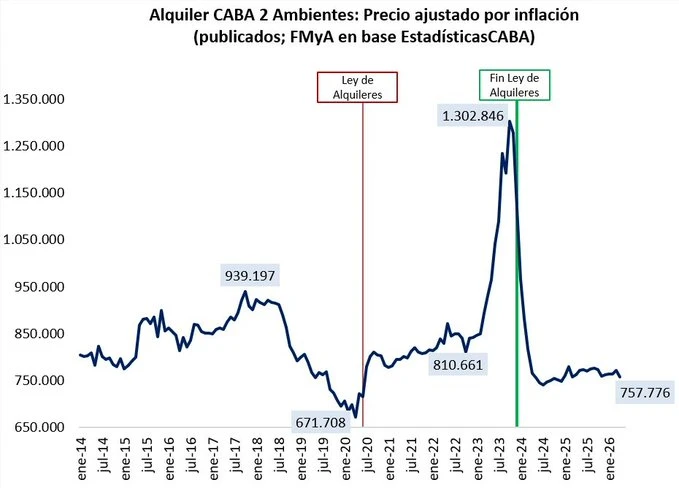
The elimination of the Rental Law promoted by the Government of Javier Milei completely changed the real estate market: in just two years, the published real price of a two-room apartment in the City of Buenos Aires fell by approximately 42%.
According to a series compiled with publications gathered by FM&A and data from CABA Statistics, the inflation-adjusted value reached a maximum equivalent to $1,302,846 at the beginning of 2024, when contracts regulated by the previous regulations were still predominant.
The inflation-adjusted data
After the repeal enacted by DNU 70/2023, the real price began to decline rapidly, reaching $757,776 in January 2026. The drop was nearly $545,000 in constant currency, demonstrating the failure of the interventionist scheme that aimed to protect tenants but ended up reducing supply and increasing rental prices.
The change was also reflected in the number of available properties. During the most critical moments of the old law, the City had less than 500 properties listed. Currently, there are around 17,000 units for rent, an expansion that restored competition to the market.
New contracts operate under different rules. Quarterly or four-monthly updates are predominant, generally linked to the Consumer Price Index, although the parties can freely agree on the duration, currency, and frequency of increases.
Meanwhile, the last agreements signed under Law 27.551 will expire between September and December of this year. For those who still remain under that regime, the annual adjustment according to the Rental Contracts Index will be 31.54% in July.
Daniel Lipovetzky, the mind behind the disastrous rental law
In this way, the market will finally leave behind a system characterized by rigid contracts, annual updates, and a practically non-existent supply. Deregulation allowed prices to begin reflecting the balance between owners and tenants once again: more supply, greater competition, flexible contracts, and lower real rents.