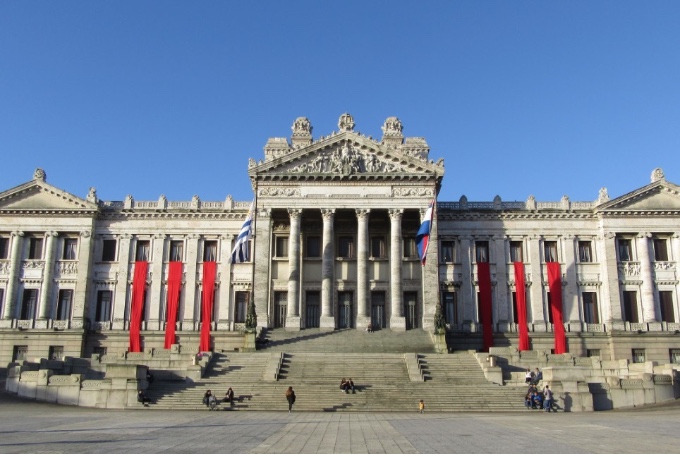
This Accountability Report 2026 is not a distant procedure. It is a concrete decision that takes money from small merchants, workers, and any Uruguayan who produces, sells, or saves. We will explain it step by step, without beating around the bush.
The government increases transfers for children from low-income households. Up to $10,000 monthly per child in the two lowest income groups, under the name of Unique Allowance. No one disputes that helping those children is good. The problem lies in how that aid is funded.
An important part of the financing comes from removing the IMESI exemption for electric cars. Starting January 1, 2027, those vehicles will pay 5% or 9% more in taxes, depending on their import value. This is not a new tax: it is the elimination of an exemption that existed since 2021. Practical result: the electric car becomes more expensive. Those who planned to buy it — a merchant who needs a work vehicle, a family that was saving — now pay more. That difference comes directly out of their pockets.
The other part of the financing comes from upward revisions of three existing taxes. The Ministry of Economy estimates that it will collect more than expected. The Autonomous Fiscal Council, a technical and independent body, stated that those estimates are “uncertain” and that there is a risk of overestimation. Here lies the central problem.
If the projections do not hold, the State is left with a hole. That hole can be filled in three possible ways, and in all three, the people pay:
Raising taxes. More burden on the merchant, the professional, or the salaried worker.
Increasing public debt. Today we spend, tomorrow we pay interest. That interest comes from the future taxes that the people will pay.
Issuing currency (printing more money). This generates inflation. Prices rise, salaries buy less, and savings evaporate. Those who suffer the most are always those who live off their work.
In all three cases — more taxes, more debt, or more issuance — it is the Uruguayan people who end up paying: the small merchant who sees his costs rise, the worker whose salary loses purchasing power, and anyone who creates value.
The numbers show the size of the problem. Primary expenditures of the State already account for around 29% of Gross Domestic Product. In 2005, it was 21.3%. Almost three out of every ten pesos produced in the country pass through public hands. As Minister Oddone explained on June 30, 2026, the total incremental for 2027 is $3.2 billion ($2 billion had already been voted on and $1.8 billion are internal reallocations). The Structural Fiscal Result closed 2025 at –3.9% of GDP, and the target for 2026 is –4.0%. The tax expenditure for 2025 reached 6.9% of GDP. The Autonomous Fiscal Council clearly warned: there is no room for permanent spending expansions without real compensation, and adjustments on the spending side harm activity less than raising taxes.
Now comes the most important part, explained clearly.
First: the language. They call “tax expenditure” what the treasury does not collect. It is a way of speaking that completely changes the meaning of things. It presupposes that money belongs first to the State and that leaving it in the hands of those who generated it is a generosity, a “spending” that the State makes. It turns the right to property into a grace that the power can take away whenever it wants. The IMESI exemption was not public spending. It was simply not taking away. By eliminating it, the State recovers the power to collect. The same reasoning applies to the 6.9% of GDP that appears as tax expenditure: a large part of that figure never left the pocket of those who produced it. Presenting it as something that the State “recovers” legitimizes the idea that the natural starting point is to collect as much as possible.
Second: what is seen and what is not seen. What is seen is the transfer to children. It is concrete, has names and surnames, generates photos and speeches. What is not seen is everything that stops happening. The capital that is not formed. The car that is not bought because it is now more expensive. The investment that does not arrive because the message is that fiscal rules can change every year. The job that is not created. When the State takes resources from the private sector, those resources are no longer available for the small merchant to reinvest, hire, or expand their business. The State does not create wealth. It only transfers it. And in the process, it destroys incentives. The merchant feels it at the counter: fewer customers with purchasing power, more tax pressure, less predictability.
Third: permanent spending is being consolidated with fragile financing. If the optimistic projections fail, the bill always arrives at the same place: the pocket of those who work. More taxes, more debt, or more monetary issuance are not abstract words. They mean that salaries buy less, that credit is more expensive, and that the store, workshop, or kiosk faces a more hostile environment.
That is why this Accountability Report should have been voted against. Not because helping children is wrong, but because it is financed with uncertain resources, it relies on the idea that private income is a grace from the State, and it enlarges a system that already takes almost 30% of what the country produces. Ordinary people cannot indefinitely wait for results that do not arrive. What always arrives is the bill: the most expensive good, the tax that appears, the inflation that erodes income, and the jobs that are not created.
Wealth arises from the voluntary effort of individuals, not from decrees or transfers. When the State forgets that, it is the entire Uruguayan people who end up paying: the small merchant, the worker, and anyone who creates value with their work.
There is an additional point that must also be explained clearly. This same Accountability Report introduces changes to the media law that expand the power of the State over radio and television licenses. The requirements for granting them are modified, the conditions of ownership are tightened, and mechanisms are facilitated that allow the Executive Power to intervene or withdraw licenses in the event of certain breaches. In practice, this concentrates more discretion in the State to decide who can broadcast and who cannot. When the government has greater capacity to revoke a radio or TV license, independent media and journalists feel the pressure. Freedom of expression is not defended only with statements: it is defended when power does not have easy tools to silence or condition those who inform and express opinions. Every advance of the State over licenses is an advance over the space of criticism and dissent.