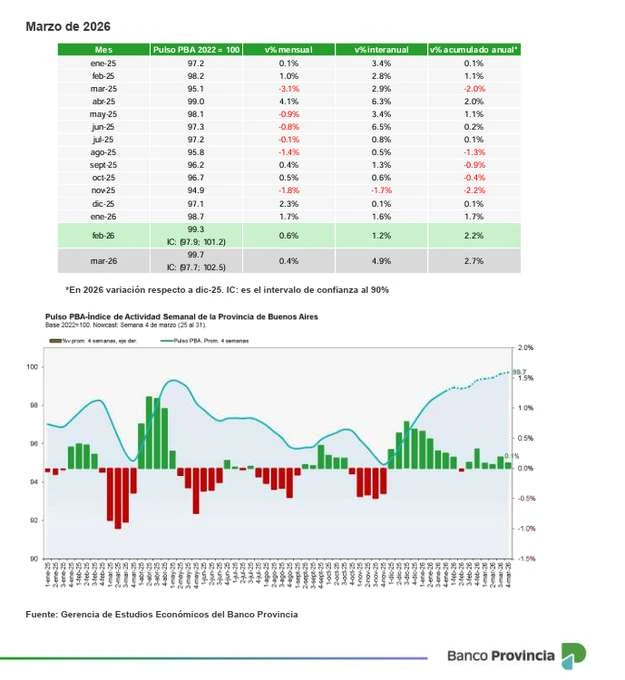
The “PBA Pulse” indicator also showed cumulative growth of 2.7% in 2026 and projects an annual expansion of 2.8% if the level of activity recorded in March is maintained, with strong momentum from key sectors such as industry, agriculture and construction.
to consolidating a broader and more diversified recovery.
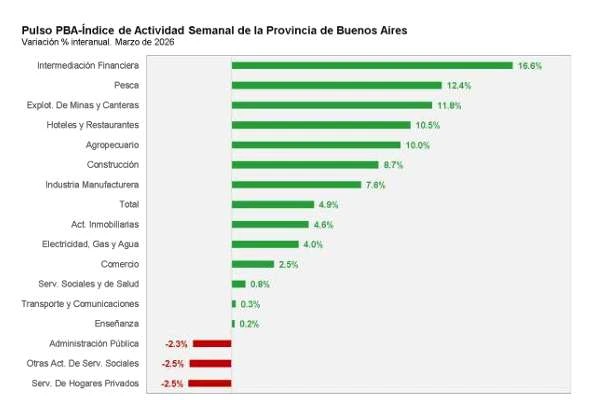
In contrast, some areas continue to decline: Public administration:
-2.3%
Other social service activities: -2.5% Private household services:
-2.5%
These falls are linked to the public sector adjustment process and the reduction of state spending, in line with the efficiency approach promoted
by the current administration.
What is the PBA Pulse
The “PBA Pulse” is an indicator based on artificial intelligence developed by Banco Provincia in conjunction with the UBA and Conicet.
It uses more than 1,200 daily data to measure economic activity in real time, allowing us to anticipate trends before the publication of official statistics
In the cumulative figure of 2026, growth reached 2.7%, which shows a dynamic of sustained growth. The report itself highlights that “if activity remained at the same level observed in March, the economy of the Province of Buenos Aires would grow 2.8% in 2026", a projection that reinforces expectations
of consolidating the economic upturn. Buenos Aires economic activity rose 0.4% in March compared to February and 4.9% year-on-year
How the first quarter ended
March data allowed us to close the first quarter with favorable results: the Buenos Aires economy accumulated growth of 3.1% compared to the previous quarter and 2.5% year-on-year, confirming a progressive recovery after months of decline and
volatility.
This performance is part of a context of macroeconomic order, with policies aimed at fiscal balance, deregulation and the recomposition of relative prices, central axes of Javier Milei's management.
The sectors driving the rebound The
improvement was generalized in most productive sectors, with significant increases: Manufacturing industry: +7.6%,
cutting a streak of eight consecutive months in low Trade:+2.5%, after two months in