
The smallest tetrapod fossil in South America was found in Brazil: a 9.5 mm skull

The smallest tetrapod fossil in South America was found in Brazil: a 9.5 mm skull

Sauropia macrorhinus, barely 5 centimeters long, lived 240 million years ago and provides key clues about Middle Triassic ecosystems, before the domination of dinosaurs

Share:

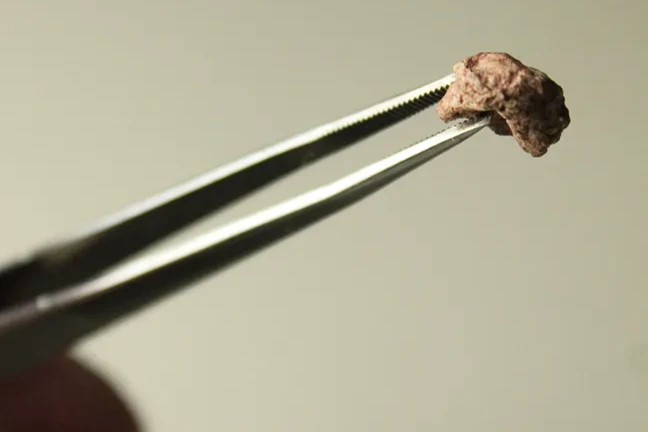
A fossilized skull measuring just 9.5 millimeters allowed for the identification of an unknown species that inhabited what is now Brazil approximately 240 million years ago. The animal, named Sauropia macrorhinus, belonged to an ancient group of reptiles and is the smallest tetrapod recorded so far in Middle Triassic deposits in South America.

The study was published on January 28, 2026, in the scientific journal Scientific Reports and was led by Rodrigo Temp Müller, a researcher at the Federal University of Santa Maria (UFSM). The discovery provides information about tiny animals that shared prehistoric ecosystems with much larger species.

Where the skull of less than one centimeter was found

The specimen was discovered at the Cortado site, located in the municipality of Novo Cabrais, in the Brazilian state of Rio Grande do Sul. It was located by paleontologist Lúcio Roberto da Silva during a field trip conducted with Pedro Lucas Porcela Aurélio.

The smallest tetrapod fossil in South America was found in Brazil: a 9.5 mm skull

The rock preserved an almost complete skull, with the jaw still associated. Its size forced specialists to carry out an extremely delicate preparation: they used fine needles and magnifying glasses to remove the adhered material without damaging the bones.

Subsequently, Leonardo Kerber examined the fossil using computed microtomography. The images allowed for the study of structures that are impossible to distinguish with the naked eye and complemented the digital reconstruction of its anatomy.

What Sauropia macrorhinus was like and what it fed on

Scientists estimate that the animal may have measured around five centimeters in length. Its appearance would have resembled that of a small lizard, although it was not a species of modern lizard, but a parareptile from the group of procolophonids.

Among its characteristics stand out proportionally large nasal openings, the broad shape of the skull, and a particular dentition, with circular-sectioned anterior teeth.

Due to these characteristics, researchers consider it likely that it consumed insects or other small invertebrates. No food remains were found to confirm an exact diet.


The scientific name also refers to its appearance: Sauropia combines the Greek word sauros, which means lizard, with piá, an expression from southern Brazil used to refer to a child. Macrorhinus alludes to the size of its nasal openings.

The smallest tetrapod fossil in South America was found in Brazil: a 9.5 mm skull

The mystery that puzzles paleontologists: was it an adult or still growing?

The tiny size of the fossil raises an important question. The skulls of its known relatives are considerably larger, so the authors do not rule out the possibility that the specimen was juvenile and had not yet reached its final dimensions.

This possibility also requires a cautious interpretation of its evolutionary relationship: certain skull traits may change during growth. Analyses place it among early-diverging procolophonids, but the classification will need to be validated with future findings.

What the discovery reveals about life before dinosaurs

240 million years ago, the continents formed Pangea, and the region was inhabited by large herbivores and predators related to the ancestors of crocodiles.

The study suggests that very small animals like Sauropia occupied niches in those food chains that are rarely represented in the fossil record. They may even have become prey for smaller carnivores, such as Parvosuchus aurelioi, known from remains found in the same geological region.

This relationship is an ecological hypothesis, not a proven interaction. The described fossil of Sauropia is preserved in the paleontological collection of the Federal University of Santa Maria, where it serves as a reference for studying the diversity of vertebrates prior to the dominance of dinosaurs.