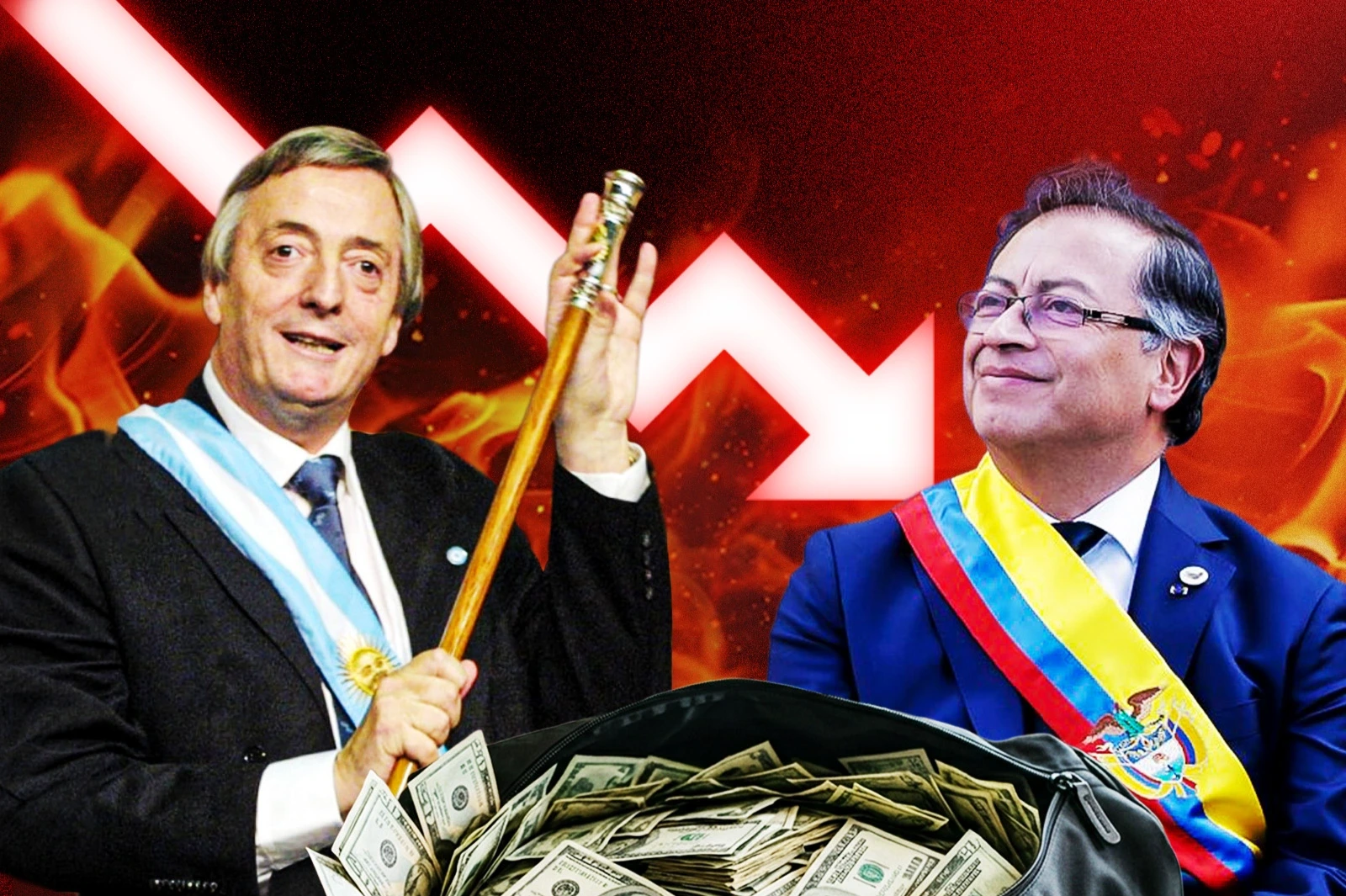
Petro repeats Néstor Kirchner's model: he pays debt with the IMF and replaces it with more expensive debt

Petro repeats Néstor Kirchner's model: he pays debt with the IMF and replaces it with more expensive debt
Gustavo Petro celebrates the full payment to the IMF like Néstor Kirchner in 2005. They replace cheap debt with very expensive bonds. The same Kirchnerist deception.

Most read in Argentina

Bone marrow: the silent factory of blood cells

  1. Máximo Kirchner was arrested while driving a truck with an outstanding warrant

  2. The Argentine National Team crushed Bolivia 4-0 in their first friendly of the FIFA date

  3. Milei started Argentina Week with meetings with OECD leaders and major companies

  4. RIGI: Toyota will make the largest investment in the history of the Argentine automotive industry

Imagen de Editorial Team
porEditorial Team
Argentina

Gustavo Petro celebrates the full payment to the IMF like Néstor Kirchner in 2005. They replace cheap debt with very expensive bonds. The same Kirchnerist deception.

Add La Derecha Diario on
Share:

The real result is not financial independence, but an increase in the cost of financing that ends up paying the taxpayer

.

The Argentine Background: Story, Expensive Debt and Impairment

In 2005, Néstor Kirchner used Central Bank reserves to cancel the debt with the IMF in one payment. The measure was presented as the end of “dependence” and an act of economic sovereignty.

But behind the story there was another reality: Argentina did not stop getting into debt. Changed creditor.


La Derecha Diario on X

  1. ARGENTINA VOLVERÁ A TENER CAPACIDAD SUBMARINA: Francia y Alemania ofrecieron financiar al 100% la compra de tres submarinos de ataque convencionales para reconstruir una capacidad que la Armada Argentina perdió tras la tragedia del ARA San Juan. La competencia enfrenta al Scorpène francés de Naval Group con el Tipo 209NG alemán de TKMS. Ambas propuestas cumplen los requisitos técnicos y contemplan una operación estimada en unos USD 2.300 millones, con financiamiento total en cuotas. La decisión final quedará en manos del Gobierno de Milei y, una vez firmado el contrato, la primera unidad podría incorporarse entre cinco y seis años después.

    11 min ago

  2. ✝️☪️ | CON LOS MUSULMANES NO JODE: Miguel Granados blasfemó contra el cristianismo al afirmar que Jesús "era hippie y pro-puto", al mismo tiempo que afirmaba que "lo banca" porque es un "brodazo".

    28 min ago

  3. "FACHO" POR QUERER IR A TRABAJAR: Un médico fue increpado por dementes comunistas mientras intentaba atravesar un corte vinculado a las protestas de la UBA. Los miserables bloquearon su paso y lo insultaron solo por querer ir a trabajar.

    41 min ago

  4. LA DERECHA AVANZA EN TERRITORIO DE LULA: Simpatizantes de Flávio Bolsonaro salieron a las calles de Tenente Ananias, una localidad del Nordeste donde Lula consiguió una ventaja de más de 30 puntos en la primera vuelta.

    51 min ago

  5. URGENTE — SE VIENE LA DERECHA EN FRANCIA: La líder derechista Marine Le Pen alcanzó el 37% de intención de voto en una nueva encuesta. https://derechadiario.com.ar/internacionales/marine-pen-alcanza-37-en-encuestas-aventaja-ampliamente-izquierda-radical-en-francia

    21 min ago

La Derecha Diario logo
TwitterInstagramYouTubeTikTokFacebook
Derecha Diario TV

Nosotros

  • Quienes Somos
  • Autores
  • Donar

Privacidad

  • Protección de datos
  • Canales
  • Sitemap
  • RSS

Contacto

  • info@derechadiario.com.ar
PUBLICIDAD
La Derecha Diario logo
ESX logoInstagram logoYouTube logoTikTok logoFacebook
ARGENTINAUNITED STATESECUADORISRAELMEXICOURUGUAY
DERECHA DIARIO TV
  • ES
    XInstagramYouTubeTikTokFacebook
  • DERECHA DIARIO TV
  • Sections
  • ARGENTINA
  • UNITED STATES
  • ECUADOR
  • ISRAEL
  • MEXICO
  • URUGUAY
  • Countries
  • La Derecha Diario logoLA DERECHA DIARIO
  • La Derecha Diario México logoLA DERECHA DIARIO MÉXICO
  • La Derecha Diario Uruguay logoLA DERECHA DIARIO URUGUAY
  • La Derecha Diario Ecuador logoLA DERECHA DIARIO ECUADOR
  • La Derecha Diario Israel logoLA DERECHA DIARIO ISRAEL
  • La Derecha Diario Estados Unidos logoLA DERECHA DIARIO ESTADOS UNIDOS
  • Topics
  • GUERRA EN IRÁN
  • The Newspaper
  • QUIENES SOMOS
  • AUTORES
  • PUBLICIDAD
  • DONAR

Related news

Martín Varsavsky invested again in Argentina: “The country is heading in the right direction, the opposite of Europe”

Martín Varsavsky invested again in Argentina: “The country is heading in the right direction, the opposite of Europe”

The espionage folders on judges, opponents, and businessmen found in CFK's vault

The espionage folders on judges, opponents, and businessmen found in CFK's vault

The United Kingdom arrested an Iranian on suspicion of preparing acts of terrorism at a US base

The United Kingdom arrested an Iranian on suspicion of preparing acts of terrorism at a US base

Trump Effect: the US economy recorded its lowest unemployment rate in over 50 years and poverty also decreased

Trump Effect: the US economy recorded its lowest unemployment rate in over 50 years and poverty also decreased

The Trump administration begins a series of refunds for excessive charges to nearly a million Obamacare users

The Trump administration begins a series of refunds for excessive charges to nearly a million Obamacare users

National Lottery: all the winning numbers from Thursday, October 1

National Lottery: all the winning numbers from Thursday, October 1

Bogotá and Buenos Aires are separated by thousands of kilometers, but today they share something much closer: the same economic deception disguised as a political epic. This week, Gustavo Petro celebrated the full payment of his debt to the IMF as if it were a historic milestone. The scene immediately goes back to 2005, when Néstor Kirchner did exactly

the same thing in Argentina.

Twenty years later, the story is repeated. And also its consequences.

The myth of the “liberation” of the IMF

Petro assured that Colombia leaves behind the Fund's “onerous conditions”. In other words: he sold the idea of financial liberation. It is the same discourse that Kirchnerism installed for years in Argentina, building an external enemy to justify

wrong internal decisions.

The problem is that the epic doesn't stand up to economic analysis.

Debt with the IMF is, in relative terms, cheap. This is multilateral financing with low rates — historically between 2% and 3.5% — and reasonable terms. Cancelling it doesn't eliminate debt: it simply replaces it

.

And that's exactly what happened.

Imagen 1396874

Pay cheaply with expensive debt

Both in the Argentine case of 2005 and in Colombia's recent decision, the mechanism is the same: cancel cheap debt to issue new, more expensive debt in the markets

.

In the Colombian case, the Flexible Credit Line taken during the pandemic —for about 5.4 billion dollars— was settled using bond issues at significantly higher rates, around 5.5% to 6.5% or even higher, according to recent investments.

The equation is simple:

  • Cheap debt → canceled

  • Expensive
  • debt → issued

  • Report of sovereignty → amplified

Imagen 1396872

After closing the door of the IMF —which offered relatively cheap financing—Kirchnerism turned to Venezuela as a source of financing. Between 2005 and 2008, the country issued bonds that were purchased by the government of Hugo Chávez at rates that ranged from 7.4% to 14.8%, well above the

cost of multilateral organizations.

There were even one-off issues with returns of more than 10% per year in dollars, making it one of the most expensive loans since the 2001 default. Colombia repeats the

formula

What is happening today in Colombia follows that same logic. The Petro government replaces cheap financing with more expensive debt, while building a political narrative of sovereignty

.

But the account doesn't disappear: it changes shape.

And in that process, the cost of indebtedness increases, reducing future fiscal margin and transferring the impact to the real economy.

A lesson that the region already knows

The parallelism between Petro and Kirchnerism is no accident. It responds to the same ideological matrix that privileges discourse over economic sustainability

.

Recent history shows that this path does not lead to sovereignty, but to more debt, higher financial cost and less predictability.

Argentina has already paid that price for years. Colombia is beginning to follow a similar path

.

And as is often the case, the narrative remains in the hands of governments. The bill, in the hands of society.