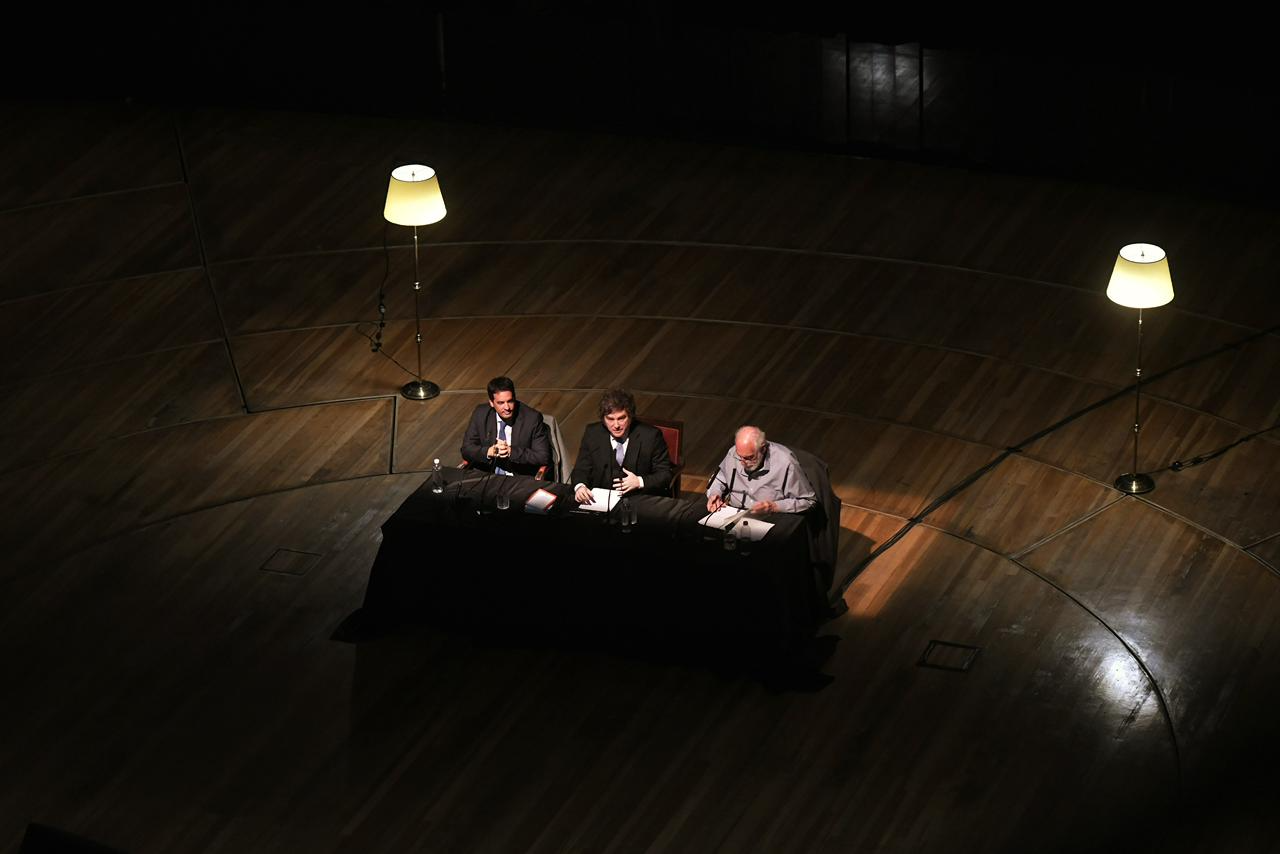
.
Reviewing that stage, Milei explained more clearly the example he used to use to differentiate the two currents. As he explained, the Keynesian economist promises politicians easy solutions through public spending — stating that he has in his hands “the miracle of the multiplication of loaves” —, which generates
immediate acceptance by power.
In contrast, he pointed out that the liberal approach poses a much more uncomfortable diagnosis: the problem is the State itself. In that sense, he crudely summarized that position by stating that the libertarian tells the politician “the problem is you, pick it up”, which leaves the liberal perspective at a disadvantage in the
political debate.
Based on this contrast, Milei argued that this type of approach explains why Keynesianism managed to prevail in public debate. In that sense, he stated that Keynes won by a rout and questioned Friedrich Hayek's position, considering that not openly confronting that
approach was a strategic mistake.
In the middle of the exhibition, a spectator interrupted with a misplaced question about inflation, trying to divert the focus of the debate. President Javier Milei stopped him immediately and ordered the situation with a categorical answer: “this is not the time, nor the place to go”, to allow economist Juan Carlos de Pablo to continue
his presentation without interruption.
Later, the president highlighted the results of his economic program and defended the course taken by his government. In that regard, he said: “We made the biggest fiscal adjustment in history and in the middle we lifted 14 million people out of poverty. LONG LIVE FUCKING FREEDOM! ”.
The president once again harshly questioned journalism and assured that there is a strong distortion between economic reality and the media narrative. In this regard, he stated that “never in Argentine history has there been such a discrepancy between real data and what the media want to sell,” and argued that criticism responds to the interests affected by government reforms
.