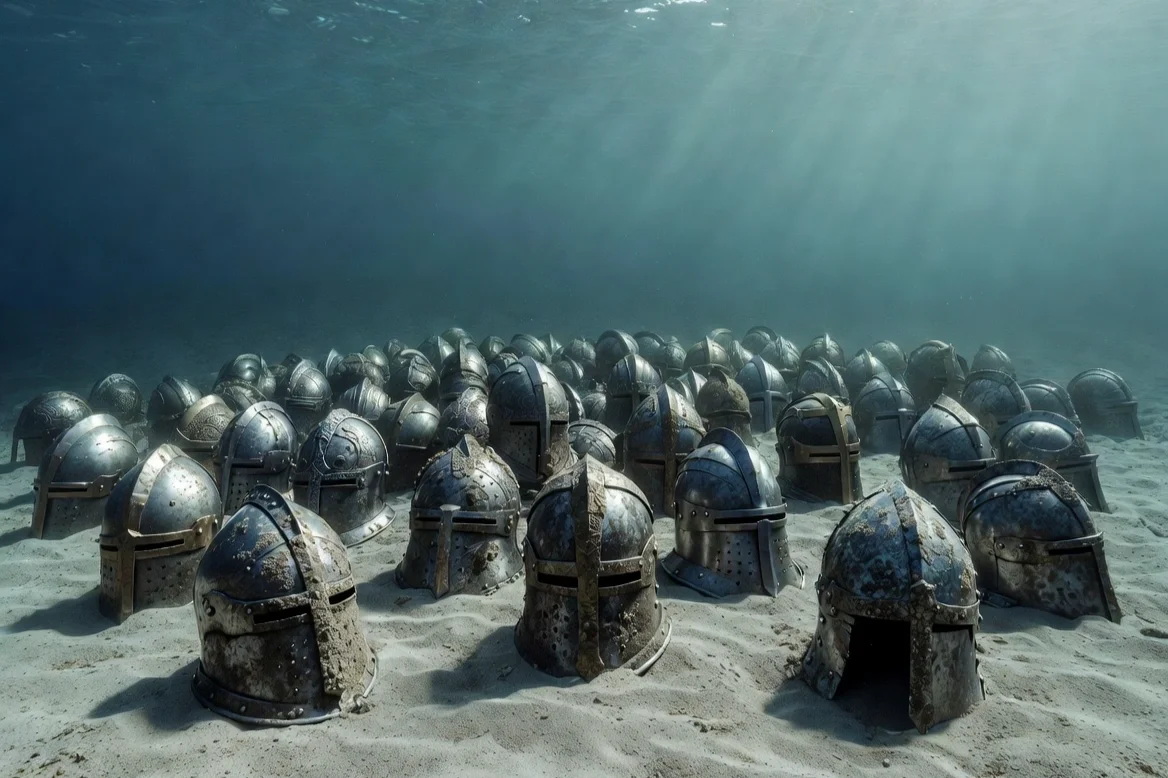
For more than three decades, a treasure of helmets recovered from the seabed off the coast of Castellón was believed to belong to the Roman era. Now, a recent study has completely changed that idea and shown that they are actually medieval pieces from the late 14th and early 15th centuries.
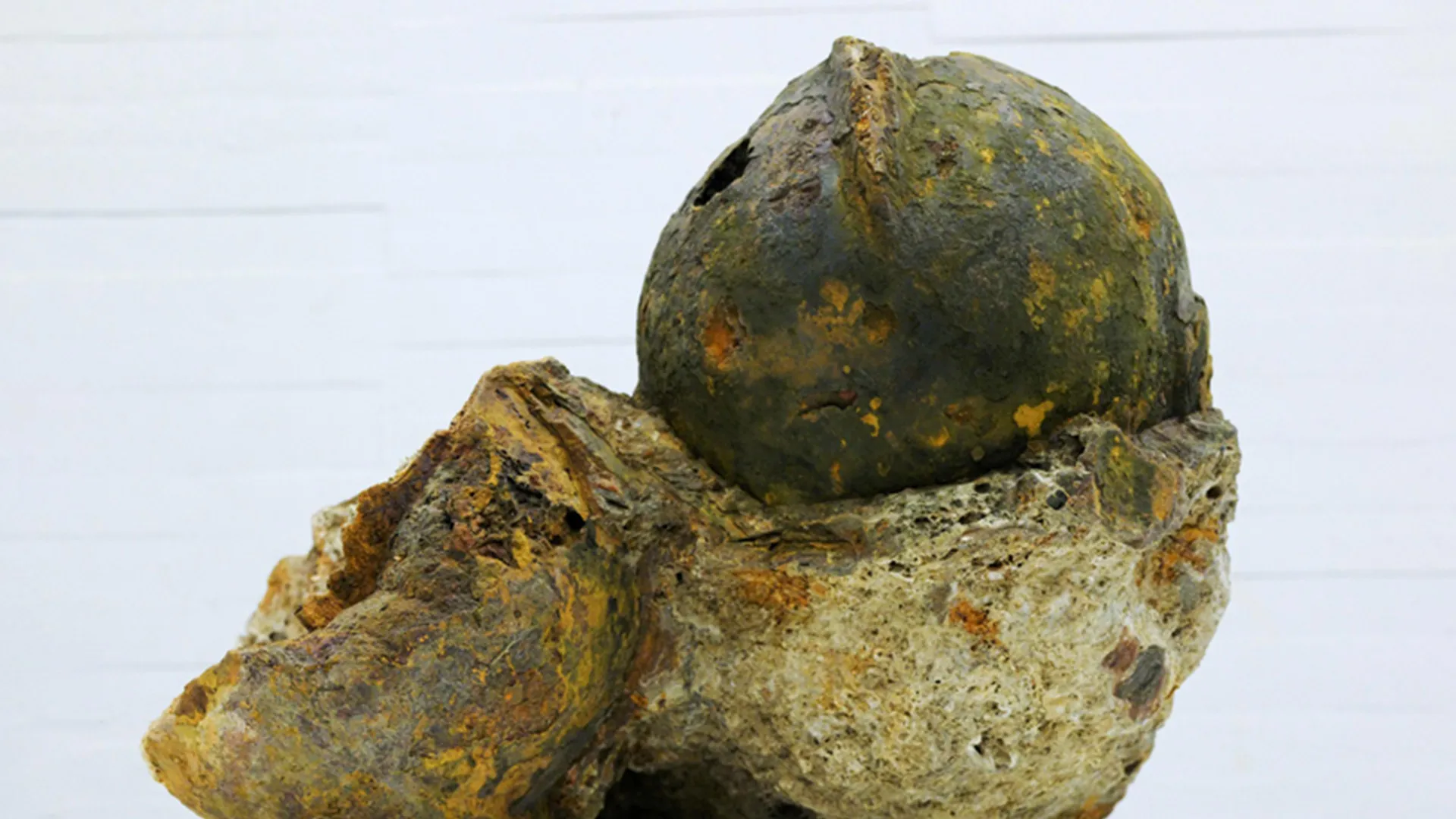
The finding, which occurred by chance in 1990 near Piedras de la Barbada, in Benicarló, represents the largest collection of medieval helmets found so far in the western Mediterranean. Local fishermen pulled up two large blocks of metal corroded by the sea, and inside were 43 iron helmets that had fused together over time.
This discovery not only corrects a misclassification but also opens a unique window into the world of arms trade in the Late Middle Ages.
The team from the University of Alicante, led by doctoral student Manuel Frallicciardi, used an analytical method developed at the university along with radiocarbon dating on preserved fabric fragments found inside some helmets. This allowed them to accurately confirm the manufacturing date.
 From Romans to Medieval
Initially, identifying the origin of the helmets was complicated because they combined features reminiscent of late Roman models and others inspired by classical traditions. However, upon further investigation, the researchers noticed that they did not exactly match any known category. Frallicciardi emphasized that there were virtually no direct parallels, although he found some similar representations in 14th-century English art.
The helmets belong to a design from a transitional period in military technology that left no direct descendants. This makes them exceptional pieces for understanding how protective equipment evolved during that time.
Experts believe that all the helmets were part of the same shipment that accidentally sank, probably while being loaded or unloaded near a dock. The site, only six meters deep, allowed part of the cargo to be buried under the sand and preserved for centuries thanks to marine concretions.
These concretions sealed the interior and preserved fabric fragments that were key for dating.
A Trade Network in the Mediterranean
The size of the shipment points to organized trafficking of military equipment between the Valencia region and commercial centers in northern Italy, such as Genoa, one of the most powerful ports of the time. Raimon Graells, a lecturer at the University of Alicante and co-author of the study, noted that this is direct evidence of large-scale arms trade and a much more complex network of exchanges than previously imagined.
The historical context explains the demand: by the mid-14th century, Islamic piracy intensified along the Valencian coasts at the same time that militarization was growing. These helmets were likely intended for local militias, forces of the Kingdom of Valencia, or groups tasked with defending the maritime border.
The finding illustrates how, amid instability, piracy, and conflicts, there was a constant flow of weapons and armor across the Mediterranean. Far from being Roman relics, these helmets become silent witnesses to the military logistics and commercial dynamism of the time.
Published in the journal Antiquity by Cambridge University Press, the results of the study from the University of Alicante provide valuable data to reconstruct a poorly documented chapter of Mediterranean history. What began as an archaeological mystery ended up revealing unexpected connections between different powers in the region.
This type of discovery underscores the importance of revisiting ancient findings with new technologies and interdisciplinary approaches, allowing for corrections of interpretations that have persisted for decades.