ADIF described the LZB system of the Madrid-Sevilla line as “obsolete and non-interoperable”; years later, signaling failures preceded fatal railway accidents
The structural deterioration of the high-speed network in Spain has ceased to be a suspicion and has become a tragic institutional reality. Under the command of the socialist government of Pedro Sánchez and the disastrous management of the Minister of Transport, Óscar Puente, the national network suffers from rampant underinvestment, technical obsolescence, and operational neglect that daily threatens the lives of users.
This alarming official neglect reached its peak not due to an unforeseen natural event, but due to the deliberate inaction of the central Executive. Official documentation shows that the top officials of the infrastructure manager ADIF and the Ministry of Transport had documented knowledge of the serious failures of the network. Far from undertaking the urgent reforms required, the socialist leadership postponed the necessary investments in national infrastructure, condemning Spanish tracks to repeated episodes of paralysis and tragedy.
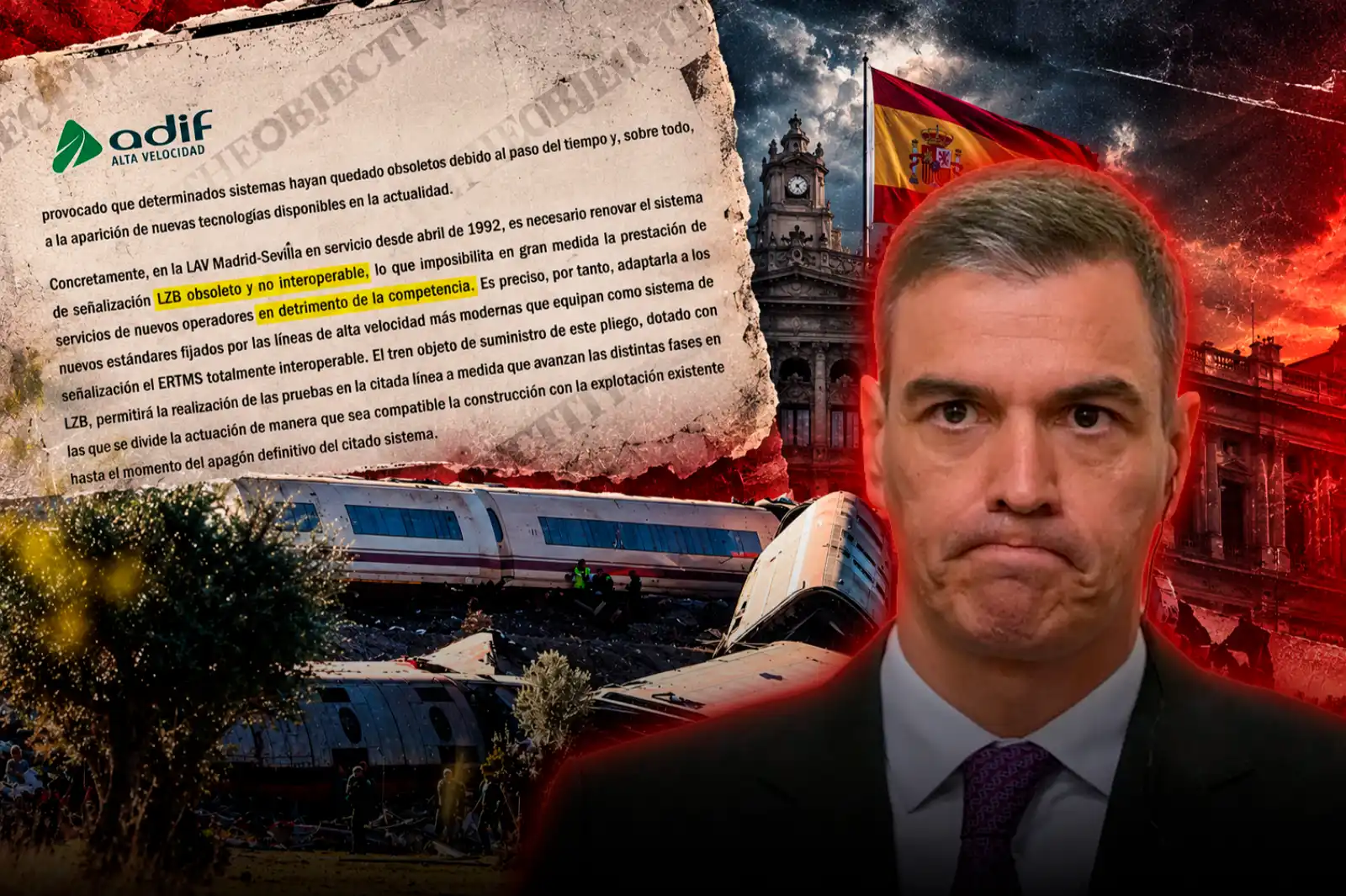
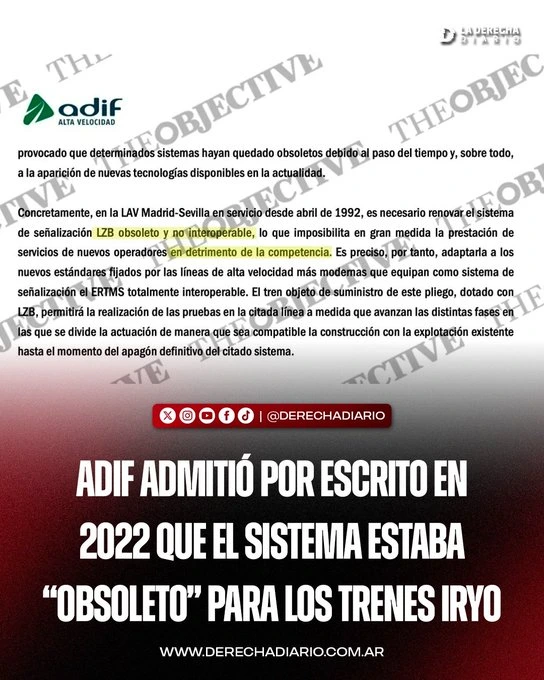
An official ADIF document recognized that the LZB signaling system on the Madrid-Seville line was obsolete and hampered the movement of trains
The nerve center of the institutional scandal is an official document from ADIF prepared in November 2022. According to investigative reporting by The Objective, the state manager drafted a technical document of 194 pages intended for the bidding of a train for high-speed tracks. In this report, ADIF explicitly acknowledged the urgent need to “renew the obsolete and non-interoperable LZB signaling system” that has been operating on the LAV Madrid-Sevilla since April 1992.
The public agency itself admitted in writing that this outdated equipment was the one that “greatly hinders the provision of services by new operators to the detriment of competition”. In technical terms, the trains from private companies Iryo and Ouigo come factory-equipped natively with the European ERTMS (“European Rail Traffic Management System”).
To be able to operate on the route to Andalusia, the companies were forced to install an adapter called STM (“Specific Transmission Module”), a highly fragile transitional device. Sources from the private sector described the adaptation process to the LZB as “a nightmare for engineers”. In fact, the president of Ouigo in Spain defined the process as “an obstacle course and a marathon at the same time” of “enormous technical complexity”, which forced a delay in her company's entry into the route by 22 months, launching its services only on January 16, 2025, while Iryo did so on March 31, 2023.
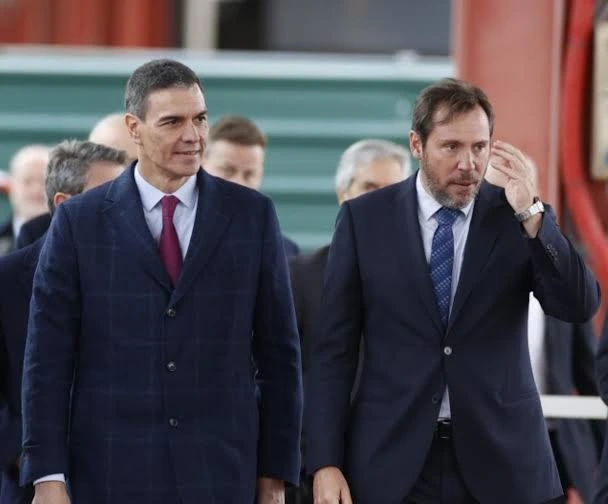
Pedro Sánchez and Óscar Puente
The seriousness of the situation was widely known in parliamentary sessions. On October 5, 2026, during his appearance before the investigative committee of the Senate created after the accidents in Adamuz and Gelida, the CEO of Iryo, Fabrizio Favara, sharply alerted his Lords and ADIF. Fabrizio Favara recorded in the Session Diary that on the Madrid-Sevilla line, the “most frequent” issue of incidence was the LZB: “it is a safe system, but quite old, and every time the train's signal disconnects from the ground signal, the train stops. It cannot move and takes quite a while to reconnect and start the service again”.
The disastrous consequence of ignoring these documented warnings for four years materialized on the morning of October 28, 2026. At 8:30, 24 minutes before the catastrophe, ADIF recorded a severe drop in the LZB central at Urda. As warned by the CEO of Iryo, the disconnection caused the automatic stop of the Italian company's train on the track. Strictly following protocol, the engineer immediately informed the Regulation and Control Center (CRC) of Atocha that the machine was paralyzed and had severe difficulties restarting the system and resuming movement.
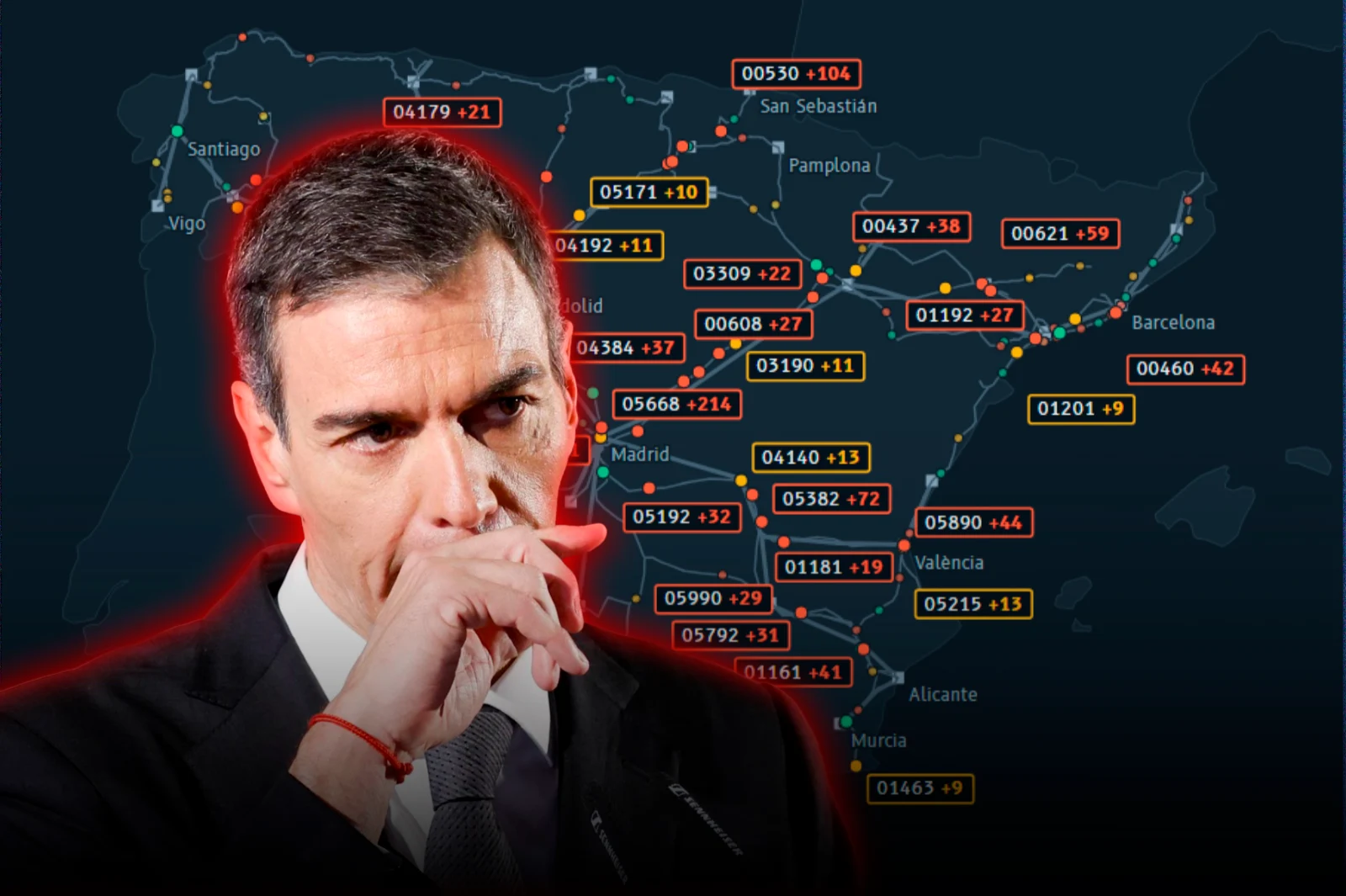
Pedro Sánchez and Óscar Puente
Despite the fact that the Iryo train remained stopped and unable to move, the command center of ADIF authorized an AVE from Renfe coming from behind to resume movement at “normal” speed. At 8:54, at kilometer 118 of the high-speed line between Los Yébenes and Urda (Toledo), the AVE traveling at over 160 km/h collided head-on with the rear of the stopped Iryo.
The collision caused the derailment of the units and the plunging of cars down an embankment, resulting in a bloodbath with 69 people dead and over a hundred injured. Although ADIF had awarded the replacement of the old LZB with the modern ERTMS in October 2021, the socialist government of Pedro Sánchez and his Minister of Transport, Óscar Puente, inexplicably delayed the execution of the works. The deliberate inaction of the PSOE administration in the face of a technical failure that they had documented in writing since 2022 makes this disaster a political and unavoidable responsibility of the regime.