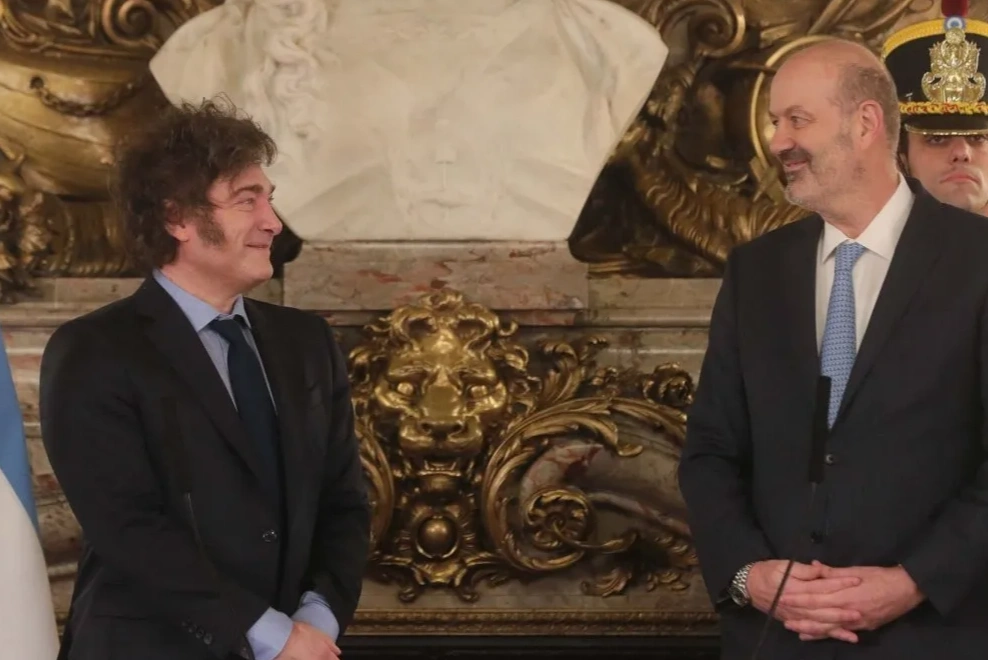
The Minister of Deregulation, Federico Sturzenegger, detailed an ambitious package of derogations that aim to eliminate old laws, political privileges and regulations that affect economic freedom and private property.
The government of Javier Milei is moving forward with a profound process of deregulation of the State. Within this framework, Federico Sturzenegger presented a battery of proposals under the name of “Lei Hojarasca”, whose objective is to eliminate obsolete, unconstitutional or directly useless regulations
.
The initiative aims to clear the Argentine legal system of regulations inherited from authoritarian governments, unnecessary bureaucratic structures and political privileges that, according to the official, affect individual freedom and economic development.
The laws that seek to eliminate because they restrict freedoms
One of the central axes of the package is the repeal of rules that violate basic rights and individual freedoms
.
Among the most striking cases are:
A 1951 law that punished Argentines for reporting human rights violations abroad Regulations of military governments that controlled the
newspaper paper or imposed cultural content Laws that allowed the
police to arrest people without cause under the excuse of “background checks” Regulations that enabled State intervention in private meetings
Explicit political privileges are also included, such as a law that granted free movement and parking to legislators, something considered incompatible with a modern democracy.
Obsolete rules that no longer make sense in the 21st century
Another block points to laws that have been completely outdated by the passage of time or
technological progress.
Among them:
19th century regulations with tax benefits without current justification
Regulations on medical technology replaced by modern frameworks
Legislation on mineral coal in a context of global energy transition
Administrative obligations such as the microfilming of documents, now totally superseded
Even a law appears that “authorizes color television”, reflecting thelevel of cumulative regulatory backlog
.
The focus on eliminating unnecessary red tape and paperwork
The project also seeks to dismantle state structures without real utility and reduce
costs for the private sector.
Among the examples:
Absurd obligations such as reporting work interruptions
State sweepstakes where bureaucracy costs more than the prize
Public funds with no verifiable impact
and citizens.
Non-existent organisms and structures without function
Another key axis is the elimination of norms that refer to organisms that no longer exist or processes that were never implemented
.
Among them:
Public funds without funding or real activity
Duplicate or overlapping Committees
Programs that never went beyond the theoretical stage
Structures created decades ago with no function today. Decrees linked to organizations that disappeared after the
crisis of 2001 or even earlier are included
.
The end of state funding to political structures
Finally, the “Hojarasca Law” proposes to end state funding of political and corporate structures
.
Among them:
The Circle of Legislators
The Argentine Federation of Municipalities
The proposal is that these entities be funded voluntarily by their members, instead of relying on public resources
.
One more step in Milei's deregulation agenda The initiative is part of
the libertarian government's strategy to reduce the size of the State, eliminate privileges and liberate the
economy.
In line with DNU 70/23 and other structural reforms, the “Hojarasca Law” seeks to attack decades of regulatory accumulation that slow down the country's growth.
The message of the ruling party is clear: moving towards a model where the State stops intervening unnecessarily and focuses on essential functions.