Former president Alberto Fernández reappears publicly alongside the Puebla Group in a progressive training course titled "Artificial Intelligence, Power, and Democratic Sovereignty", a proposal with a marked leftist component that brings together former officials and leaders linked to Latin American socialism.
The program will begin on October 26, virtually, and will last six weeks, equivalent to about 30 hours of coursework. The socialists aim to charge USD 300 to each participant, although the organization offers a system of "partial scholarships" that can reduce the amount for activists and interested individuals.
The "diploma" from the Puebla Group where Alberto Fernández participates
Fernández will be in charge of the module called “Augmented Government”, while former Ecuadorian Foreign Minister Guillaume Long, who held the Ministry of Foreign Affairs during the presidency of the convicted for corruption Rafael Correa, will teach the section on “Geopolitics of AI”.
The roster also includes the leader of Chilean communism Marco Enríquez-Ominami, coordinator of the Puebla Group, who will be responsible for the module on “Power, Communication, and Leadership”. Feminist Josefina Maharbiz and Octavio Majul will lead the section dedicated to “Sovereignty, Security, and Autonomy”.
The strong ideological profile of the diploma is also reflected in other names in the call. Rafael Correa, who attempted to impose a dictatorship in Ecuador, will be responsible for delivering the opening conference, while former Colombian president Ernesto Samper will lead the closing. Andrés Arauz, former minister and former presidential candidate from Ecuador, will also participate.
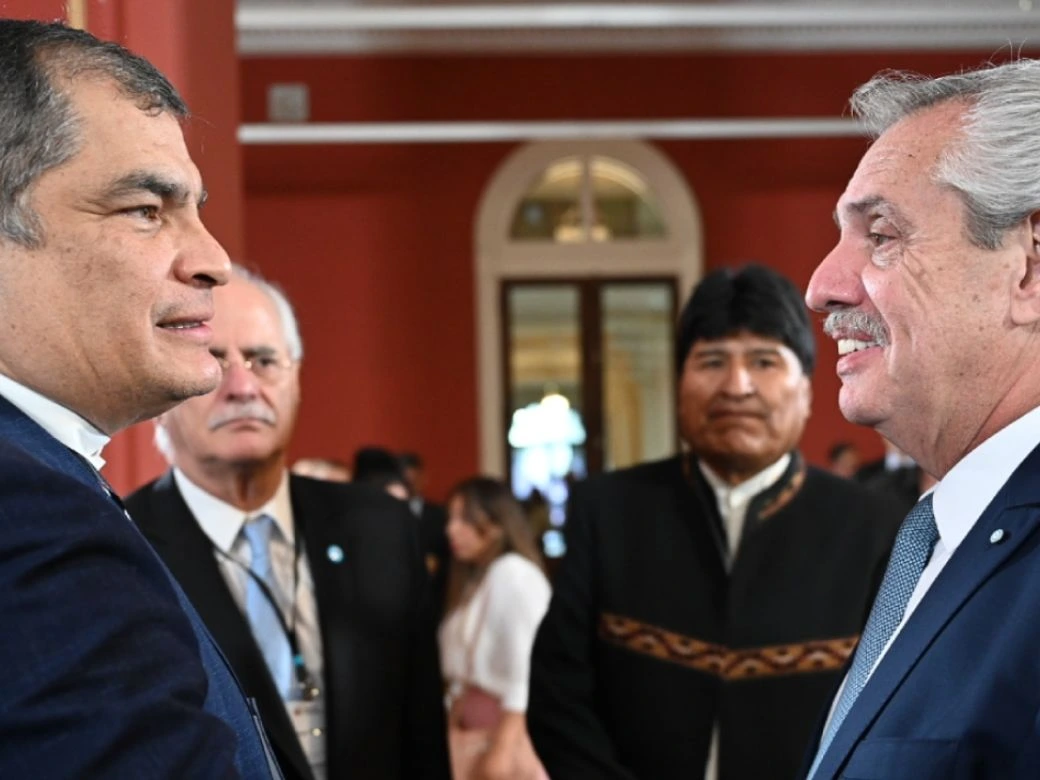
Rafael Correa alongside Alberto Fernández and Evo Morales
Far from presenting itself as a technical training, the program itself focuses on power, politics, and what is called “Latin American technological sovereignty”. Among its objectives are to analyze how power is exercised in the algorithmic era, discuss the democratic control of automation, and develop a regional perspective on technology. No prior programming knowledge or technical training in AI is required.
The admission criteria reflect this militant orientation confirmed by those called. The organization expressly clarifies that they are not primarily looking for those who know about Artificial Intelligence, but for people capable of using that knowledge to strengthen political action, "democracy," and what they call regional sovereignty. Among the sought profiles are public authorities, state officials, social leaders, and political leadership from across the regional left.