April had been the month with the highest buying intensity for the Central Bank, with purchases amounting to USD 2.769 billion. However, the Ministry of Economy claims that the coming weeks could show an even greater pace due to the influx of foreign currency from the agro-export complex.
In the financial market, there is consensus that the supply of dollars from the agricultural sector has not yet fully impacted the Free Exchange Market. This expectation fuels official projections, which aim to maintain a strong accumulation of reserves throughout the rest of the year.
President Javier Milei is reaping significant economic achievements.
Currently, the progress towards the annual purchase target has already reached 78.76%. Official estimates for 2026 project that the Central Bank could close the year with net purchases between USD 10 billion and USD 17 billion, depending on both the influx of exports and the evolution of domestic demand for pesos.
The Central Bank's rebuilding process has become one of the central pillars of the Government's economic program. After years of constant reserve loss, extreme controls, and uncontrolled issuance during the Kirchner administrations, the current monetary scheme has managed to sustain almost daily dollar purchases while continuing the process of inflation deceleration and macroeconomic order.
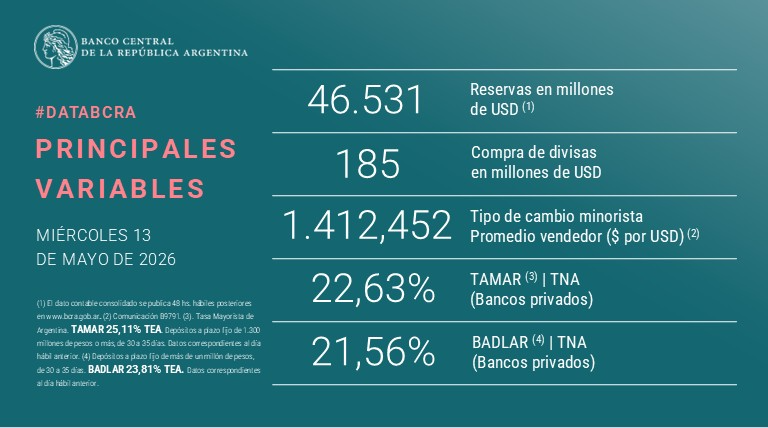
The Central Bank recorded this Wednesday its largest dollar purchase so far in May and deepened the process of rebuilding reserves driven by the Government of Javier Milei. The monetary authority added USD 185 million in a single day, raising the total stock of international reserves to USD 46.531 billion.
With this new result, the agency led by Santiago Bausili has already accumulated USD 7.876 billion in net currency purchases since the beginning of 2026, under the new monetary scheme implemented by the liberal administration. The figure becomes even more significant considering that the bulk of the liquidation from the grain harvest has not yet fully entered the market.
The summary of the day.
This is the highest level of international reserves since February 25 and one of the highest records observed since 2018. The increase reflects not only the sustained purchases by the Central Bank but also the recovery in the prices of various assets that make up the reserves.