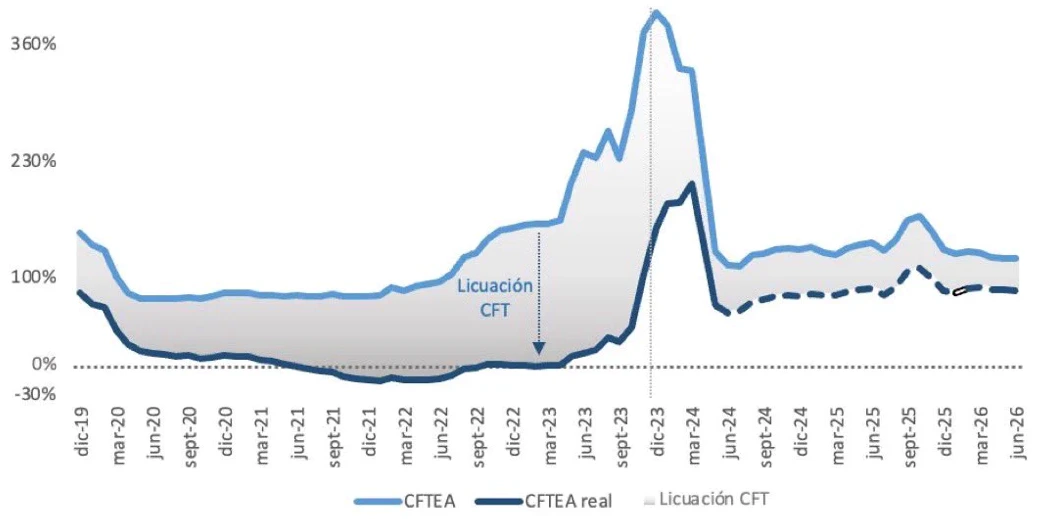
The rise in delinquency appears as a consequence of the return of credit, the drop in inflation, and the sharp increase in rates due to the coup-plotting politicians in 2025
The omnipresent lamentation about indebtedness actually speaks to the story of something positive told in a negative way: it specifically refers to the much-desired return of access to credit for businesses and families. Let us remember that until December 2023, credit represented a quarter of what it does today in relation to GDP.
The growth of credit was a very positive result of the economic policy implemented from that moment on. It is incorrect to call it indebtedness, because it is actually credit to the private sector.
And its level is much lower, not only than in developed countries —against which our volume is minuscule— but also compared to countries in the region. So what has been portrayed as something bad was actually something positive.
The problem lies in the significant level of delinquency
The problem lies in the significant level of delinquency in the servicing of those credits. And that delinquency is due to various factors.
First of all, in Argentina, all economic agents have been accustomed to inflation eroding a good part of the future payments they committed to. This time that did not happen in Argentina.
Inflation —instead of increasing or remaining at the same level— fell. As a result, those expectations were not met.
Additionally, both individuals and businesses —particularly families— turned to different forms of funding, different credit channels.
Liquidation of credits
The central policy of the Government, which is fiscal solvency
To this, it is added that starting in March 2025 —when it was insisted that the IMF would not approve the review of the economic program and that there would be no fresh money— there was an incessant attack against the government, sustained in the media and in political forums.
This attack became fierce at the beginning of the second semester, when a real onslaught of ridiculous bills began, aimed at breaking the central policy of the Government, which is fiscal solvency. Those ridiculous bills became law, and even managed to overturn a presidential veto, something unprecedented. To this were added six or seven requests for impeachment against the president.
In that destabilizing climate, the demand for money began to wane, deteriorating, pouring an unprecedented mass of funds into a rapid process of dollarization of portfolios.
The government, to ensure the stability of the economy, was forced into stricter fiscal and monetary discipline, and interest rates skyrocketed. Inevitably, this entire scenario ended up affecting economic activity, which had been growing at a remarkable pace.
The increase in delinquency was primarily a byproduct of the gigantic destabilizing offensive by the opposition, prior to the midterm elections.
The reasons behind the increase in delinquency
This was compounded by over-indebtedness through different credit channels, the loss of expertise of banks in credit analysis —resulting from lending almost exclusively to the State for fifteen years— and the erroneous presumption of many borrowers, who believed that inflation would erode the weight of their commitments as had happened in the last quarter of a century.
On average, those who took out a loan in March 2022 had a total financial cost (TFC) of 85 %. With runaway inflation, they ended up paying a real financial cost of -15 %.
This means they returned less capital in real terms than they had received. In March 2023, the real TFC was just 1.5 %.
But those who took out or renewed their credit in March 2024 faced a real TFC of 206 %.
Today the answer cannot be any "Platita" plan
Today the answer cannot be any Platita plan,because that would be robbing those who have no responsibility for what is happening to give it to others who —in any case— are the ones who freely chose to take on those obligations.
Furthermore, any initiative of this kind is to assist the banks, which are professional entities that should know whom to lend to, how to do it, and what cost can be charged to their clients, being directly responsible for the risk they assumed.
A logical and plausible solution
A logical and plausible solution is to address some of the factors that make rates so high. The main component is the Gross Income tax; it is in the hands of the governors to eliminate it or —at a minimum— to suspend it temporarily.
It is a truly outrageous tax from every point of view, extremely distorting and also abusive from the perspective of the cost it represents. They would significantly alleviate the financial cost if they suspended it, at least temporarily.
Another component is the Stamp tax, which is also in the hands of the provinces. National taxes, on the other hand, have a secondary impact; the most burdensome —by far— is the Gross Income tax.