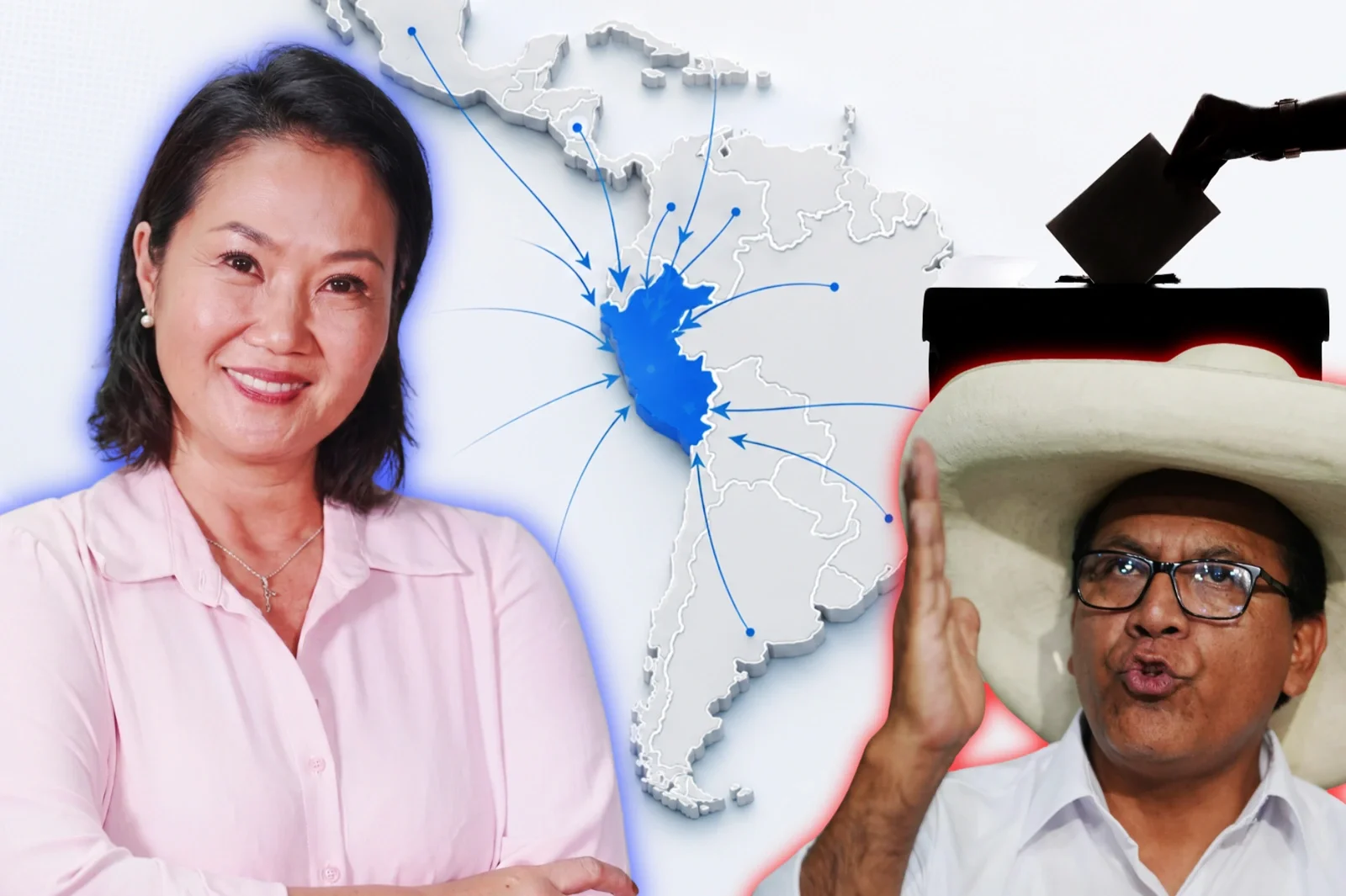
With 96% of the ballots counted, the elections in Peru show an extreme parity that keeps not only the entire country but also the region on edge regarding the final outcome.
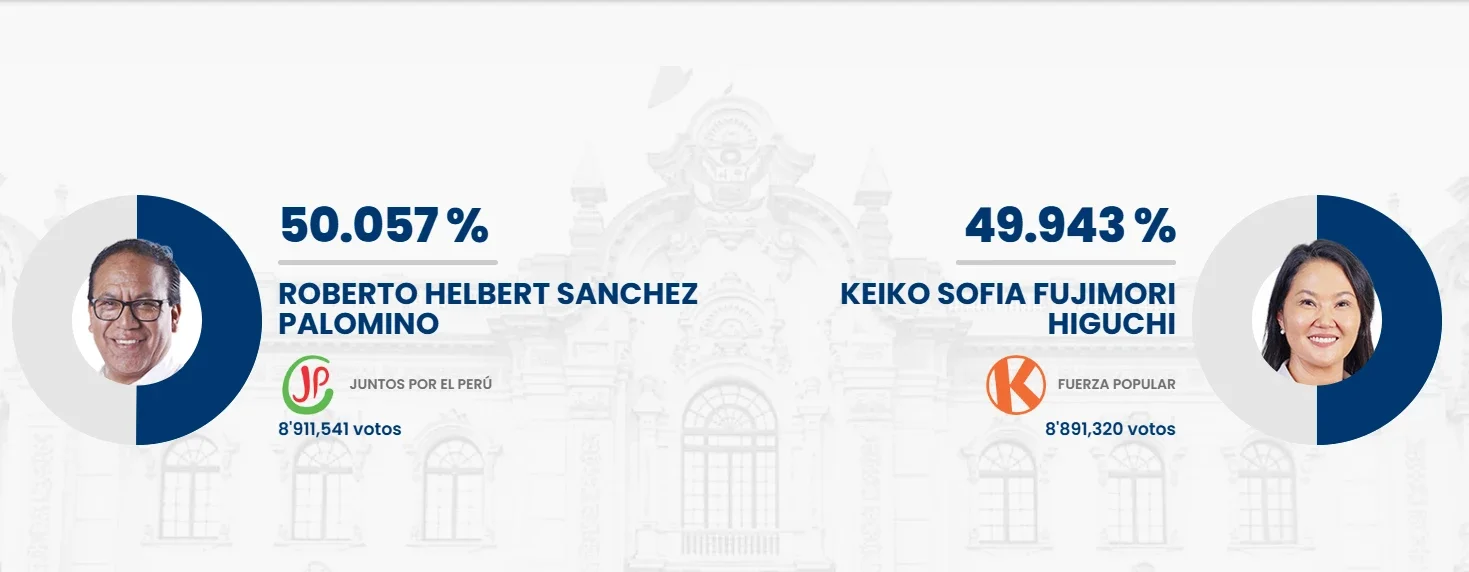
At the moment, the communist Roberto Sánchez leads with 50.057% of the votes (8,911,478), while the right-wing Keiko Fujimori is just behind with 49.943% (8,891,052), a difference that has narrowed to just 20,000 votes.
However, behind that apparent minimal advantage lies a key dynamic that could completely alter the outcome: the vote abroad, where Fujimori achieves a strong backing, crucial for changing the result within the country.
Partial result with 96% counted
In the exclusively national count, Sánchez leads with 50.135% against Fujimori's 49.865%, with a difference of approximately 47,000 votes in his favor. However, that advantage begins to fade when the votes cast outside of Peru are included.
The foreign vote
Abroad, the trend is completely reversed. Fujimori receives 65.518% of the votes compared to Sánchez's 34.482%, giving her a lead of over 27,000 votes in that segment, with only 30% of the ballots counted.
The projections reinforce the centrality of this factor. While in Peruvian territory there are still 471 ballots to be counted, equivalent to about 95,000 votes, which would largely favor Sánchez, abroad there are still 1,724 ballots left to count, meaning nearly 150,000 votes where Fujimori maintains a strongly consolidated lead.
The breakdown of the pending ballots within Peru shows a mixed scenario. In regions like Cusco (225 ballots) and Ayacucho (1 ballot), Sánchez maintains broad advantages, while in districts like Loreto (234 ballots) and Ucayali (8 ballots), Fujimori manages to prevail, albeit with narrower margins.
Keiko Fujimori and Roberto Sánchez
Under these projections, the partial result in Peru would widen the difference in favor of Sánchez to about 42,000 votes. However, when incorporating the behavior of the vote abroad, where a distribution close to 65% for Fujimori is projected, the candidate could completely reverse the result and be ahead by approximately 3,000 votes.
This scenario highlights the vote of Peruvians abroad, which would become a decisive factor in halting the advance of the communist Sánchez.
The final definition will largely depend on the observed ballots that will need to be reanalyzed, totaling 1,501 in Peru and 46 abroad. In the Peruvian case, a relevant fact is that 61% of those ballots correspond to Lima, where Fujimori obtains a significant advantage of 63.5% against 36.5%.
With this outlook, the election remains completely open. What seemed like a slight consolidated advantage for Sánchez could dissipate in the face of the weight of the foreign vote, which emerges as the main support for Fujimori in her attempt to reverse the result and avoid a political shift towards communism that generates strong concern both in Peru and in the region.