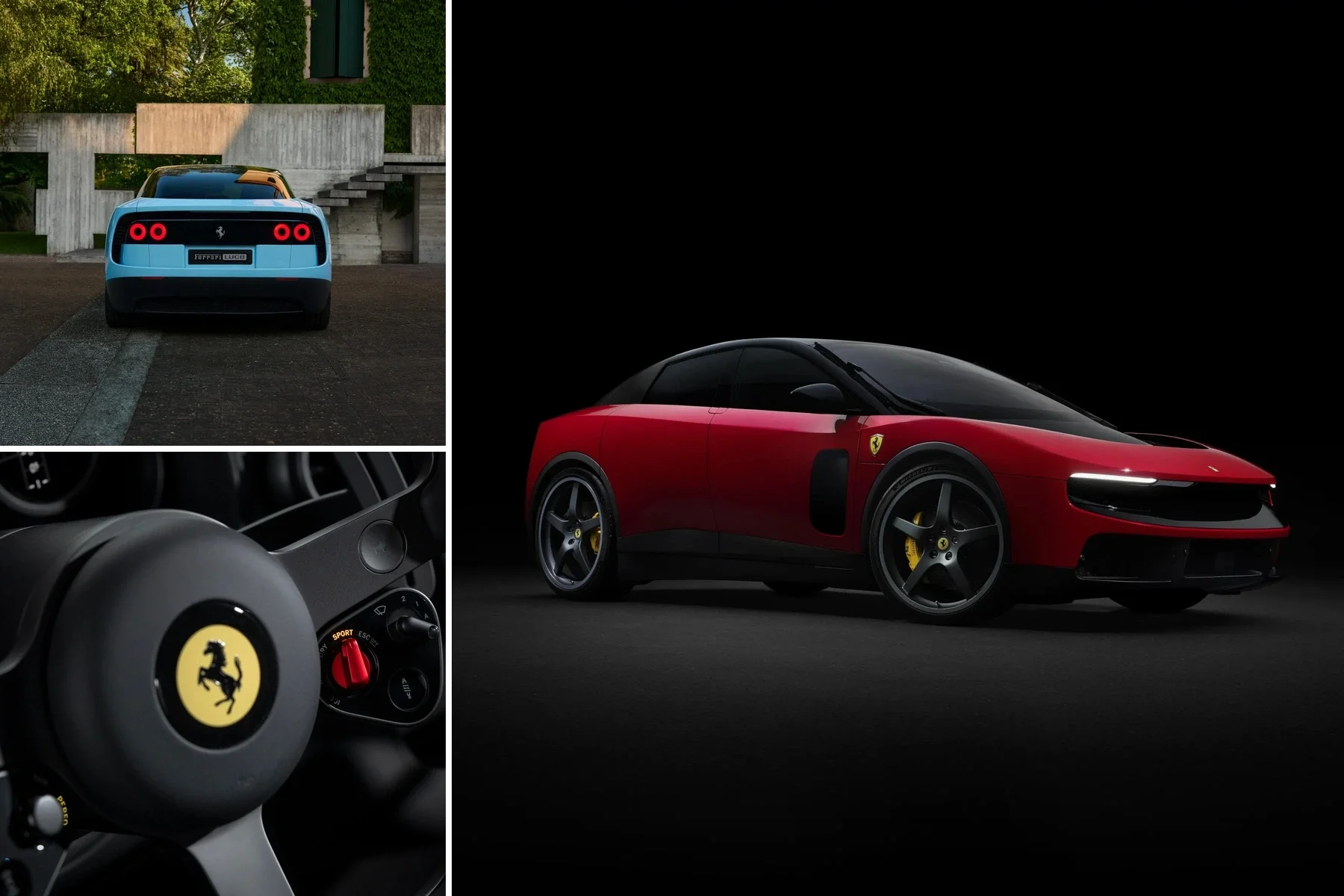

Ferrari has finally entered the world of electric vehicles with the Luce. A model that is generating controversy among its fans. The car, presented just outside Rome, marks a negative turning point for the Italian brand.
The most striking thing is that the Luce looks nothing like a traditional Ferrari. Instead of the aggressive and angular lines that characterized the brand for almost 80 years, this electric vehicle appears smooth, rounded, and minimalist, with clear influences from Apple product design.
This makes sense because the project was developed in collaboration with LoveFrom, the studio led by Jony Ive, the famous designer behind Apple’s most iconic products, along with his partner Marc Newson.
Ferrari fans are already expressing their discontent on social media. The reasons are obvious; Ferrari is a brand associated with power and speed, the engine roaring with its overwhelming power. All of that has been overshadowed by the world of electric vehicles.

Interior of the Ferrari Luce
While the exterior is completely different from the usual, the interior surprises with a combination of minimalism and functionality. There is a profusion of buttons, knobs, and screens with rounded edges typical of Apple devices. The central screen moves on a ball-and-socket mechanism, allowing it to be oriented towards the driver or the passenger.
Additionally, it includes a palm rest to operate the controls without needing to look and a mechanical display with three independent motors that can function as a clock, chronograph, compass, or launch control indicator. The attention to detail is extreme, something typical of Jony Ive's style.
The car features an aerodynamic “glass house,” large wings, and integrated lights that achieve the lowest drag coefficient in Ferrari's history.

 Power and Performance
Under its body, the Luce hides four electric motors that deliver a combined 1,035 horsepower. The two front motors provide 282 hp, while the rear ones deliver 835 hp. This allows it to accelerate from 0 to 100 km/h in 2.5 seconds and from 0 to 200 km/h in 6.8 seconds.
The 122 kWh battery gives it a range of around 500 kilometers according to the WLTP cycle, although in real conditions something close to 500 km is expected. It uses an 800-volt architecture that allows for fast charging of up to 350 kW.