
Google will test AI chips in space with SpaceX satellites

Google will test AI chips in space with SpaceX satellites
Imagen de Editorial Team
porEditorial Team
Argentina

The Suncatcher Project will launch a prototype to evaluate whether TPUs can withstand radiation, vibrations, and the extreme heat of low Earth orbit

Add La Derecha Diario on
Share:

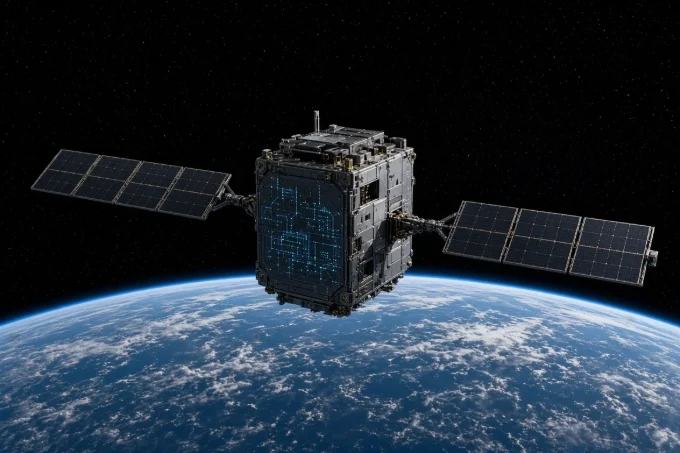
Google advances with its Suncatcher Project and prepares to launch a prototype satellite aboard a SpaceX rocket. The goal is to verify whether its Tensor Processing Units, known as TPUs, can operate under the demanding conditions of space.

The mission will travel on SpaceX's upcoming Transporter-18, in collaboration with Planet. During the flight, data will be collected on the behavior of these chips in response to radiation, temperature changes, and launch vibrations.

The company presented this initiative in 2025 as a long-term research project. It seeks to answer a key question: whether artificial intelligence hardware can withstand the space environment and, in the future, process large volumes of information outside of Earth.

In low Earth orbit, satellites receive sunlight almost continuously. According to Google, this would allow for generating up to eight times more solar energy than on the planet's surface. Over time, several constellations could work together for larger-scale AI tasks.

Google will test AI chips in space with SpaceX satellites

How the hardware is prepared for launch

The journey to low orbit lasts about ten minutes. During this time, the spacecraft faces intense vibrations and accelerations of up to ten times the force of gravity. Some components, such as the TPUs, can experience forces between 50 and 100 g.

To prepare, the team subjected the satellite to vibration tests on three axes that simulate the actual launch conditions. They also evaluated the chips in a proton beam facility at the Crocker Nuclear Laboratory at the University of California, Davis.

During those tests, the TPUs performed artificial intelligence tasks while monitoring for potential errors, such as a bit flip. Initial results showed that the Trillium TPUs can withstand a dose of ionizing radiation greater than what they would receive on a five-year space mission.

However, Google warned that some evaluations can only be conducted in real space. Therefore, this first mission is crucial to validate the hardware's behavior outside of laboratories.

The challenges of operating in a vacuum

Once in orbit, the TPUs will face radiation from solar events and cosmic rays, which can affect electronic components. Heat is another central issue: these chips generate a lot of heat in a small space, and in a vacuum, there is no air to dissipate it.

Google will test AI chips in space with SpaceX satellites

Google is developing a system that combines heat pipes and radiators to evacuate thermal energy. The design has already been tested in a thermal vacuum chamber that recreates space conditions. The mission will allow for testing how that cooling system responds in real conditions.

With the data obtained, the team will be able to adjust the design for future tests. The idea is for future satellites of the Suncatcher Project to carry dozens of TPU chips and operate in groups around the Earth.

To process AI tasks at scale, those satellites will need to exchange large amounts of data. Each will need to know its position and that of nearby neighbors. Google plans to use laser connections to achieve this.

Google will test AI chips in space with SpaceX satellites

The project's horizon

Space communication technology already exists, but these lasers will need to transmit large volumes of information over short distances. The company compares the challenge to hitting a target the size of a coin from kilometers away while both points are moving.

Google hopes to test that connection in 2027 when it places two satellites in orbit. This first test aims to show what works, detect potential problems, and apply those learnings in subsequent missions.

The Suncatcher Project represents an experimental step towards the possibility of hosting artificial intelligence infrastructure outside the planet. The results of this initial mission will define the pace and scope of the following stages.


La Derecha Diario logo
TwitterInstagramYouTubeTikTokFacebook
Derecha Diario TV

Nosotros

  • Quienes Somos
  • Autores
  • Donar

Privacidad

  • Protección de datos
  • Canales
  • Sitemap
  • RSS

Contacto

  • info@derechadiario.com.ar
PUBLICIDAD
La Derecha Diario logoLa Derecha Diario logo
ESX logoInstagram logoYouTube logoTikTok logoFacebook
ARGENTINAUNITED STATESECUADORISRAELMEXICOURUGUAY
DERECHA DIARIO TV
  • ES
    XInstagramYouTubeTikTokFacebook
  • DERECHA DIARIO TV
  • Sections
  • ARGENTINA
  • UNITED STATES
  • ECUADOR
  • ISRAEL
  • MEXICO
  • URUGUAY
  • Countries
  • La Derecha Diario logoLA DERECHA DIARIO
  • La Derecha Diario México logoLA DERECHA DIARIO MÉXICO
  • La Derecha Diario Uruguay logoLA DERECHA DIARIO URUGUAY
  • La Derecha Diario Ecuador logoLA DERECHA DIARIO ECUADOR
  • La Derecha Diario Israel logoLA DERECHA DIARIO ISRAEL
  • La Derecha Diario Estados Unidos logoLA DERECHA DIARIO ESTADOS UNIDOS
  • Topics
  • GUERRA EN IRÁN
  • The Newspaper
  • QUIENES SOMOS
  • AUTORES
  • PUBLICIDAD
  • DONAR

Related news

Tesla accelerates its arrival in Argentina and would open its first store in October

Tesla accelerates its arrival in Argentina and would open its first store in October

"Revenge in Prison" tops the list of the 10 most-watched movies on Netflix Argentina

"Revenge in Prison" tops the list of the 10 most-watched movies on Netflix Argentina

Deputies of Axel Kicillof did not vote on a project by Mayra Mendoza and Tignanelli

Deputies of Axel Kicillof did not vote on a project by Mayra Mendoza and Tignanelli

Milei Effect: Argentina recorded a historic high in pharmaceutical exports

Milei Effect: Argentina recorded a historic high in pharmaceutical exports

New medical report on Mirtha Legrand: she is progressing very well with her respiratory condition

New medical report on Mirtha Legrand: she is progressing very well with her respiratory condition

YPF increased its fuel prices by only 1% compared to an international rise of 15%

YPF increased its fuel prices by only 1% compared to an international rise of 15%