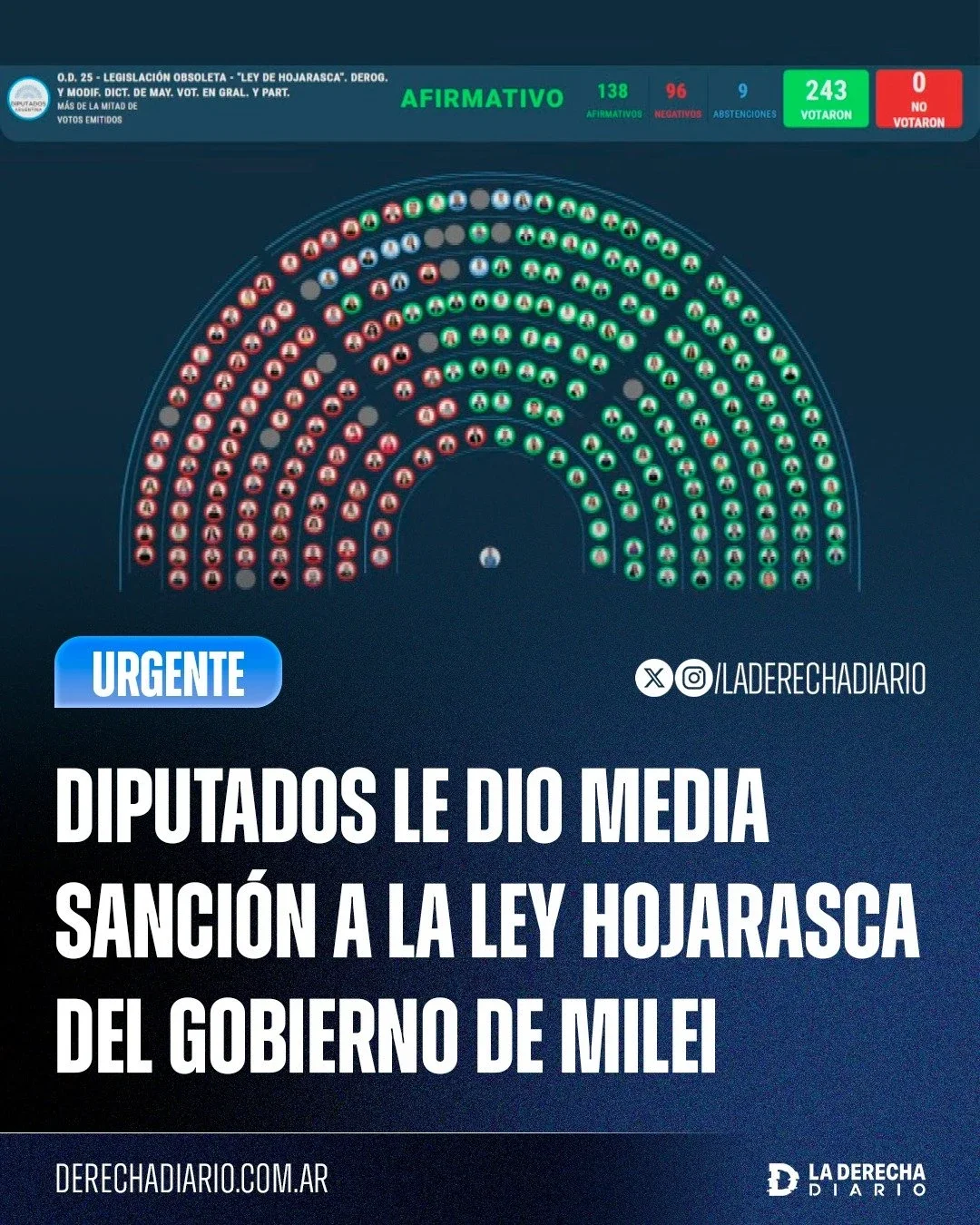
This Wednesday, the Chamber of Deputies gave preliminary approval to the so-called "Leaf Law", an initiative promoted by Minister Federico Sturzenegger aimed at eliminating dozens of obsolete laws and simplifying the Argentine regulatory framework.
With this preliminary approval, the government of Javier Milei seeks to advance one of its key projects for deregulating the State.
The vote recorded 138 affirmative votes, 96 negative votes, and 9 abstentions, reflecting significant support for a proposal that aims to modernize the country's legal framework.
The voting.
The Milei government's project promotes legal certainty and eliminates unnecessary barriers for economic and social development, based on a central principle: anything not prohibited by the National Constitution should not require a specific law.
The initiative proposes to repeal regulations that, in many cases, created bureaucratic structures and unnecessary expenses for the State.
Among them are laws that gave rise to agencies such as the Argentine Federation of Municipalities, identified by the government as examples of structures that increased spending without providing concrete solutions.
President Javier Milei.
One of the most notable aspects of the project is its goal to “clean up” the Argentine legal system. Many of the laws affected by this review were enacted during de facto governments, such as those of Jorge Rafael Videla, Juan Carlos Onganía, Reynaldo Bignone, and Agustín Lanusse, among others.
However, it also includes regulations promoted during democratic periods, during the presidencies of Raúl Alfonsín, Cristina Fernández de Kirchner, Néstor Kirchner, and Juan Domingo Perón.
The government of Javier Milei emphasized that this reform represents a fundamental step towards a more agile, efficient, and aligned State with current needs, leaving behind regulations that have become obsolete or that directly hindered private initiative.
With the preliminary approval already obtained in the Chamber of Deputies, the project must now be addressed in the Senate, where the ruling party will seek to turn one of the central pieces of its structural transformation program into law.