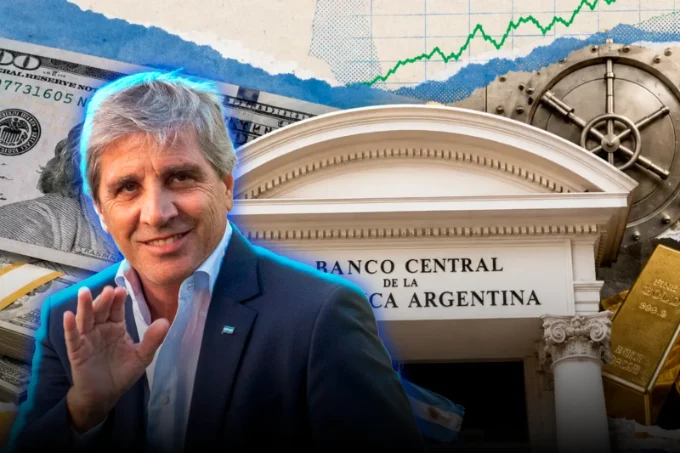
The Economy rescued Non-Transferable Bills held by the BCRA for USD 781 million and removed them from the public debt records. The securities had been issued since 2006 to support the use of reserves in the payment of Treasury obligations
To eliminate the financial wreckage inherited from populism, the National Government led by Javier Milei dealt a new blow to the stock of spurious debt that was suffocating the Central Bank of the Argentine Republic (BCRA). The Ministry of Economy officially announced the repurchase of Non-Transferable Bills for a total of USD 781 million to the monetary authority.
The operation, executed on Monday, August 10, 2026, was formalized by Joint Resolution 47/2026 from the Secretariat of Finance and the Secretariat of Treasury in the Official Gazette on Tuesday, August 11, 2026. The Ministry of Treasury emphasized that “the titles received from the operation will be removed from the public debt records”. This reduces state commitments and frees the central bank from instruments with no market value.
Bausilli, Milei, and Caputo
The Non-Transferable Bills emerged in January 2006, to compensate the Central Bank for delivering reserves intended to pay the International Monetary Fund (IMF). The operation consisted of covering liabilities of the National Treasury using reserves from the BCRA.
This mechanism became systematic. According to estimates from the current administration, between 2003 and 2023, the National Treasury received the astronomical sum of USD 116 billion via Non-Transferable Bills. In the financial realm, these Bills are viewed as assets of "uncertain value", as they cannot be sold or traded in the secondary market, offer low or no returns, and tend to be automatically renewed.
This mechanism caused what the Ministry of Treasury described emphatically: “It is worth remembering that the Non-Transferable Bills were placed with the BCRA as a counterpart for the use of international reserves by the Treasury, in a context of chronic fiscal deficit and closure of voluntary capital markets. This implied a significant accumulated deterioration in the BCRA's assets, replacing a liquid and valuable asset (dollar) with another illiquid and worthless asset, with net reserves that at the beginning of December 2023 were negative by more than USD 11 billion”.
In detail, the National Treasury rescued two specific debt instruments that were lying in the BCRA's portfolio:
A bill with a maturity scheduled for June 30, 2031, with an original nominal value of USD 76,248,473.
A bill with a maturity set for April 20, 2032, with an original nominal value of USD 1,226,343,706.
The president, Javier Milei
The price paid for each was set according to the usual market mechanisms, ensuring the transparency of every cent used in this liability management operation.
This victory continues the plan of Luis Caputo and Santiago Bausili. In May, the ministry of Luis Caputo already made a similar move after receiving $24.4 trillion in dividends from the entity led by Santiago Bausili for the fiscal year 2025.
At that time, the economic portfolio used $18.4 trillion for the repurchase of Non-Transferable Bills in the BCRA's portfolio for a total of USD 21.7 billion in original nominal value. According to the Ministry of Economy, the operation reduced the gross debt of the National Treasury by approximately 3.3% of Gross Domestic Product (GDP). A year earlier, the Central Bank had already obtained USD 12 billion in cash from the total cancellation of bills maturing on June 1, 2025 and April 29, 2026, as well as from the partial cancellation of a title maturing on April 3, 2029, with funds from the USD 20 billion agreement with the IMF.
The cleaning up of the balance sheet is the prelude to substantive reforms. The ruling party will seek to approve a modification to the Organic Charter of the entity that contemplates the elimination of these titles and prohibits the Treasury from transferring this type of titles to the Central Bank as a way to obtain international reserves. This reform will be ready to be addressed on August 26 in Congress.
Milei and Caputo
On the same date, the ruling party will advance in the Chamber of Deputies with the Fiscal Innocence II project. Meanwhile, voices from the old school like the CEO of ABECEB, Mariana Camino, cautiously warn about an economy with two speeds, stating that “There will be no political or social legitimacy if everything does not converge”.
However, the reality of the markets demonstrates the robustness of the economic program. Despite external fluctuations that caused a 3% drop in the S&P Merval, declines of up to 6% in Argentine stocks on Wall Street, and an increase in country risk to 466 points, confidence in the peso is total. The wholesale dollar ended offered at $1,490.50, its lowest value so far in August, while to the public it dropped to $1,515 for sale at the Banco Nación, consolidating the libertarian course.