The Minister of State Deregulation and Transformation, Federico Sturzenegger, revealed that the draft “Law on the Inviolability of Private Property”, promoted by the Government of Javier Milei, could generate investments of almost 15 billion dollars in different productive sectors of the country.
The million-dollar investments will come as a result of the removal of restrictions and regulations that limited economic growth for decades.
In an article written in Clarín, the official stated that “we had simply banned growth”, referring to the set of regulations that prevented the development of economic activities in which Argentina had advantages.
As he explained, the Government's current strategy seeks to reverse this scenario through deregulation and opening up to new investments.
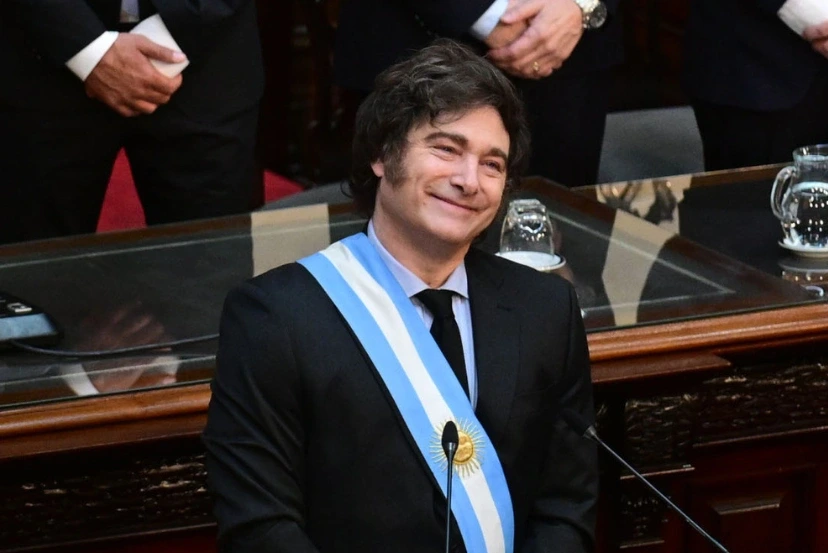
President Javier Milei.
One of the central axes of this process is the reform of the Glacier Law, which will make it possible to move forward with large scale mining projects. At the same time, the Minister of Economy, Luis “Toto” Caputo, estimated mining exports of 165 billion dollars over the next ten years, consolidating the sector as one of the main poles of attracting
capital.
In turn, the possible partial repeal of Land Law 26,737 appears as another key factor. According to Sturzenegger, these regulations restricted foreign investment by limiting the purchase of land and hampering partnerships between local landowners and external investors, which reduced productive potential in various regions.
Potential investments
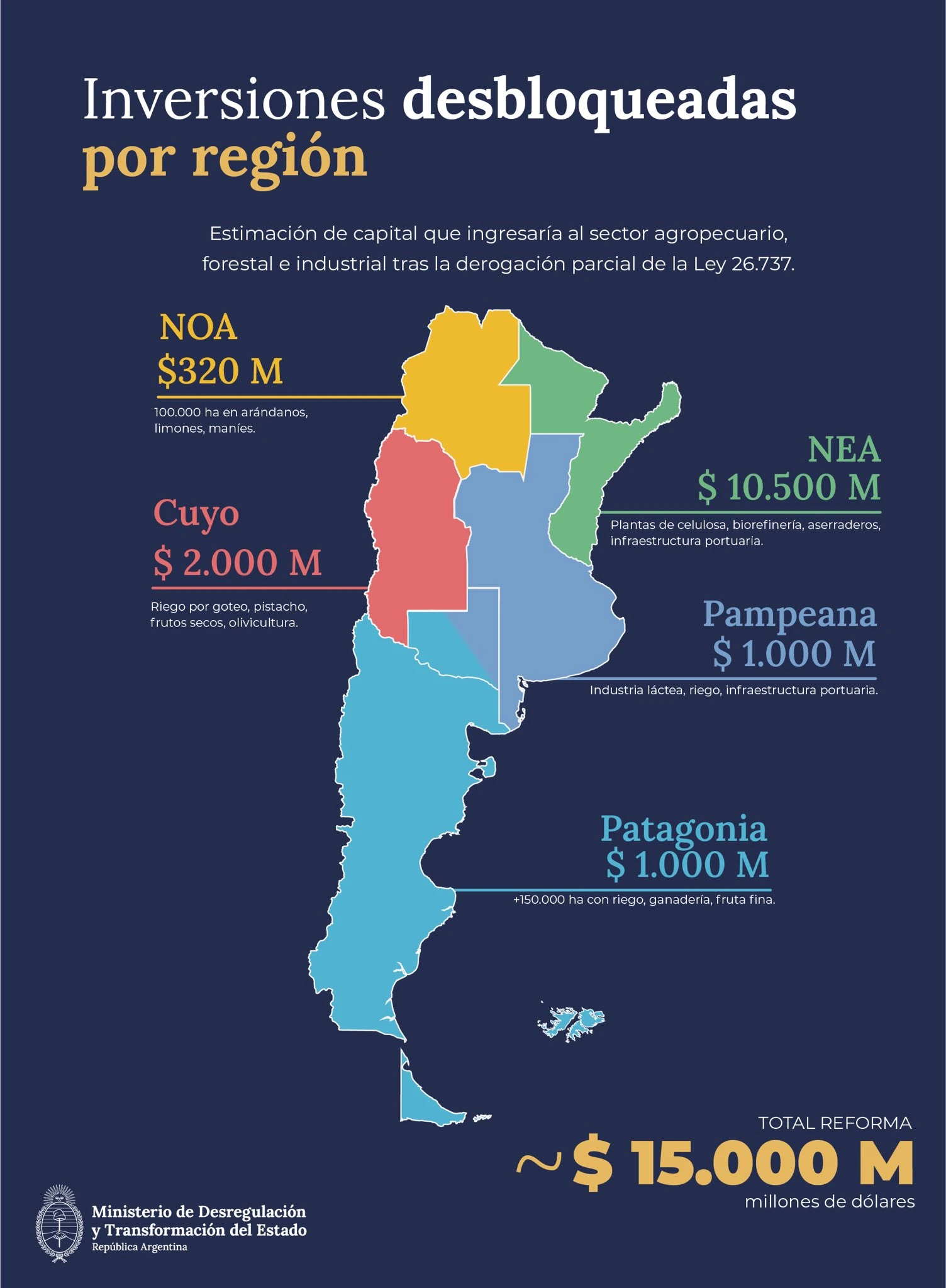
In northeastern Argentina (NEA), comprised of Misiones, Entre Ríos and Corrientes, an investment volume of 10.5 billion dollars is projected
.
Planned developments include two Fluff/BSKP/DP pulp mills for 2.2 billion dollars each, two Kraftliner pulp mills for 1.5 billioneach, investments in sawmills for 300 million, a biorefinery for 2.5 billion and port works for 300 million.
Potential investments.
In addition, in Chaco, investments are anticipated in the cotton sector and in a port in Barranqueras, with the objective of transforming the province's logistics capacity
.
In the Northwest (NOA), which encompasses Catamarca, Tucumán, Salta and Jujuy, the projected investments amount to 320 million dollars, destined for irrigation and industrialization on about 100,000 hectares, with developments in productions such as blueberries, lemons, livestock and legumes.
For its part, the Pampas region could raise nearly $1 billion in projects related to the dairy industry, irrigation systems and port infrastructure, boosting agricultural and livestock production.
In Cuyo, investments would exceed 2 billion dollars, aimed at the development of crops such as pistachio, nuts and olive trees, with a focus on drip irrigation, water reservoirs and processing plants on more than 100,000 hectares.
Finally, Patagonia, including La Pampa, Rio Negro, Chubut and Santa Cruz, could receive more than $1 billion in initiatives related to agricultural development with irrigation, livestock and intensive crops in fertile valleys.
In this context, Sturzenegger remarked that “we must only leave behind the fears and interests that had condemned us to the poverty and decline to which Kirchnerism had led us”, and concluded: “Today is a time to reaffirm the challenge of progress that this government of Javier Milei had sinceday one. Argentina will be prosperous. VLLC! ”.