This result is mainly explained by the fall in liabilities held by the Central Bank, an entity chaired by Santiago Bausili, which fell by almost USD 56,000 million, offset by an increase in gross debt of USD 28,475 million.





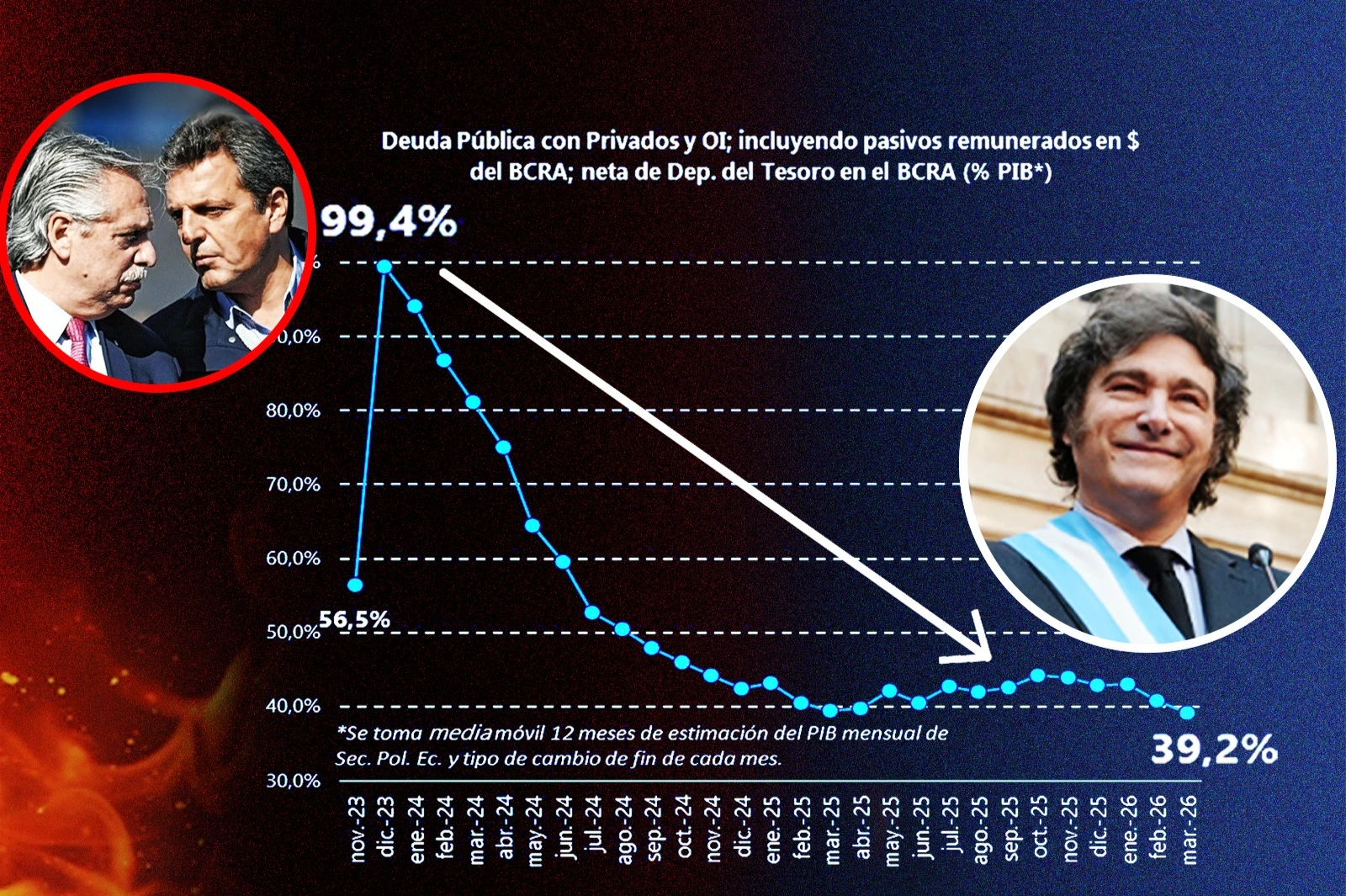

A study carried out demonstrates the sharp fall in debt thanks to the elimination of the fiscal deficit and macroeconomic stability.
This result is mainly explained by the fall in liabilities held by the Central Bank, an entity chaired by Santiago Bausili, which fell by almost USD 56,000 million, offset by an increase in gross debt of USD 28,475 million.





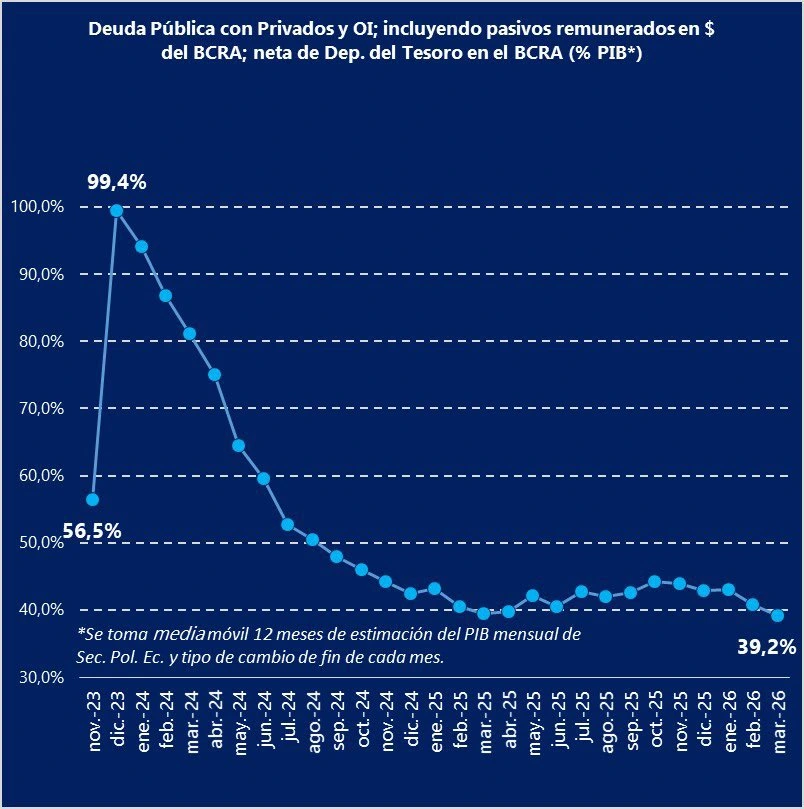
The evolution of public debt in Argentina has shown a marked downward trend since the inauguration of President Javier Milei, according to data that analyze consolidated net debt as a percentage of Gross Domestic Product (GDP).
The indicator, which includes the liabilities paid in pesos of the Central Bank of the Argentine Republic and discounts Treasury deposits, shows a significant drop in just over two years.
According to a study carried out, the level of indebtedness towards the end of 2023, during the last month of Kirchnerism's government, reached 99.4% of GDP. However, after two years of Milei's administration, the report places it at around 39.2% by March 2026
.
This enormous reduction reflects a sustained change in debt dynamics, in line with the economic strategy promoted by the current Government to eliminate the fiscal deficit and defend the "surplus
”.In this context, the Minister of Economy, Luis “Toto” Caputo, spoke about the trend through social networks, where he stated: “And it will continue to fall...”, referring to the report and the continuing decline in the relative weight of debt.
other hand, data from November 2025 also allow us to analyze the evolution of debt in nominal terms. If we consider the liabilities of the BCRA, between November 2023 and September 2025, public debt fell by USD 27,486
Expanding the historical view, the comparative data show significant differences compared to previous efforts. During the two terms of the corrupt Cristina Fernández de Kirchner, debt measured under this methodology increased by USD 101.9 billion, driven by an increase of USD 81.9 billion in gross debt and USD 20 billion in
BCRA liabilities.
Under Mauricio Macri's administration, the increase was USD 32,54 billion, as a result of an increase of USD 53,650 million in gross debt, partially offset by a reduction of USD
21.1 billion in Central Bank liabilities.On the other hand, during Alberto Fernández's administration, debt registered a significant increase of USD 164,878 million, explained by an increase of USD 112.2 billion in gross debt and USD 52.6 billion in BCRA liabilities.
Finally, if we consider a methodology that excludes the public sector and incorporates both the liabilities of the Central Bank and the evolution of net reserves, so far in the management of Milei, there has been a drop of approximately USD 35 billion.
The evolution of these indicators is a reflection of the ongoing macroeconomic ordering process, with a focus on the reduction of indebtedness and the consolidation of the Central Bank's balance sheet.