Another central point is the return of the radio spectrum. Telecom must return a total of 130 MHz, including an immediate return of 60 MHz nationwide, additional returns in high concentration areas, and the allocation of the remainder to the secondary market.
The national government won a key showdown against Grupo Clarín and harshly conditioned the acquisition of Telefónica Móviles Argentina by Telecom. The operation, which could leave nearly 70% of telecommunications services in the hands of a single economic group, built on the historical state benefit, can only move forward if the company accepts a strong package of legal demands.
The decision was made by the Competition Defense Tribunal, the decision-making body of the National Competition Authority, based on a technical report prepared by ENACOM. The official goal is to prevent the formation of a monopoly that harms users, limits competition, and closes the market to new operators.
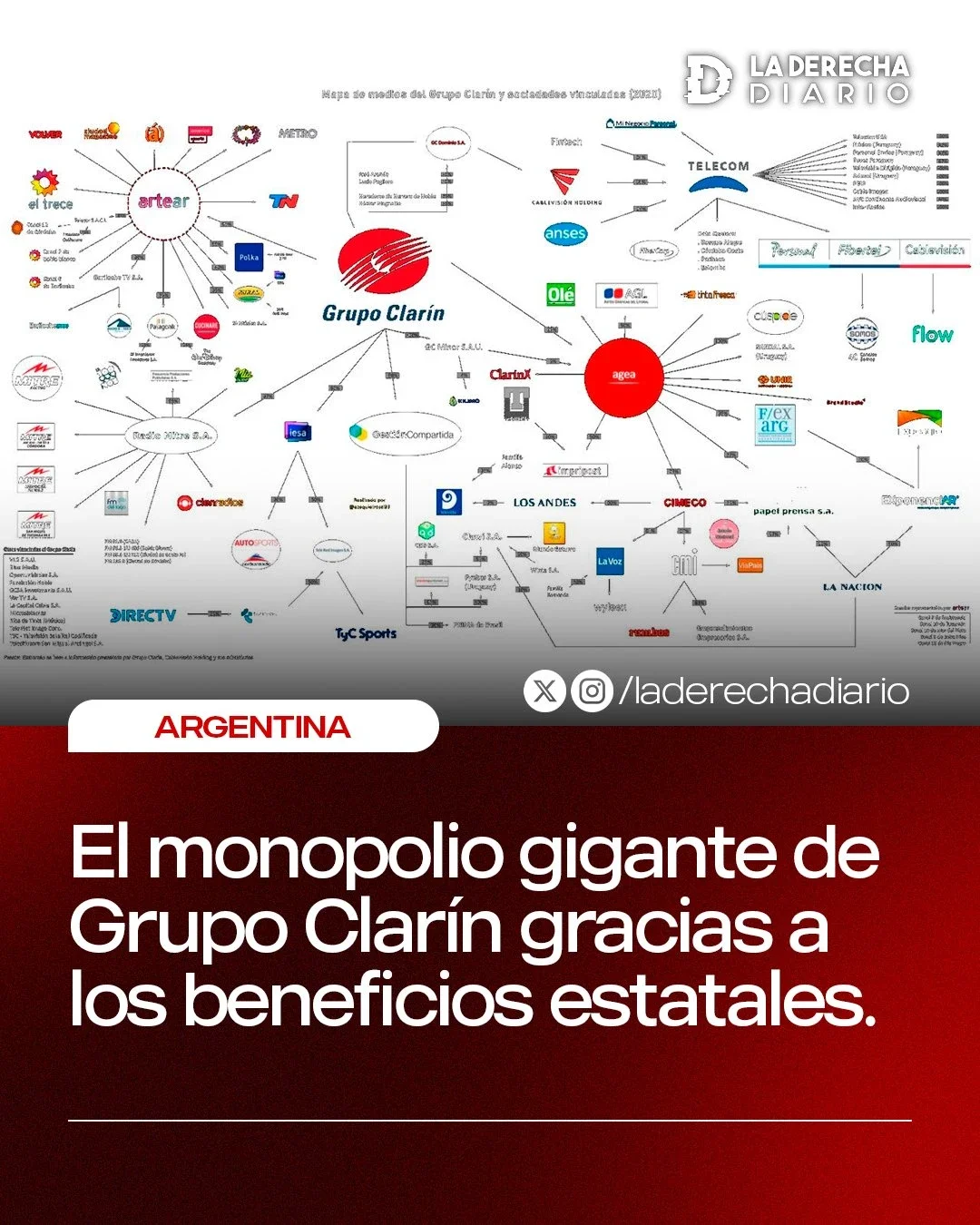
The monopoly map of Clarin built on the basis of state benefits
The main condition imposed on Telecom is the divestment of nearly 50% of its mobile portfolio. The company must relinquish 6 million customers, along with the associated infrastructure, distributed among AMBA, the Northern Region, and the Southern Region, to a new competitor in the sector.
Additionally, the government will require Telecom to guarantee that new operator access to infrastructure, spectrum, systems, and interconnection conditions for 2 years. The aim is for the transfer to be real and for the new player to provide service while developing its own network.
In all locations where the resulting company exceeds 50% retail market share in fixed internet, Telecom will have to cede customers to competitors. With these measures, the government seeks to prevent an unnatural dominant position that affects prices, service quality, and investment.
The national government won the standoff against Grupo Clarín and imposed strict conditions on the acquisition by Telecom.
The maneuver exposed the power accumulated by Grupo Clarín, a business giant that for decades grew under the umbrella of state benefits, tailored regulations, and privileged ties to politics. With Telecom, the holding sought to advance to a decisive position in mobile telephony, fixed telephony, internet, and pay television.
However, the government set a limit: if Clarín wants to keep Telefónica, it must give up millions of users, infrastructure, and radio spectrum. Otherwise, the operation will be rejected.