
The European Commission classified Argentine soy as a "high iLUC risk" crop, which excluded national soybean biodiesel from the EU renewable energy mandates
Agregar La Derecha Diario en
Compartir:
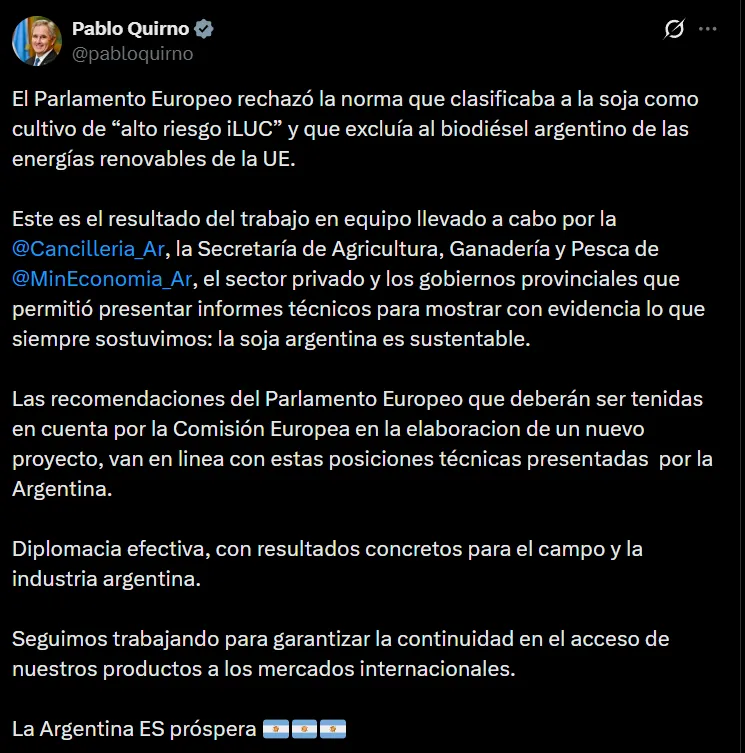
In excellent news for the agricultural sector, the oil industry, and Argentine exports, the European Parliament rejected on Wednesday, July 8, 2026, the changes proposed by the European Commission that classified Argentine soy as a “high iLUC risk” crop (indirect land use change).
This measure, had it succeeded, would have excluded national soy biodiesel from the EU's renewable energy mandates, jeopardizing a business worth hundreds of millions of dollars.
Chancellor Pablo Quirno summarized it clearly: “This is the result of the teamwork carried out by the Foreign Ministry, the Secretariat of Agriculture, Livestock and Fisheries, the private sector, and provincial governments”.
Thanks to solid technical reports demonstrating the sustainability of Argentine soy, the European Parliament aligned its recommendations with the position defended by our country. Now the European Commission must rewrite the regulation taking these guidelines into account.
A victory for serious and effective diplomacy
This decision represents a concrete relief for a key sector. Between 2018 and 2025, 97% of Argentine biodiesel exports were destined for the European Union. In 2025 alone, around 280,000 tons were sent for about US$350 million, plus another US$50 million in soy oil. Maintaining that access means preserving jobs, foreign currency, and activity in the productive interior.
Gustavo Idígoras, president of the Argentine Oil Industry Chamber (CIARA), celebrated: “This is great news. A successful public-private management from Argentina.”

The sector highlighted the sustained work of recent months with MEPs, member states, and the Commission itself, which included technical documentation and high-level meetings.
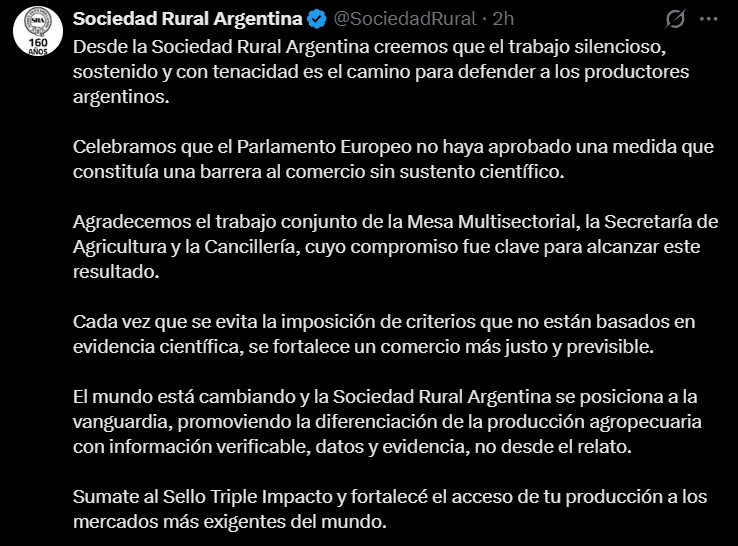
The Argentine Rural Society also valued the outcome: “Silent, sustained, and tenacious work is the way to defend Argentine producers”.
The paradigm shift under Milei
This achievement is not coincidental. It reflects the approach of Javier Milei's government: firm defense of Argentine interests in the world, public-private articulation without ideologies, and diplomacy based on evidence and concrete results, not on empty speeches.
While work continues to ensure that the new wording of the regulation explicitly recognizes Argentine soy as a sustainable raw material (without risk of land use change), the message is clear: Argentina is prosperous and ready to compete and win in international markets.