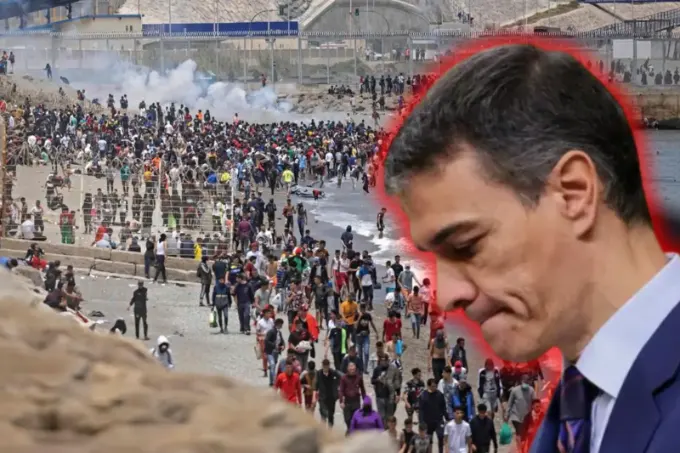
Hundreds of immigrants, mostly Muslims from sub-Saharan Africa, attempted this Saturday to advance from Morocco to the Spanish city of Ceuta to settle irregularly in European territory, amid a new day of migratory tension just two weeks after the mass crossing recorded at the end of July.
The groups had gathered in the vicinity of Fnideq, known in Spanish as Castillejos, the last Moroccan locality before the border with Ceuta. Some of the invaders remained hidden in mountainous areas and later descended towards the border with Spain.
For the moment, Moroccan security forces deployed riot units and blocked the advance. During the operations, police charges, tear gas, and scuffles were reported with those trying to continue towards the border.
According to security sources cited by local media, 294 people were detained, including 248 sub-Saharan immigrants and 46 Moroccan citizens. In addition, authorities reported another 61 arrests related to the alleged promotion of illegal crossings via social media.
The new attempt had been called in recent days through Facebook, WhatsApp, and TikTok, where messages circulated calling for a gathering on August 15 to attempt a mass entry into Ceuta, both by land and by swimming.
In light of the warnings and the scandal triggered by the authorities' indifference during the last invasion, Spain and Morocco mobilized around 7,000 personnel on both sides of the border. On the Spanish side, nearly 4,000 members of the National Police, Civil Guard, riot units, and Armed Forces were deployed, while Morocco allocated approximately 3,000 agents, in addition to drones, mobile units, and maritime surveillance.
The operation took place after the serious crisis of July 30, when tens of thousands of people crossed from Morocco to Ceuta, inspired by the lax migration policy of Spanish socialism. Thousands subsequently remained in Spanish territory, and the infrastructure designated for accommodation and asylum applications came under heavy pressure.
The situation once again placed the migration policy of the socialist Government Pedro Sánchez at the center of the debate, who had only weeks earlier advanced with a mass regularization of immigrants. The crisis also caused tensions within Europe and led Italy to strengthen controls on travelers coming from Spain.
For now, the deployment prevented the groups advancing from Castillejos from reaching Ceuta en masse, although the mobilization once again highlighted the growing pressure on one of the main land borders between Africa and the European Union.