
Hydrogen stack at 250 °C without water: the Australian breakthrough that changes the rules

Hydrogen stack at 250 °C without water: the Australian breakthrough that changes the rules
Imagen de Editorial Team
porEditorial Team
Argentina

Researchers at Monash University have created an ultrathin membrane that allows fuel cells to operate at high temperatures without hydration, paving the way for simpler, cheaper, and more efficient systems.

Add La Derecha Diario on
Share:

A team of researchers from Monash University in Australia has made a significant breakthrough in hydrogen fuel cell technology. They developed an ultrathin membrane that operates at 250 °C without needing a drop of water, solving an obstacle that has hindered the development of this technology for decades.

Hydrogen fuel cells represent one of the most promising alternatives for decarbonizing sectors such as heavy transport and industry, where traditional electric batteries have limitations. These cells emit only water and heat, recharge quickly, and offer a range similar to that of fossil fuels.

However, conventional membranes, such as those based on Nafion, need to be constantly hydrated to allow the passage of protons. This limits their operation to temperatures below 80-100 °C, as water evaporates at higher temperatures and the system fails.

The new GBP membrane

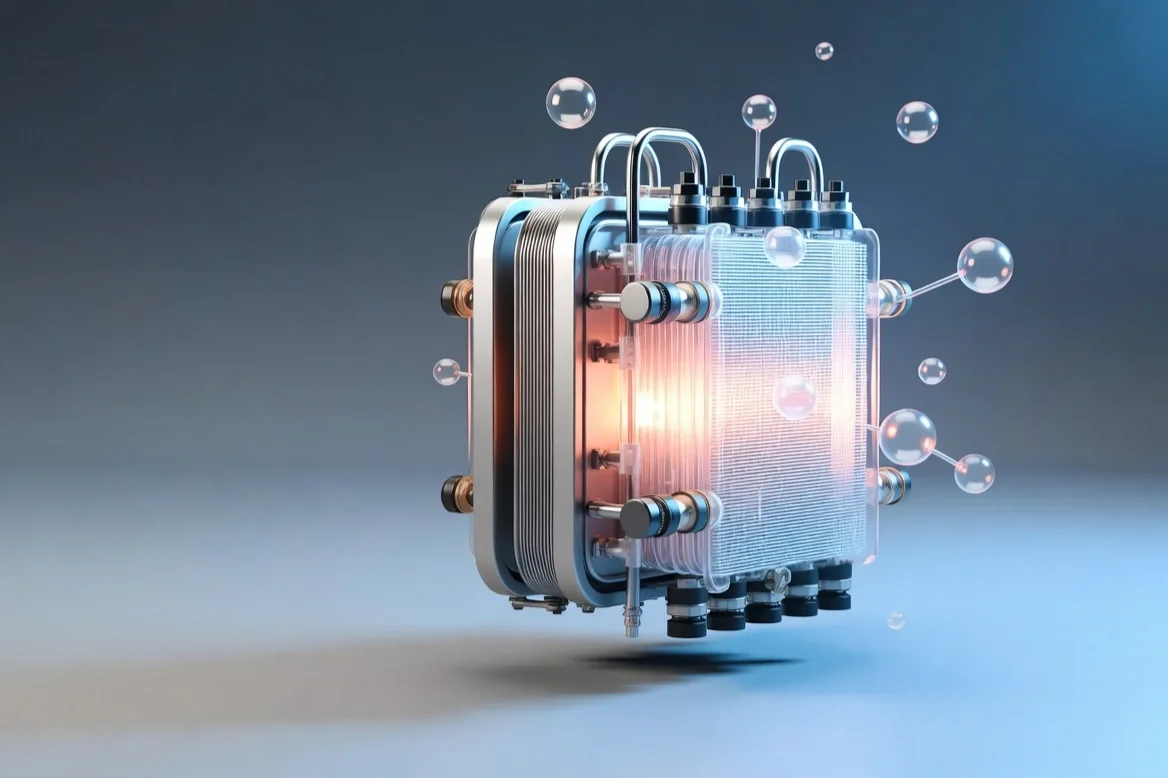
The scientists, led by Huanting Wang and Kaiqiang He, created atomic-thin nanosheets using graphene and boron nitride. In those spaces, they introduced phosphoric acid in a nanoconfined state, preventing it from evaporating even at high temperatures. The result is a membrane of just 50 micrometers called GBP.
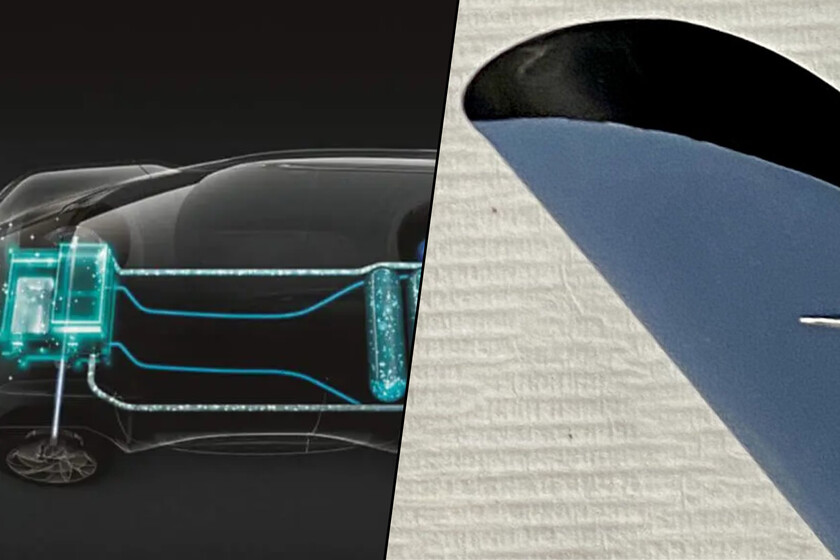
A hydrogen fuel cell that operates at 250 °C without a drop of water: researchers solve a problem that has been stuck for decades

This membrane acts as a "dry highway" for protons, which move with great efficiency without relying on water. Wang explained that they combined conductive nanosheets with nanoconfined phosphoric acid to maintain rapid proton transport in dry conditions.

The mechanism is synergistic: protons traverse the hexagonal rings of graphene and boron nitride while hopping through the hydrogen bond network of the confined acid between the layers. This combination ensures high conductivity and stability.


Impressive results in tests

In laboratory tests, the GBP membrane achieved a proton conductivity of 166 mS cm⁻¹ at 250 °C and a power density of 1.011 mW cm⁻² in a hydrogen-oxygen fuel cell. Additionally, it operated for 150 continuous hours without showing degradation.

These numbers far exceed those of traditional membranes in the sector. Operating at 250 °C eliminates the need for complex humidification and water management systems, which currently add weight, volume, and cost to vehicles.

Another key benefit is that at this temperature, the platinum catalyst better tolerates impurities such as carbon monoxide. This would allow the use of less pure and more cost-effective hydrogen. It also facilitates cooling, allowing for smaller radiators and lighter vehicles.

Applications beyond the automobile

The technology was also tested in direct methanol fuel cells, where it reached 502 mW cm⁻² with concentrated methanol at 250 °C. This makes it attractive for portable systems where storing hydrogen is complicated.

The researchers point to potential uses in data centers, airplanes, trains, factories, and hospitals as energy backup. Additionally, it could be applied in electrochemical processes such as water splitting, carbon dioxide reduction, or ammonia synthesis.

If scaled industrially, this innovation could accelerate the adoption of hydrogen fuel cells in sectors where battery electrification does not quite fit. The next step is to move from research to viable commercialization.

This development published in Science Advances marks a turning point in the search for more efficient and sustainable energy solutions for the future.


La Derecha Diario logo
TwitterInstagramYouTubeTikTokFacebook
Derecha Diario TV

Nosotros

  • Quienes Somos
  • Autores
  • Donar

Privacidad

  • Protección de datos
  • Canales
  • Sitemap
  • RSS

Contacto

  • info@derechadiario.com.ar
PUBLICIDAD
La Derecha Diario logoLa Derecha Diario logo
ESX logoInstagram logoYouTube logoTikTok logoFacebook
ARGENTINAUNITED STATESECUADORISRAELMEXICODERECHA DIARIO TV
  • ES
    XInstagramYouTubeTikTokFacebook
  • DERECHA DIARIO TV
  • Sections
  • ARGENTINA
  • UNITED STATES
  • ECUADOR
  • ISRAEL
  • MEXICO
  • URUGUAY
  • Countries
  • La Derecha Diario logoLA DERECHA DIARIO
  • La Derecha Diario México logoLA DERECHA DIARIO MÉXICO
  • La Derecha Diario Uruguay logoLA DERECHA DIARIO URUGUAY
  • La Derecha Diario Ecuador logoLA DERECHA DIARIO ECUADOR
  • La Derecha Diario Israel logoLA DERECHA DIARIO ISRAEL
  • La Derecha Diario Estados Unidos logoLA DERECHA DIARIO ESTADOS UNIDOS
  • Topics
  • GUERRA EN IRÁN
  • The Newspaper
  • QUIENES SOMOS
  • AUTORES
  • PUBLICIDAD
  • DONAR

Related news

“I'm Kuka”: a defendant in the Fake Invoices case admitted how he received money from the State

“I'm Kuka”: a defendant in the Fake Invoices case admitted how he received money from the State

The Milei Government adhered to the Geneva Consensus in defense of life and family

The Milei Government adhered to the Geneva Consensus in defense of life and family

Ford advances in the transformation of its Kentucky plant to manufacture the electric truck Fathom

Ford advances in the transformation of its Kentucky plant to manufacture the electric truck Fathom

Leftist killer Luigi Mangione is expected to plead guilty tomorrow in the hope of avoiding a life sentence

Leftist killer Luigi Mangione is expected to plead guilty tomorrow in the hope of avoiding a life sentence

Trump analyzes options to succeed Karoline Leavitt: Alina Habba and Matthew Boyle, the top candidates

Trump analyzes options to succeed Karoline Leavitt: Alina Habba and Matthew Boyle, the top candidates

Democrat Gavin Newsom imposes a road tax in Fresno and sparks a battle for local autonomy

Democrat Gavin Newsom imposes a road tax in Fresno and sparks a battle for local autonomy