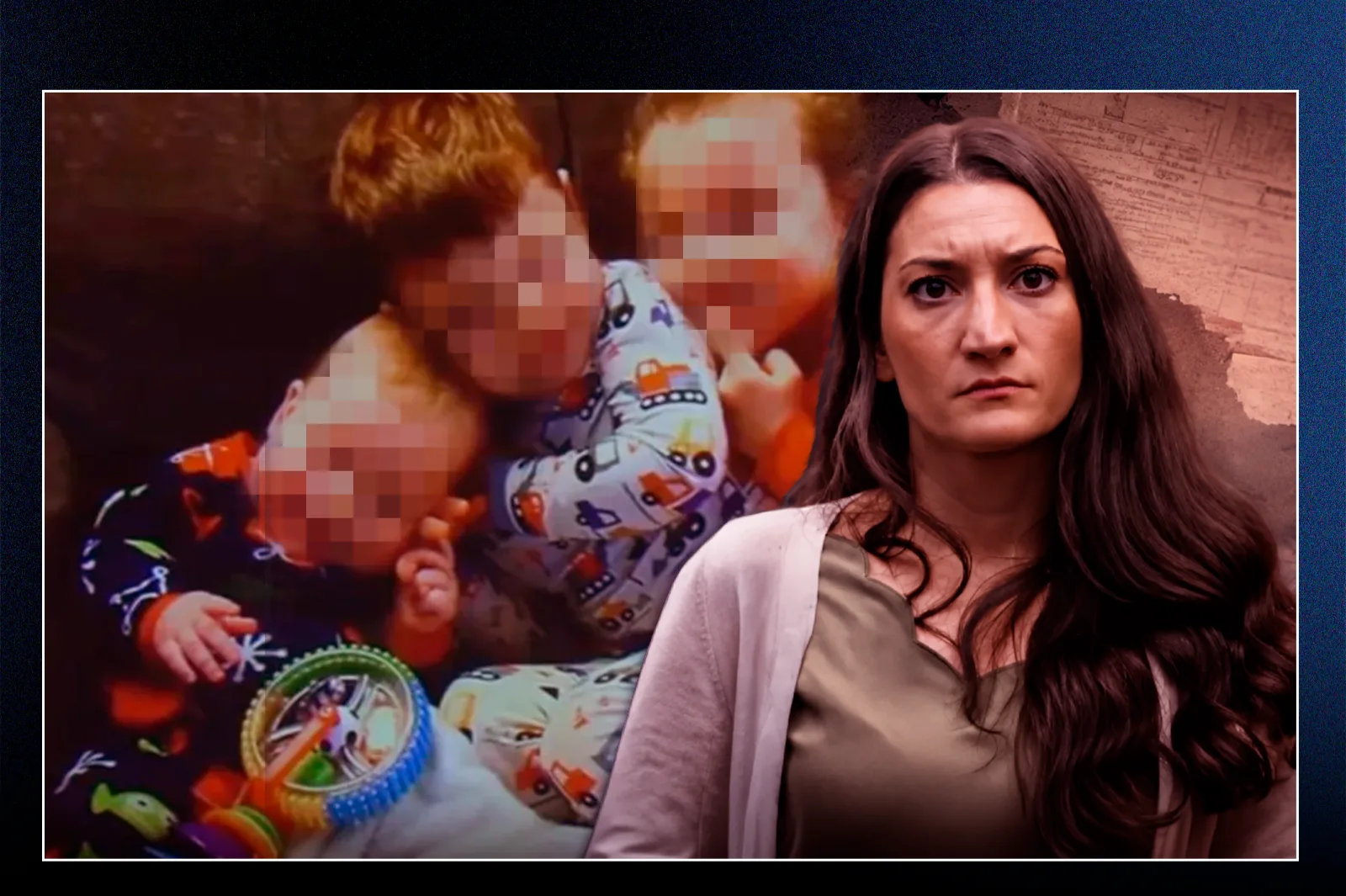
Cora was five years old. Dawson was three. Callan was eight months. On January 24, 2023, in a house in Duxbury, Massachusetts, their mother strangled all three of them, one after the other, and then jumped out of a second-floor window.
This week, the trial against Lindsay Clancy entered its final phase. The prosecution closed its case on Monday; the defense closed its case on Friday. Rebuttal witnesses, closing arguments, and jury deliberation are still pending. There is no verdict, and nothing that follows is intended to anticipate it.
But there is one fact that does not depend on the jury, because neither side disputes it: Clancy's lawyers do not deny that she killed her children. Her defense does not claim innocence; it claims insanity. It argues that a postpartum psychosis, exacerbated by disastrous psychiatric treatment, prevented her from understanding what she was doing. The only thing the jury must decide is whether she was criminally responsible at that moment. She admits her authorship through her lawyers.
It is important to establish this point before proceeding, because it is exactly what collides with the most disturbing phenomenon of this trial, which is not in the courtroom but outside: the transformation of a child killer into a heroine.
The Faith
In front of the court, hundreds of women gathered to support her. On TikTok, thousands of videos labeled "Same, Lindsay" circulate, where mothers share that they too have had thoughts of harming their children, using as identification material the personal diary entries read during the hearing. A fundraiser linked to the family surpassed one million dollars; according to the latest figures, it approaches 1.8 million, contributed by over 57,000 people. And a theory circulates, without a single piece of evidence, that the real murderer was the husband.
Calling this rampant feminism is accurate but falls short, because it does not explain its form. And the form is unmistakable: this is a religion.
It has a dogma, prior to any evidence and safe from it: the woman is never the perpetrator. It has a sacrament, the donation, which functions exactly like a medieval indulgence — I pay, then I belong to the side of the good. It has a heresy, which is suggesting that a mother could be guilty of anything. It has martyrs, it has liturgy, and it has public confession. And it has, because every religion of this kind needs it, a demon: if she could not have done it, someone had to have done it, and that someone is the widower who buried his three children. The accusation against him does not arise from any evidence. It arises from a theological need.
A creed like this is not discussed with data because it was not built with data. That is why its followers can contradict Clancy's own lawyers without even noticing the contradiction:
The lawyers are litigating a case; they are professing a faith. And that is why neither of the two possible answers from the jury will move their position even a centimeter, as we will see in the end.
Where It Comes From
It is worth asking where this came from, because it did not come from nowhere and it will not go away on its own.
The first answer is the oldest: the religious appetite does not disappear when churches empty; it relocates. The need to belong to a chosen body, to have sins and absolutions, to identify a demon, and to feel that one is on the right side of a cosmic war predates any catechism and survives them all. An entire generation was educated in the idea that this apparatus was superstition and was left with the intact apparatus and no object. These are the temples it found.
The second is more uncomfortable and more specific. In recent decades, an idea has taken hold that now functions as currency: moral authority is not earned by conduct but inherited by belonging to a category. If innocence comes with the card and not with actions, then each member of the group has a direct interest in ensuring that no other member can be guilty of anything, because each guilty party devalues the possession of all. Viewed this way, the defense of Lindsay Clancy is not an act of compassion towards Lindsay Clancy. It is the defense of the exchange rate. What is at stake for these women is not this woman: it is the premise that they cannot be authors of anything bad, and that premise does not allow for a single exception, because one alone collapses it.
The third is technical. Platforms distribute attention, and attention rewards proximity to the extreme. Saying "me too" in the face of infanticide is the cheapest move available to gain a status that in real life takes years. Added to this is a therapeutic culture that has taken clinical vocabulary out of the office and turned it into identity: intrusive thoughts have ceased to be a symptom one takes to a doctor and have become a credential one displays in a video. The result is this new and hard-to-name thing, women who publicize themselves as potential murderers of their own children to belong to something.
What It Costs
None of this would be more than a grotesque spectacle if it were limited to the screen. It is not limited.
It costs, first, the very possibility of justice. If a category of people cannot be guilty, trials cease to be trials and become census procedures: the sentence is deduced from the accused's card. There is no need to explain to an Argentine reader where that leads. A court that distributes blame by belonging is not a court; it is a distribution of political power by other means.
It costs, second, concrete individuals. A faith that needs a demon manufactures one, and it does not manufacture it with theoretical material: it manufactures it with a man who buried his three children and whom tens of thousands of strangers accuse of having killed them. That man committed no crime and is not being judged for any. He is being judged by the narrative need of people who have never seen him.
It costs, third — and this should be especially considered by those who claim to defend mothers — the credibility of postpartum psychosis. It is a real, devastating, and underdiagnosed condition. That this trial puts under scrutiny thirteen psychotropic medications prescribed in four months by six different professionals is one of the few good things that the case can leave behind. But turning the diagnosis into a collective excuse, into a hashtag that anyone can wear, guarantees that the next woman who arrives at an emergency room saying she hears voices will be listened to with a little less seriousness. The activism is not protecting sick mothers. It is wearing them out.
And it costs, above all, what this case shows with an almost unbearable clarity: in a society where the status of victim is claimed, those who cannot claim anything are left last. An eight-month-old child has no political identity, has no account, cannot film a video explaining his victim status, cannot belong to any protected category. In a culture that distributes moral credit according to who raises their hand the highest, the three children from Duxbury are, structurally, the last in line. That is why almost no one talks about them. It is not an oversight: it is the predictable result of the system.
It is worth saying something more, because the point lends itself to confusion. This is not a generic problem of women. It is the problem of a doctrine that claims to speak on their behalf and that, to sustain itself, needs that none of them is ever responsible for anything. The first victims are the women to whom that doctrine denies, by definition, the status of adults. Even if many of them do not even notice it.
The Divide on Our Side
It would be careless not to mention that there was also a shortcut on this side. Clancy's medical record is legitimate material for anyone who distrusts the pharmaceutical industry, and that distrust is reasonable; but a handful of commentators — Candace Owens being the loudest — moved from reasonable suspicion to a premature verdict, declaring that Clancy is "obviously not guilty" without having seen any evidence. It lasted a day: her own camp corrected her within twenty-four hours, from Townhall, and no one followed her. An error does not make a faith. But it helps to understand why the distinction that follows is the only one that truly matters.
A condition is not a puppeteer
Insanity is an ancient and legitimate institution. Criminal law has recognized for centuries that those who could not understand the nature of their act cannot be punished for it, and no serious conservative should mock that. But it is worth understanding why that exemption exists
that exemption exists because the rule is the opposite. The law exempts those who could not understand precisely because it presupposes that all others can. The exception does not deny individual responsibility: it confirms it, marking its boundary. When in 2001 Andrea Yates drowned her five children in Texas, her mental state could be discussed without ever failing to distinguish for a single minute between the victims and the perpetrator.
What has crept into the debate in recent weeks is not that narrow and regulated legal exception. It is a complete anthropology: the idea that behind every act there is a cause that explains it and, therefore, no one is left who has done it. The pill made me do it. Before it was trauma, childhood, poverty, patriarchy, the algorithm. Each of those factors can be real and documented, and none is enough to dissolve the acting subject. A condition is not a puppeteer.
A civilization of agents asks: what did you do with what happened to you? A culture of patients asks: what happened to you for you to do this? The second question may be necessary; what is dangerous is when it replaces the first. Because then we stop looking for circumstances that explain the subject and start looking for circumstances that make him disappear.
All liberal and conservative positions rest on a single premise: that there exists an individual who chooses and is responsible for what he chooses. It is the premise of merit, of property, of contract, of punishment, and of freedom. It is the reason we oppose the State treating adults as minors. Whoever suspends it for a specific case because the outcome suits them does not suspend it for that case: they suspend it entirely.
Two Experts, One Woman, Two Truths
There is an immediate intuition: if she jumped out of a window after killing her children, she understood what she had done. But Massachusetts law allows for another question. Since Commonwealth v. McHoul, a person can be declared insane not only if they lacked substantial capacity to understand the unlawfulness of their conduct but also if they could not adjust their conduct to the law.
And there appears a more interesting problem than any distant diagnosis. Two experts can look at the same woman, the same record, and the same day and reach opposing conclusions about her capacity to answer for her actions. That is exactly what happened in this trial.
The institutional question, then, is inevitable: what kind of criterion have we built if its application depends on expert knowledge that even its own experts cannot share? The doubt does not require knowing what was going on inside Lindsay Clancy's head. It is enough to look at the instrument with which we intend to judge her.