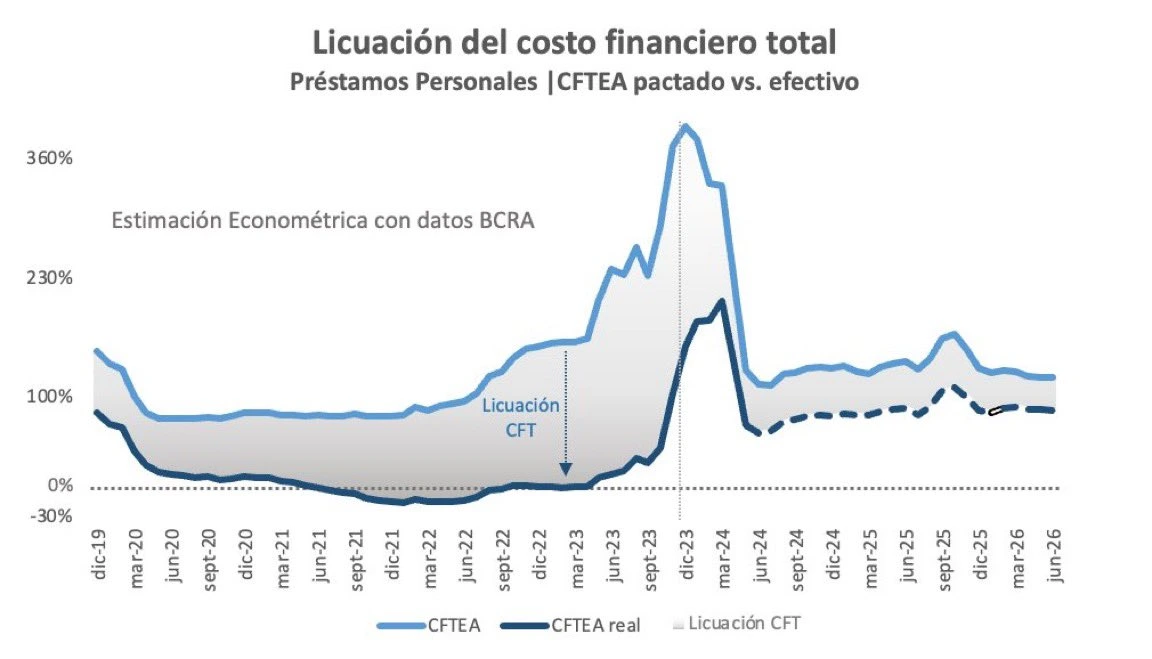
The most significant jump is observed a year later. Those who took or renewed a loan in March 2024 faced a real CFT of 206%, a considerable difference compared to the negative real financial cost recorded just two years earlier.
The evolution shown in the graph indicates that the real financial cost went from negative levels to a strong increase, in a context where inflation stopped reducing the real value of debts.
The consequence is that a debt that could previously lose real weight over time became a much more difficult obligation to meet. The change was not only related to the nominal amount of the installments but also to the modification of the economic conditions that determined how much that debt represented in real terms.
Weights.
The End of Liquidation
During the period of high inflation, the liquidation mechanism also had a consequence on the credit market: those who lent money were the ones who lost, because repayment occurred in a context where the real value of capital was rapidly deteriorating.
This scenario also did not favor the expansion of credit. If lending money implied assuming a significant loss in real terms, there were fewer incentives to provide financing under those conditions.
With the change in regime, the situation changed. Inflation stopped liquidating debts and, at the same time, the financial cost began to represent an effective burden for those who had taken out loans.
The central point, then, is the change in the real weight of obligations. What could be partially offset by very high inflation for years ceased to be so when inflation began to decline and financial conditions changed.
In this new scenario, the installments and the cost of loans ceased to be liquidated by inflation and began to impact much more directly on incomes, a fundamental change that Argentines must take into account for the future.
In the midst of the debate over the increase in debt in Argentina, the change in the economic scenario in recent years largely explains the reasons for this new situation.
During the Kirchner era, with high inflation, those who took out loans could see how the real value of their debts decreased over time. The effect, destructive for savers, was favorable for debtors and detrimental for lenders, as the money repaid had a lower value in real terms.
This mechanism began to change when, following the arrival of the Government of Javier Milei, inflation dropped sharply and, consequently, the financial cost began to weigh much more heavily on incomes.
Money
The result was a change in the conditions of loans that helps explain why an increasing number of debtors began to have difficulties meeting their obligations.
A recent study on the liquidation of the total financial cost of personal loans, developed with an econometric estimate based on data from the BCRA, clearly shows the change recorded between 2019 and 2026.
The most significant data appears when comparing the total financial cost (CFT) agreed upon with its evolution in real terms. On average, a person who took out a loan in March 2022 faced a CFT of 85%. However, in a context of extremely high inflation, that cost ended up transforming into a real financial cost of -15%.
This means that, in real terms, the debtor ended up repaying less capital than they had received. Inflation acted as a mechanism that progressively reduced the weight of the debt, while those who had granted the loans were the ones bearing the loss of real value.
The study
The Deceleration of Inflation
The situation began to change at the end of 2023. By March of that year, the real CFT of loans was already around 1.5%.