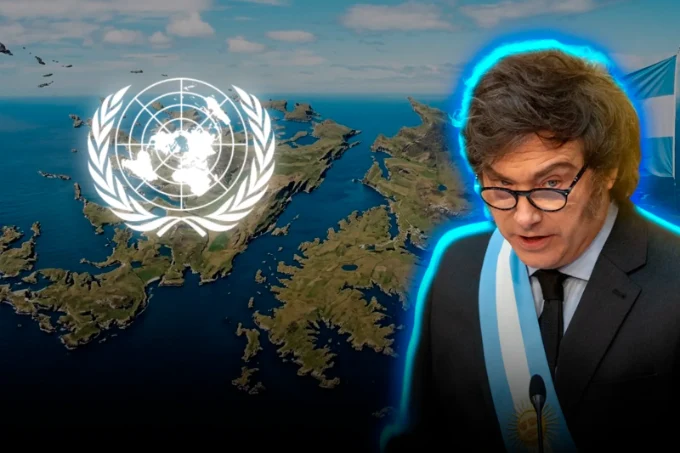
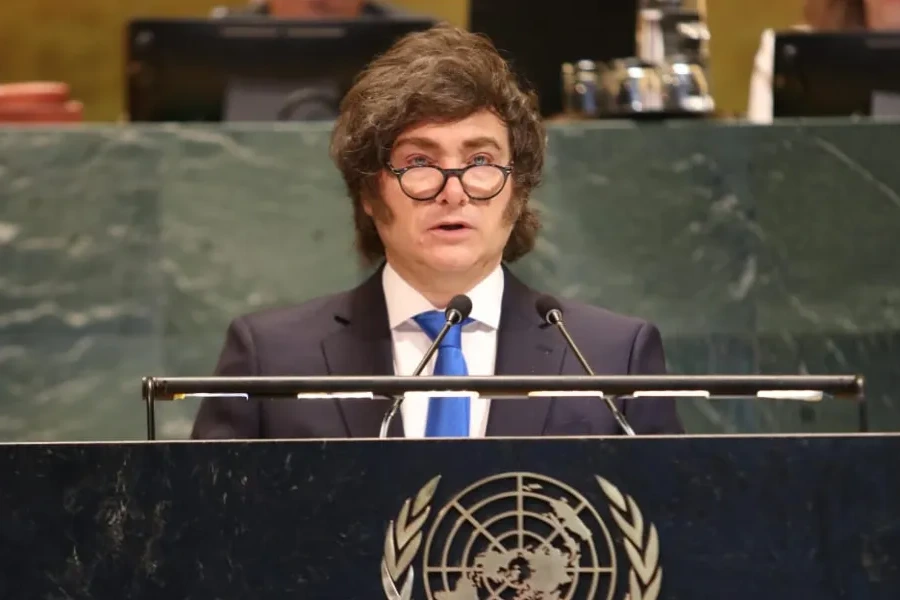
President Javier Milei made a strong defense of Argentina's sovereignty over the Falkland Islands during the beginning of his speech before the United Nations General Assembly
In this context, the president harshly criticized the UN itself for its inability to enforce the resolutions it adopts and pointed directly at its actions in the dispute between Argentina and the United Kingdom.
“An organization that set out to defend the sovereignty of its members looked the other way regarding the Falklands. The Falklands are a national cause for us,” Milei stated.
The President also questioned the functioning of the international organization and listed various episodes in which, according to him, the United Nations failed to meet the objectives for which it was created.
“They failed in their task, allowed chaos and international territory. They supported dictatorships and systematically voted against Israel,” he affirmed.
In this sense, Milei posed a central question about the effectiveness of the organization's decisions: “What good is a resolution if for decades the other party can act contrary to it?.”
"The Falklands are a national cause for us"
After a critical assessment of the organization, the president stated that an institution created to defend the territorial sovereignty of its members "decided to look the other way" regarding the situation of the Falkland Islands, South Georgia, South Sandwich Islands, and the surrounding maritime spaces.
"The Falklands are a national cause for us. I repeat: the Falklands are a national cause for us," he affirmed, emphasizing that the case is a demonstration of the gap between the words of international organizations and the reality they intend to act upon.
A UN with words, but without consequences
Milei recalled that five decades ago the General Assembly approved resolution 3149, which urges the parties to refrain from making unilateral changes while the dispute remains open. Fifty years later, he stated, "the situation has not changed, but unilateral changes continue."
From there arose the central question of his intervention: "What good is a resolution if for decades the other party can act in the opposite direction and that resolution remains intact in the archives, but powerless in the face of reality?".
According to the President, "there are no shortages of words or resolutions, what is lacking is for them to have consequences," and an institution whose word does not weigh on the facts "loses the most important thing: it loses its authority." He added that, in that scenario, those who follow the rules do not receive rewards and those who break them do not suffer repercussions. Therefore, he defined, the Falklands are not just a matter between Argentina and the United Kingdom, but also a test of the UN's ability to enforce its resolutions.
The Sea Lion project and the Argentine response
Milei denounced that the Sea Lion project is advancing towards oil extraction on the Argentine continental shelf, in the Northern Falkland Basin, through British licenses that Argentina rejects as "illegal and illegitimate." He stated that any action not authorized by the Argentine State constitutes an unlawful act, both under international law, including the United Nations Convention on the Law of the Sea, and domestic law.
In light of this situation, he listed the measures adopted by his government:
Formal claims to the United Kingdom.
Recourse to available legal tools.
Sanctions against the companies involved and their suppliers.
Submission to Congress of a National Sovereignty Defense Law.
"A peaceful, practical, and effective defense"
The President marked a contrast with the past: "For too long, Argentine governments opted for a discursive defense. We chose a peaceful, practical, and effective defense." He repeated it to emphasize the point.
And he went beyond the claim before the organization: "Argentina will not sit back and wait for the UN and the international community to rise to their own mandate; it will take action."
The islanders and self-determination
Milei also referred to the inhabitants of the islands. He recalled that the General Assembly itself has determined in numerous resolutions that the principle of self-determination does not apply in this case, as it involves a population implanted by the occupying power over a territory whose sovereignty is disputed.
"That principle exists to liberate colonized peoples, not to enshrine situations derived from colonization," he stated. And he warned that if the United Kingdom makes a selective interpretation of that principle, it must explain how it reconciles it with the debates on self-determination within its own territory.
A call for dialogue and a message to the energy sector
To the United Kingdom, he reiterated the call to resume negotiations to find a peaceful solution to the sovereignty dispute, as required by international law. He also invited it to exchange opinions without delay to resolve the controversy over the exploitation of natural resources.
At the same time, he addressed the global energy sector. He presented Vaca Muerta as "a historic opportunity" and extended an invitation: "Come. Invest. Develop it. Do it with us." With a clear limit: "We will not be indifferent to those who exploit resources under illegal external occupation."
An Argentina that wants to be a power again
Milei described the course of his government as a break from decades of "managing decline." He affirmed that the country embraces free enterprise capitalism, opens its economy to trade and investment, develops its strategic resources, and rebuilds its military instrument "after decades of neglect."
He also defined a geopolitical choice: alignment "without ambiguity" with the West, particularly with the United States and Israel, with whom he said shares a kinship of values and strategic complementarity. In this context, he condemned the attacks by the Iranian regime against Israel, recalled the designation of the Iranian Revolutionary Guard as a terrorist organization, and reiterated the pursuit of justice for the attacks of 1992 and 1994 on Argentine soil.
He clarified that Argentina will continue to participate in multilateral forums "in good faith," but that "we do not confuse cooperation with subordination."
Other criticisms of the organization
In the second part of his presentation, Milei questioned what he defined as a "bureaucratic leviathan" that seeks to decide how peoples should live. He criticized the 2030 Agenda, predicted that the 2045 Agenda "will fail," and questioned the management of the pandemic by UN-dependent organizations. He recalled that Argentina decided to leave the World Health Organization.
Artificial intelligence: "vanguard of freedom"
On artificial intelligence, the President rejected the fears that, he said, are used to justify state control. He stated that just as the Industrial Revolution did not destroy jobs, AI will be "the pin factory of the 21st century, and much more."
"In the face of artificial intelligence, Argentina will be at the forefront of freedom," he announced. He offered the world a cutting-edge legal framework, the commitment not to regulate preventively, limited liability for companies operating with AI agents, and tax benefits, supported by critical minerals, energy, and the country's talent. He added that it is necessary for the West to lead this technology so that it respects values such as life, freedom, and private property.
"Look to the south"
The closing was a message of national ambition. Milei listed what, he said, Argentina has: energy, food, critical minerals, human talent, the South Atlantic, and a natural gateway to Antarctica, in addition to "the will to transform our possibilities into national power."
"We want a prosperous, influential, and powerful Argentina. Not to subjugate others, but to be free," he affirmed. And, addressing scientists, entrepreneurs, and creators around the world, he invited them: "look to the south."
He concluded with a phrase about the country's destiny: "Decline is not a destiny but the result of repeated decisions, and if that course can be chosen, it can also be changed." He closed with the classic "Long live freedom, damn it!"