President Javier Milei confirmed that he will deepen the reform program during the second half of his term and ruled out changing the economic course to gain an electoral advantage in 2027, stating that his main challenge will be to surpass the results of his own management and fulfill the commitments made to the Argentines.
During an interview with LN+, the president recalled that he inherited a stagnant economy since 2011 and inflation that, he claimed, was heading towards an annual rate of 17,000%. In light of this scenario, he highlighted that the Government implemented the fiscal adjustment promised during the campaign and began to modify structures that had fueled Argentina's decline for decades.
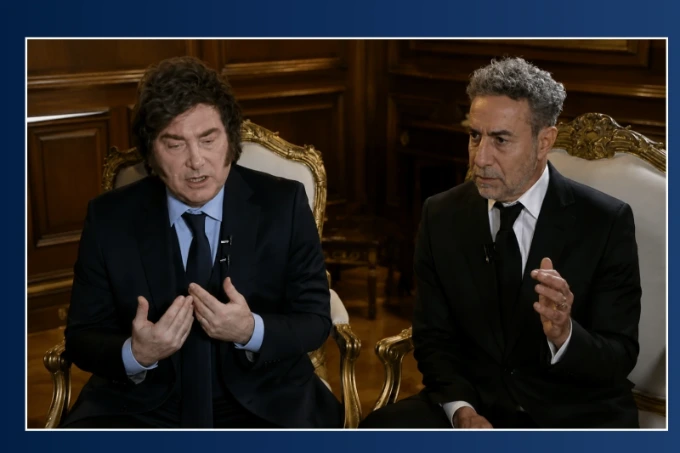
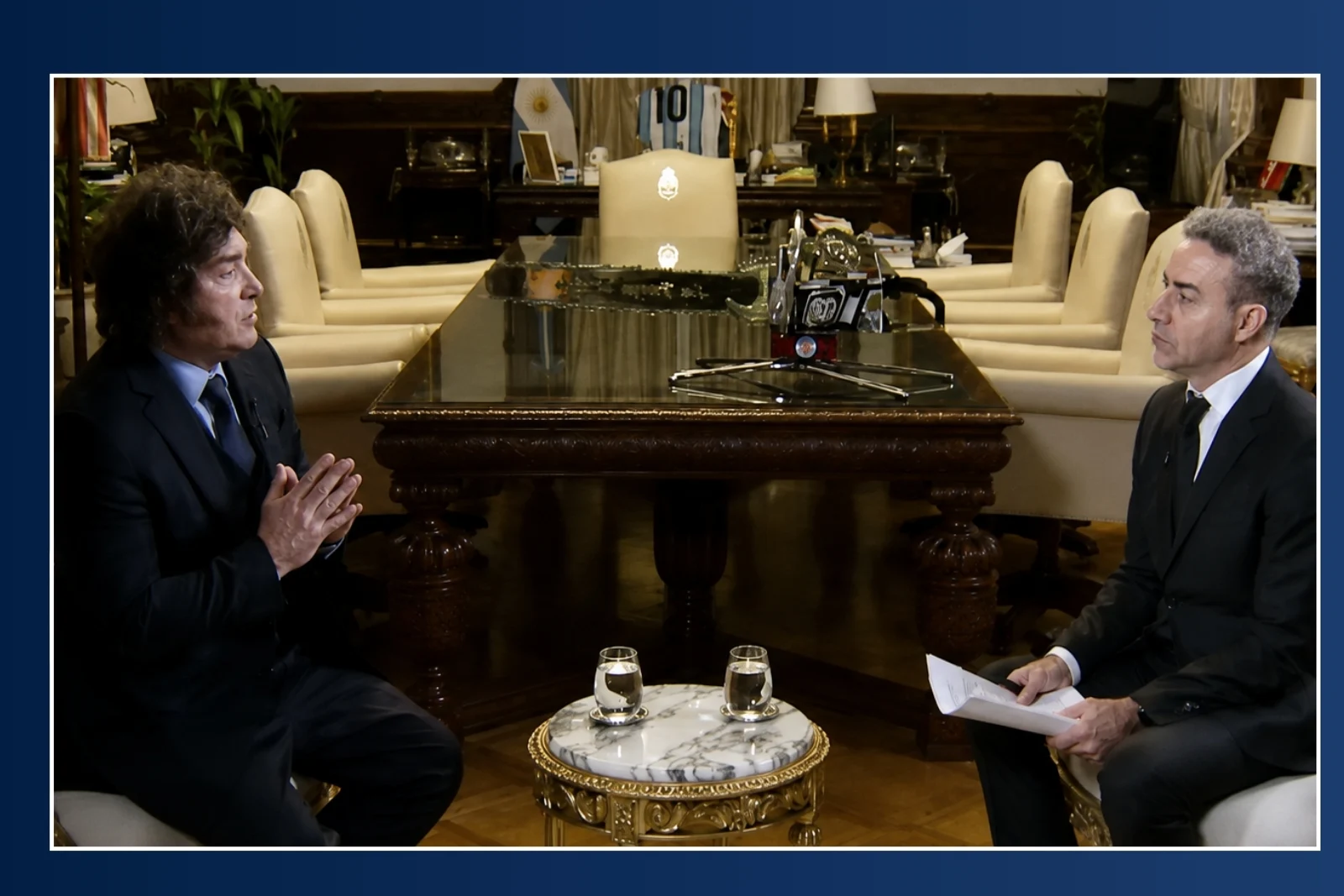
Javier Milei received journalist Luis Majul
“Everything I said I was going to do, they said was impossible, that it was madness, and I fulfilled it all. And I did it in the middle of the term,” Milei stated. He also assured that Minister Federico Sturzenegger is on track to complete 17,000 deregulations.
The President stated that he does not consider Cristina Kirchner or the rest of the traditional leadership as his main adversaries. “My competitor is myself. I do not compete against the decadent past, against the formulas of failure,” he expressed. For Milei, Kirchnerism represents “the old model,” characterized by fiscal deficit, monetary issuance, and the so-called “plan platita.”
In this regard, he guaranteed that the Government will not resort to public spending or money printing to improve its chances in the 2027 presidential elections. “I am not going to sacrifice my reputation or my legacy by doing a monstrosity like Kirchnerism did,” he declared, recalling the monetary expansion applied during the 2023 campaign.
Milei also defended the announced reforms regarding the Organic Charter of the Central Bank, the tax regime, the capital market, and the insurance sector. As he explained, the initiatives aim “at the heart of Argentina's decline over the last 91 years” and seek to change the financial framework that allowed successive fiscal crises.
The president also responded to the criticisms from Cristina Kirchner and Alberto Fernández. Regarding the convicted former president, he stated that she can make “all the presentations she wants” and rejected media reports that attributed her judicial situation to a supposed political agreement. In response to Fernández's criticisms, he was blunt: “I respond with results.”
During the interview, Milei also questioned the immigration policy promoted by socialist Pedro Sánchez in Spain and stated that sectors of the European left use immigration as an electoral tool. He also reaffirmed his criticisms against Brazilian President Lula da Silva and recalled that he was convicted and detained for corruption before the sentences were annulled on procedural grounds.
Finally, the President defended security policies aimed at protecting women and contrasted the results of his administration with the symbolic campaigns promoted by progressivism. “When someone touches a woman, we grab them by the hair and put them in jail,” he asserted. For Milei, the response to violence must focus on enforcing the law and punishing criminals, rather than financing ideological slogans without concrete results.