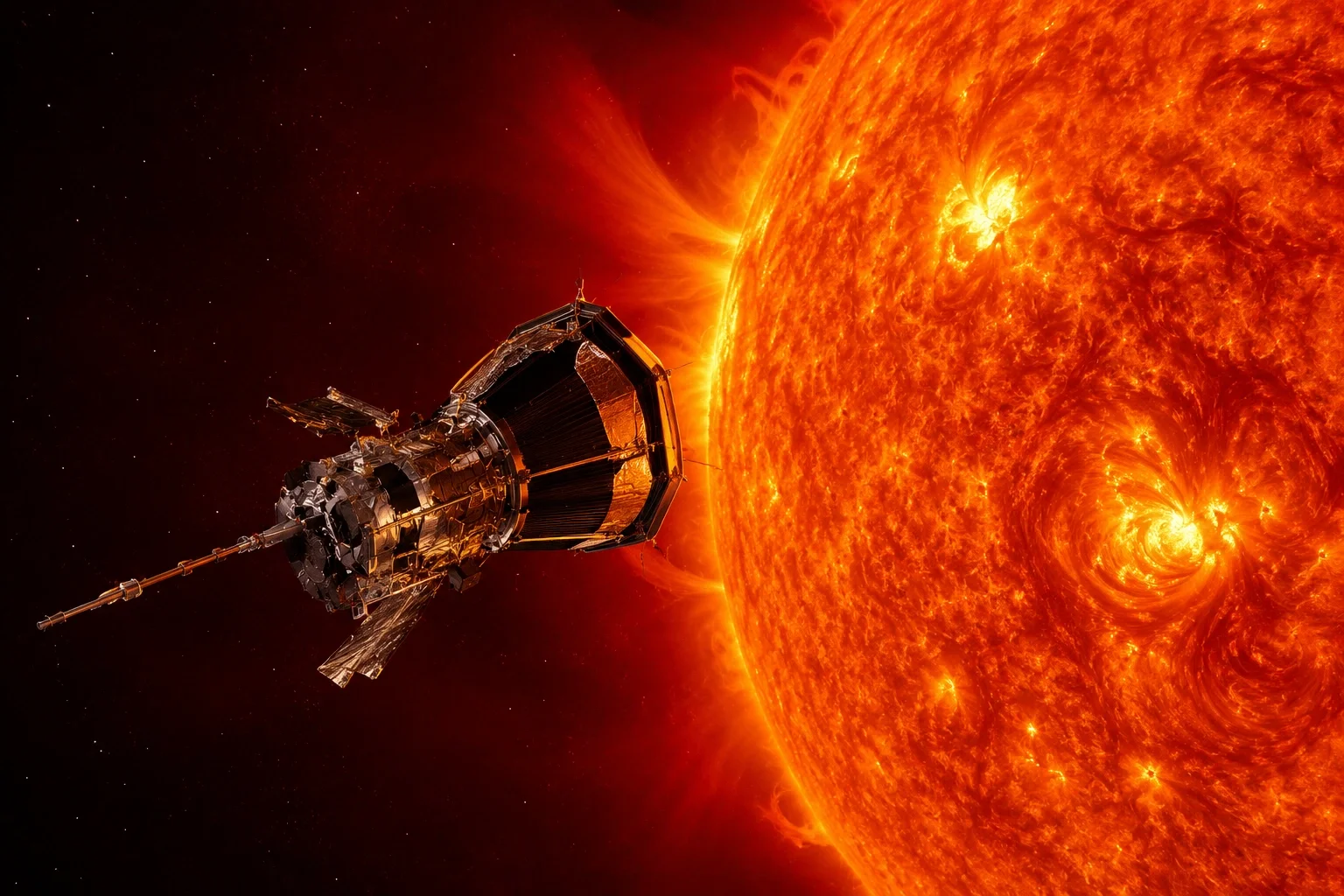

The NASA Parker Solar Probe completed its 28th approach to the Sun, coming within just 3.8 million miles of the surface and reaching a speed of 430,000 miles per hour. This step marks a new milestone in the mission that has been studying our star for eight years.
The spacecraft began its approach on June 3 and sent a beacon signal on Thursday to confirm that everything was in order. Since its launch in 2018, the Parker has been getting closer and closer, breaking its own records for distance and speed. In the first flyby, it reached “only” 213,200 mph at 15 million miles.
Despite the extreme heat endured by the thermal shield —which reaches nearly 1,700 degrees Fahrenheit— the probe remains in excellent condition. Engineers highlight that the internal temperature remains stable thanks to thermal blankets, indicating that the shield is not degrading.
“That thermal consistency is a key indicator of the spacecraft's health,” explained John Wirzburger, systems engineer for the mission at the Johns Hopkins Applied Physics Laboratory.