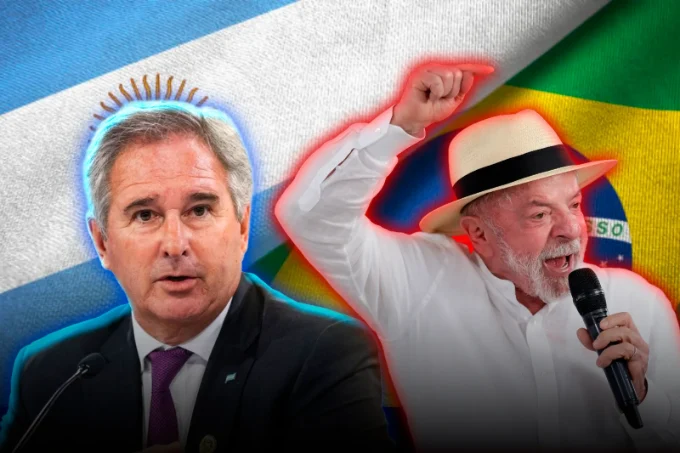
The chancellor assured that the country will not break relations with Brazil despite Lula's decision to withdraw the ambassador, and stated: "It takes two to fight. We are not going to engage in that fight nor break relations."
The political landscape of South America has undergone a dramatic turnaround in recent years. With the arrival of libertarian president Javier Milei to power, the hegemony of the continental left has been curtailed. This clash of models has led to an evident escalation from the Brazilian administration.
The direct conflict erupted after Argentine president Javier Milei refused to apologize for defining the leader of Brazil as the criminal he is.
In response to Argentina's firm stance, dictator Lula da Silva staged a true dictator's farce on the international stage by forcing the withdrawal of the Argentine ambassador from his territory.
Argentine Foreign Minister Pablo Quirno firmly dismissed Lula da Silva's maneuver. Quirno established the official position unyieldingly:
“For us, this is a unilateral decision that we regret. We understand there are differences between the governments, but we never bring them to the diplomatic level. We will maintain our position”.
From the offices of the Brazilian Ministry of Foreign Affairs, led by Mauro Vieira, an attempt was made to downplay the impact by claiming it was all a “misunderstanding” and that there was no formal expulsion.
However, Casa Rosada does not accept the defensive rhetoric of a cornered Itamaraty. A high-ranking source from the libertarian administration was emphatic to the media:
The Argentine ambassador, Daniel Raimondi, was formally “invited to leave” the neighboring country, forcing Argentina to leave only a chargé d'affaires, a move characterized as a unilateral decision.
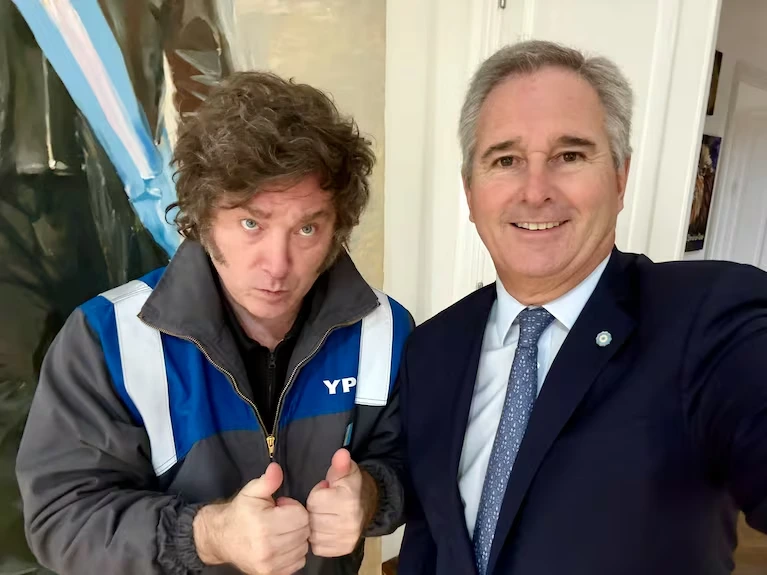
Javier Milei and Pablo Quirno
This excessive measure by Brazil coincides with the prior withdrawal of its own ambassador in Buenos Aires, Julio Bitelli. Meanwhile, Brazilian diplomacy is trying out excuses, falsely accusing Argentina of maintaining an ideological conflict with countries in the region such as Paraguay.
In defense of national sovereignty, Argentine official sources recall the transparent nature of the libertarian leader:
Similarly, they openly denounced that the political apparatus of Brazil has actively interfered in the electoral processes of Argentina during the years 2019 and 2023.
This panorama of ideological siege is compounded by digital manipulation. President Javier Milei has shared data and analysis from the Digital Monitor survey through the Encuestas Argentinas account on the X platform.
This report demonstrates a fierce anti-Argentine campaign: Brazil was the country that generated the most publications about Argentina, with an overwhelming 22% of the total traffic between December 2022 and July 2026. This supports the allegation that Lula da Silva financed a campaign on social media against the Argentine government.
Despite the coordinated attacks and the resentment of the Workers' Party, the Government of the Argentine Republic does not halt its course.
Ambassador of Brazil, Julio Bitelli
Formal diplomatic relations are strained by the whim of Lula da Silva due to Javier Milei's open support for conservative opposition figures such as Flavio Bolsonaro of the Liberal Party (PL) —a connection solidified since the meeting with the family of the latter on July 7, 2024 at the beach resort of Camboriú—.
Far from isolating himself, the liberal leader's agenda remains more active than ever. Today, August 5, amid the conflict, the president travels at night to Ecuador to sign trade agreements with his counterpart Daniel Noboa. His trip will continue to Colombia, where he will participate in the inauguration of Abelardo de la Espriella, strengthening the regional leadership of the new American right.
Finally, Foreign Minister Pablo Quirno summarized the composure and strategic pragmatism of Argentina by stating: “It takes two to fight. We are not going to enter that fight or break relations”.
However, he made it clear the historical importance of maintaining the ideological course of the nation and the bilateral relationship: “No one is a saint in this situation. We are playing a game that is so important for the region. Let us understand that before Milei came to power, the region was in the hands of Correa, Boric, Lula, and that has changed very quickly. It also has to do with the support the President has given on these issues”.