


I see many people worried about the country risk. And I also see on social media some who specialize in publishing their increases every day, with great delight, with the implicit message, or not so implicit, that this cannot go on and that the Government is facing a catastrophe.
Argentina has lived for a very long time with a country risk above 1,500 points. The reality is that a country risk of 600, 1,000, or 1,500 points makes no difference when you do not need to go to the debt markets.
And that is precisely the situation of Argentina.
The country does not need to resort to international debt markets today. Even when the country risk was much lower, when it reached levels close to 400 points, the Government had already made that decision.
Argentina obtains financing much cheaper through international private banks, multilateral organizations, or other central banks. Additionally, its fiscal solvency allows it to operate without needing to resort to debt markets.
Of course, it would be convenient to have a low country risk. It would be very positive if it were at 200 basis points, as it would allow the Argentine economy to finance itself internationally at much lower costs.
But let’s distinguish the issues.
Presenting the country risk as the weak point of the building, the one that brings down the entire structure of the Government, is entirely false.
October inflation and past prices
The other issue that has been stirred up in recent days was the retail inflation for October, which reached 2.2%. Let’s agree that an inflation rate starting with 2 looks very bad.
However, when you look at the historical series, you find that it is the lowest for that month since 2017. And when you delve deeper and analyze the components, you encounter a quite different picture.
Fundamentally, it was a problem of regulated prices, where the conflict in the Strait of Hormuz directly impacts.

Moreover, we know that a good part of the adjustments in regulated prices correspond to old inflation, inflation from the past. It is a kind of archaeological inflation, buried, that now appears through the readjustment of relative prices.
It is about recovering increases that had not been previously recognized and that, for that reason, are now above the rest of the goods and services.
The good news is that this work is already 95% done. There is very little left to complete this readjustment.
The second favorable news is that in recent days, oil prices have started to drop, especially after the summit between the United States, Russia, and China.
In recent months, increases in oil and gas have strongly driven the inflation index.
There were also seasonal prices, which increased even more than the regulated ones. But with the seasonals, something particular happens: today's excessive rise will turn into tomorrow's notable drop.
Now, when they rise, they are used to question the Government. But when they drop and contribute to reducing inflation, they will surely tell us that inflation decreased only because of the seasonals.
To read everything negatively, they are sent to do so.
Core inflation, the most important data
The truly important aspect of the October index lies in the core inflation.
Core inflation was 1.5%. And the average for the last three months was also around that level, the lowest since January 2018.
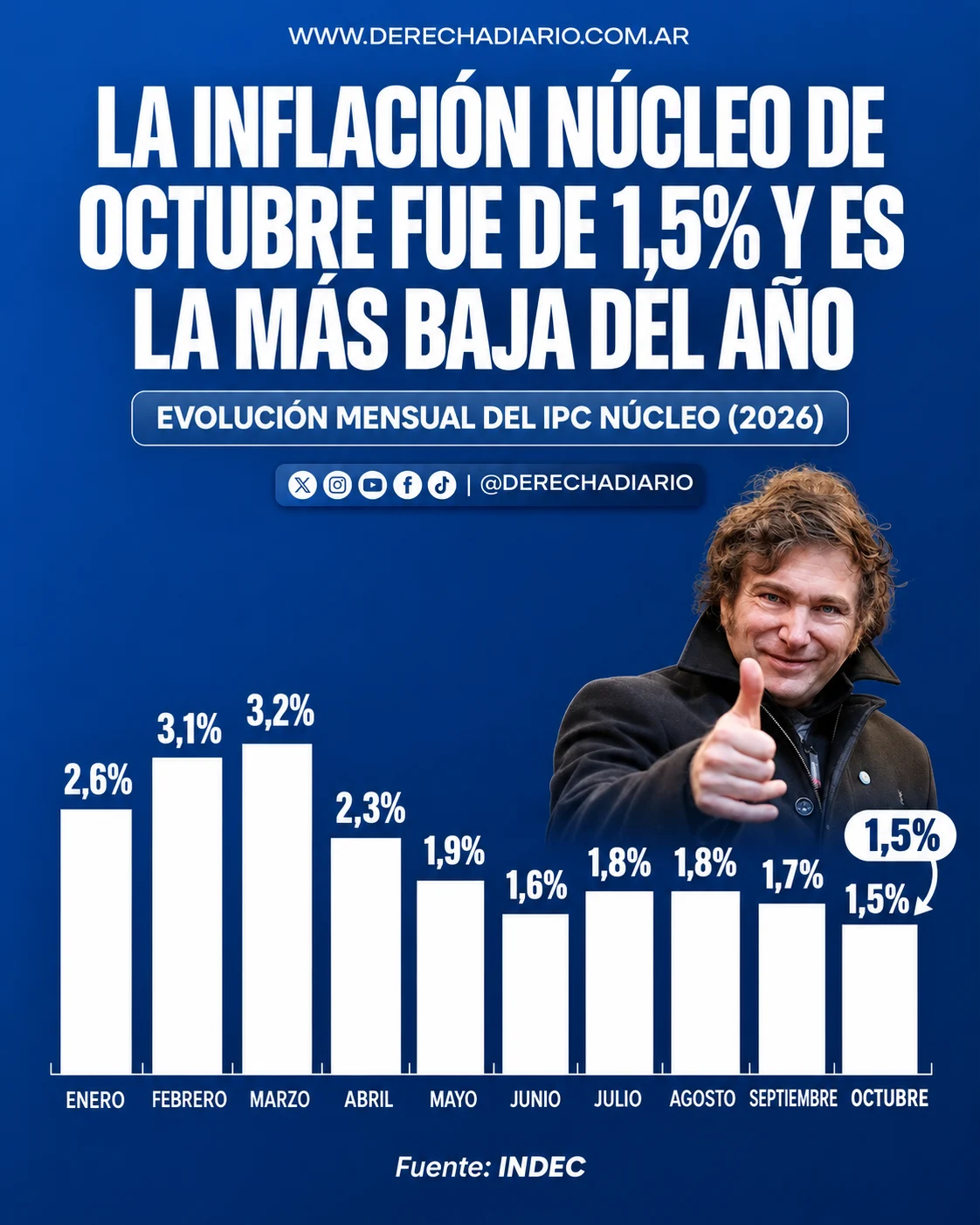
That is to say, when we clear the regulated prices, linked to the readjustment of tariffs, and the seasonals, we find inflation levels that we have not seen in over eight years. We have to go back to the government of Mauricio Macri, before his crisis.
And when we observe the wholesale prices published this week, we find something similar. Two of the indicators were at 1.5% and another at 1.6%.