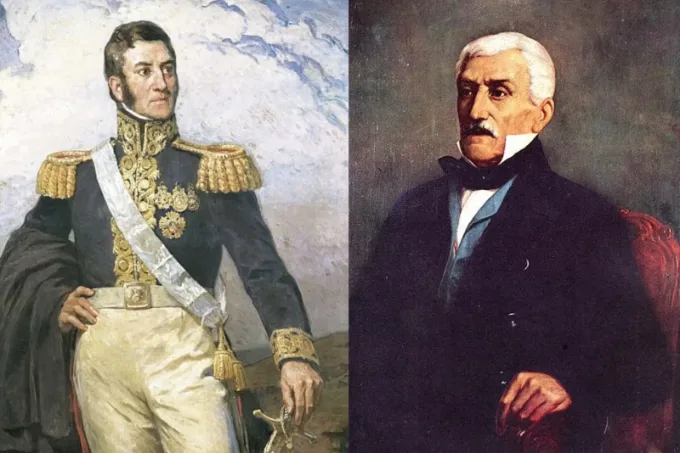

San Martín, he was great when the sun shone on him and even greater at sunset

San Martín, he was great when the sun shone on him and even greater at sunset
Imagen de Editorial Team
porEditorial Team
Argentina

At 176 years since his death, the example of San Martín once again challenges an Argentina that is debating the size of the State, privileges, and the value of freedom

Add La Derecha Diario on
Share:

Every August 17, Argentines turn their gaze towards José de San Martín. But for the people of Corrientes, there is an even deeper reason; the Liberator is a man of this land, from Yapeyú, on the banks of the Uruguay River. And from here, his destiny began, the freedom of a continent.

The anthem that honors him has a phrase, the title of this article, that perhaps summarizes, like no other, the greatness of his life: “He was great when the sun shone on him and even greater at sunset.”

Because San Martín was great when he triumphed at Chacabuco and Maipú, when he crossed the Andes, and when he achieved glory. But he was even greater when he could have held onto power and chose to renounce it.

That is the lesson from San Martín that we most need to remember. Because there are men who use victories to seize power and there are men who use power to achieve freedom.

Napoleon and San Martín: two opposing ways of understanding glory

Juan Ramón Aguirre Lanari, a native of Corrientes and distinguished with the Sanmartinian Palms, recounted... “While in the Murcia Regiment, San Martín had a chance encounter with Napoleon, who, taking from his white and sky-blue coat, read aloud the name inscribed on the lapel…...Murcia.” This encounter serves to understand San Martín by comparing two great men of war, but with completely different objectives.

Napoleon made war an instrument to affirm his power, conquer territories, and subjugate peoples. He ended up crowning himself emperor. He sought personal glory, conquering for himself.
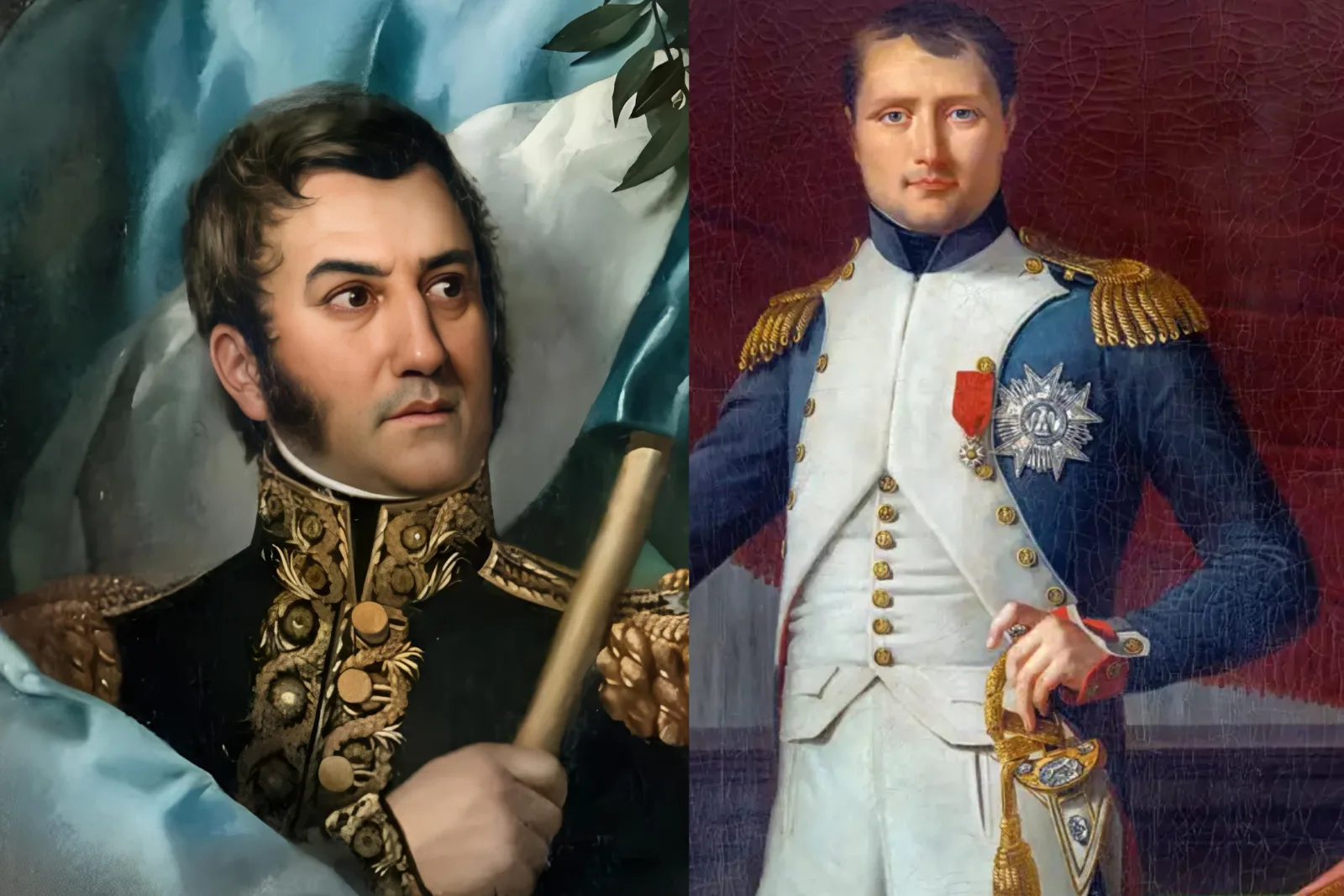
San Martín and Napoleon Bonaparte

San Martín, on the other hand, made war an instrument for liberation. He ended up distancing himself from power, placing a higher cause above his own ambition. He did not fight to conquer; he fought to liberate. He did not conquer for himself; he fought for others to be free.

There lies the true greatness of San Martín. Because winning a battle requires talent, strategy, and courage. But renouncing power after having won requires something even greater: moral greatness.

Austerity as a form of public service

His public conduct was consistent with that conception. When he was appointed Colonel Major, he rejected new positions. After Chacabuco, he twice declined the promotion to Brigadier General. After Maipú, Chile wanted to honor him with a silver tray, and San Martín returned it.
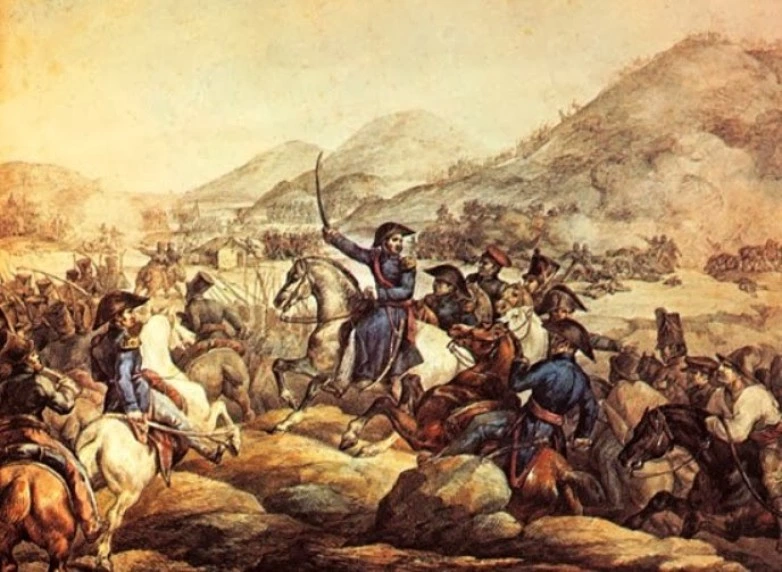
San Martín at the Battle of Chacabuco

As governor of Cuyo, he decided to cut salaries in half, and a monetary reward he received he chose to allocate to founding a public library.

His explanation should be written on the walls of all public offices: “The State is in need, and it is necessary that we all contribute to remedy it.” How far that conception of public service seems at times.

When the State stopped serving the citizen

For decades, Argentina built around the State a huge structure of privileges. Positions, perks, subsidies, regulations, and benefits grew until they transformed what should have been at the service of citizens into a system that often ended up serving itself.

The State came to be confused with those who administered it temporarily, while the citizen was reduced to financing an ever-growing and costly structure.

A few years ago, when I wrote about San Martín, I called for politics to once again look to his example of republican austerity and put an end to the privileges that outraged society.

Milei and a new discussion about power

Today, in August 2026, that reflection takes on a different dimension. Argentina is undergoing a change of era. And that change has a name, Javier Milei, which cannot be understood merely as a discussion about inflation, deficit, taxes, or growth. It is a deeper discussion, about what place the State should occupy and what place the individual should occupy.

Milei burst onto the scene to precisely question that logic; his argument starts from an uncomfortable premise for power: the State does not create the resources it administers; it obtains them from citizens, so the discussion is no longer merely economic; it is moral.

Is it fair that those who temporarily administer the State have privileges that those who work every day do not?

San Martín seems to respond from two centuries ago: Greatness is not in accumulating power. It is in knowing why it is held and when it is necessary to renounce it.

That is why the transformation embodied by Milei exceeds a government. Something is being discussed that for decades seemed untouchable: the privileges of politics, the size of the State, and the relationship between the citizen and power.

It does not mean that everything is resolved, it means something more important; an attempt is being made to change direction, understanding that freedom requires sacrifice, responsibility, and perseverance.

Freedom demands sacrifices and renunciations

San Martín knew this; independence was not a gift. Freedom had an enormous cost in lives, sacrifices, and renunciations. And when the moment came when his continued leadership of the armies could become an obstacle to the higher cause he defended, he chose to step aside.

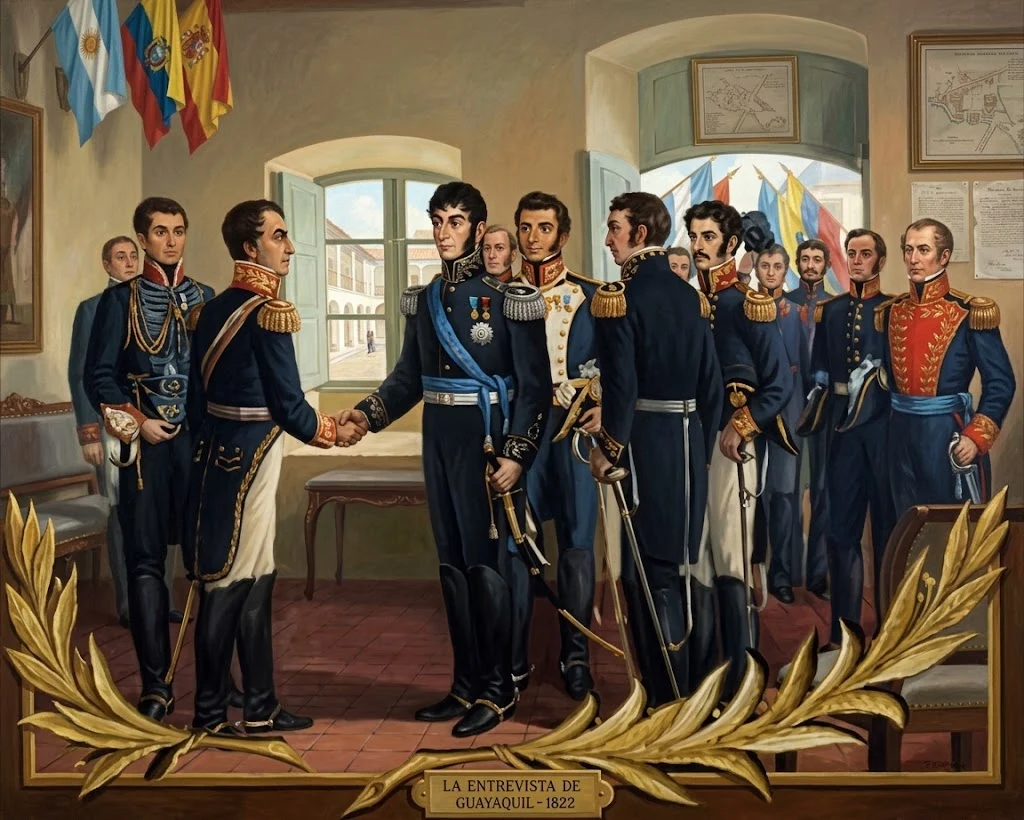
In Guayaquil, he could have contested leadership, he could have clung to the prestige he had gained, but he chose the cause over his ego. Freedom over power. That was, probably, his most extraordinary victory, because there is a form of power that is much deeper than holding a position; it is having the moral authority to renounce it.

Meeting between José de San Martín and Simón Bolívar

A Nation of Free Men

San Martín left us his example of service, sacrifice, austerity, patriotism, renunciation, and above all, freedom. His figure speaks to us again, and we must remember for what and how he lived.

Two centuries later, Argentina is once again discussing whether we want a society subjected to an ever more powerful State or a society of free, responsible citizens who are masters of their own destiny.

That is, ultimately, the heart of the change that Milei represents and proposes, and that San Martín reminds us of… politics should not be the path to privileges; it should be the path to ending them.

Are we willing to renounce privileges so that Argentina can once again be a Nation of Free Men?

San Martín has already given his answer. Now it is our turn.


La Derecha Diario logo
TwitterInstagramYouTubeTikTokFacebook
Derecha Diario TV

Nosotros

  • Quienes Somos
  • Autores
  • Donar

Privacidad

  • Protección de datos
  • Canales
  • Sitemap
  • RSS

Contacto

  • info@derechadiario.com.ar
PUBLICIDAD

Related news

Abelardo ordered a minister on Twitter to fire all the leftists from her ministry

Abelardo ordered a minister on Twitter to fire all the leftists from her ministry

The Third Wave of "cultural socialism" in universities

The Third Wave of "cultural socialism" in universities

The Civil Guard confirmed 15 rapes in Ceuta following the invasion of illegal Moroccan immigrants

The Civil Guard confirmed 15 rapes in Ceuta following the invasion of illegal Moroccan immigrants

The court upheld the power of U.S. troops to make arrests in border areas

The court upheld the power of U.S. troops to make arrests in border areas

Brake on Madness: Greg Abbott banned the installation of foot washing stations for Muslims in airports

Brake on Madness: Greg Abbott banned the installation of foot washing stations for Muslims in airports

The Trump administration warned the European Union about its regulations on American companies

The Trump administration warned the European Union about its regulations on American companies

La Derecha Diario logoLa Derecha Diario logo
ESX logoInstagram logoYouTube logoTikTok logoFacebook
ARGENTINAUNITED STATESECUADORISRAELMEXICODERECHA DIARIO TV
  • ES
    XInstagramYouTubeTikTokFacebook
  • DERECHA DIARIO TV
  • Sections
  • ARGENTINA
  • UNITED STATES
  • ECUADOR
  • ISRAEL
  • MEXICO
  • URUGUAY
  • Countries
  • La Derecha Diario logoLA DERECHA DIARIO
  • La Derecha Diario México logoLA DERECHA DIARIO MÉXICO
  • La Derecha Diario Uruguay logoLA DERECHA DIARIO URUGUAY
  • La Derecha Diario Ecuador logoLA DERECHA DIARIO ECUADOR
  • La Derecha Diario Israel logoLA DERECHA DIARIO ISRAEL
  • La Derecha Diario Estados Unidos logoLA DERECHA DIARIO ESTADOS UNIDOS
  • Topics
  • GUERRA EN IRÁN
  • The Newspaper
  • QUIENES SOMOS
  • AUTORES
  • PUBLICIDAD
  • DONAR