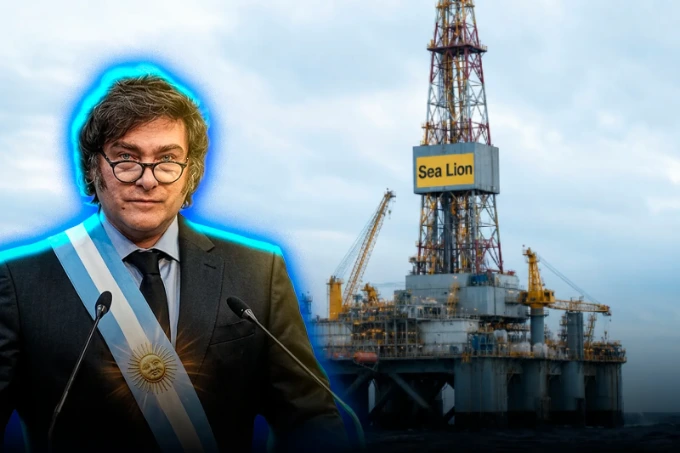
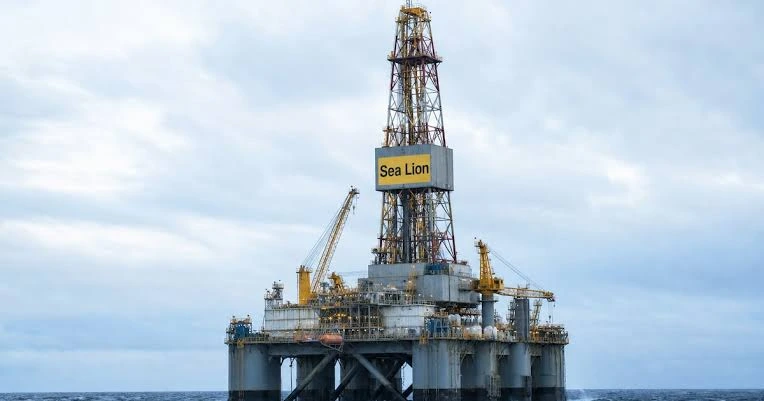
The sanctions driven by the government of Javier Milei against companies linked to the illegal exploitation of resources in the Falkland Islands have begun to create difficulties in the development of the British oil project Sea Lion.
A series of decisions made in recent weeks has exposed a clear problem for its operators: the risk of working with international suppliers and investors.
Following the measures announced by the government of Milei, one of the first effects was the positioning of SLB, Halliburton, and Baker Hughes, the three largest oil service companies in the world, which announced that they will not participate in hydrocarbon projects in the Falklands or in their surrounding maritime areas.
All three have operations in Argentina, particularly in the energy sector, so they decided not to jeopardize their operations in the country.
The Sea Lion Project
Concern in London
Meanwhile, the United Kingdom published a specific guide on September 15 for companies engaged in economic activities or supplying goods and services to the Falklands.
The document dedicates a section to the Argentine sanctions against companies and offers support from the British government to those facing pressures or actions related to their illegal activities in the islands.
As a result of Milei's measures, British authorities announced that they are willing to intervene directly to provide security to companies facing difficulties in their operations in the archipelago.
The need to publish this guide arose after Argentina intensified actions against companies related to hydrocarbon activities. The Milei government also presented a project to expand and tighten sanctions against those exploiting natural resources without Argentine authorization.
President Javier Milei
The United Kingdom extended the licenses
In this context of tension, the United Kingdom also announced the extension of all offshore hydrocarbon licenses in the Falklands for five years, with the possibility of adding another two years.
The head of Trade, Industry, and Mineral Resources of the islands, Cheryl Roberts, explained that the extensions aim to “provide security to operators” so they can continue investing and developing their areas.
The measure includes expanded work programs and commitments to advance with new evaluation wells. Among the companies linked to the development of Sea Lion are the British Rockhopper Exploration and the Israeli Navitas Petroleum.
President Javier Milei
A pressure that also reached the judiciary
Alongside commercial difficulties, a judicial front has emerged. On September 16, the Federal Court of Río Grande ordered Rockhopper and Navitas to refrain from starting, continuing, or executing the Sea Lion project, as part of a precautionary measure.
The current situation shows that Argentine sanctions have not yet paralyzed Sea Lion, but have indeed introduced a factor of commercial, legal, and operational risk that jeopardizes the British project.
For London, the challenge now is to convince suppliers, investors, and international companies to participate, despite the risks and sanctions, in the illegal hydrocarbon activities in the Falklands.