Researchers at North Carolina State University have successfully recovered cellular material from centuries-old parchment manuscripts without causing any damage to the documents. The method allows for the analysis of genetic information preserved in animal skin and opens a window to data about trade, livestock, and daily life dating back over a thousand years.
Parchment, made from animal skins, was used for millennia in Europe, the Middle East, and parts of Africa for legal records, maps, and all kinds of texts. Since the skins preserve biological remnants, these documents hold genetic clues alongside the written words.
“As they are made from animal skins, it is often possible to extract genetic information from the parchments,” explains Tim Stinson, corresponding author of the work and associate professor of English at North Carolina State University. “This genetic information, in turn, offers us a window into the past and answers questions about when and where a manuscript was produced.”
The same information can go much further than the origin of each document. Since parchment was used for centuries, the recovered DNA helps study how domestic animals changed, how different breeds emerged, and what diseases affected livestock.
A simple method that does not damage heritage
“As parchments were used for such a long time and often record detailed historical information, the genetic data they contain can also shed light on the evolution of domesticated farm species, the development of breeds over time, livestock diseases, and more,” notes Matthew Breen, co-author of the study and distinguished professor of comparative oncology genetics at the College of Veterinary Medicine at the same university.
Until now, the main obstacle was access. Libraries, museums, and institutions were reluctant to allow sampling of rare and culturally significant pieces for fear of permanently damaging them. The new work demonstrates that it is possible to collect material without harming the documents, representing a significant advance for this emerging field.
To test the technique, the team sampled 91 manuscripts preserved in the Rubenstein Library at Duke University. The documents came from as far away as England and Ethiopia and were produced between the late 8th century and the early 20th century.
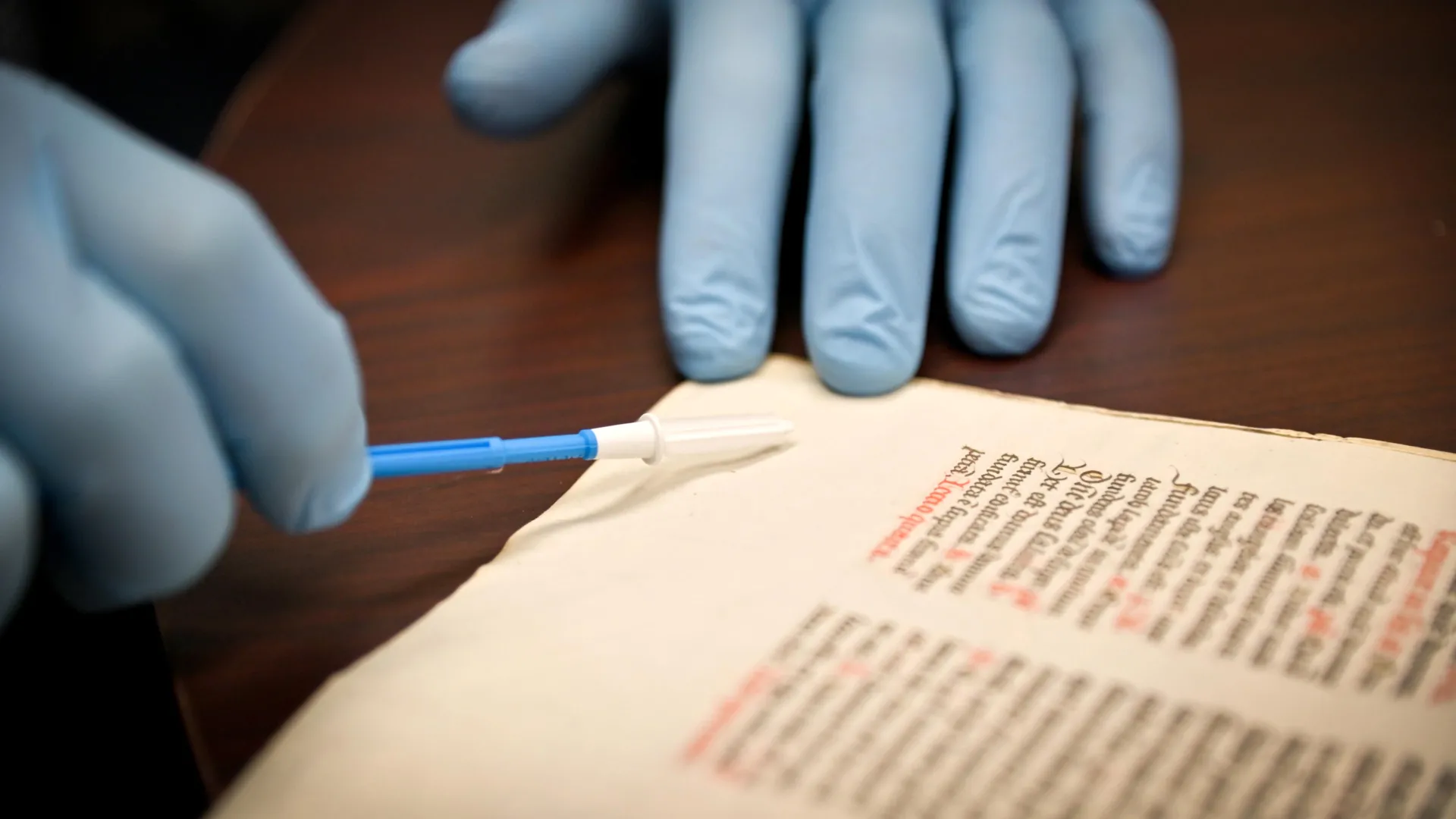
The procedure is surprisingly simple: researchers gently rub the parchment with a dry cytology brush, the same type used in Pap smear tests. The brush collects cellular material and leaves the historical document intact.
From ancient skin to genetic sequence
“Cytology brushes can be used dry and do an excellent job of collecting cellular material without damaging the integrity of the sampled artifact,” says Breen. After obtaining the cells, the team removes them from the brushes and applies forensic-grade next-generation sequencing technologies to isolate and amplify the genetic sequences.
“We are using cutting-edge technologies and genetic analysis techniques to obtain new empirical information about historical cultural and agricultural practices,” summarizes Stinson.
The ability to recover a substantial amount of genetic information without damaging the parchment could make institutions more comfortable authorizing the study of valuable manuscripts. “We have demonstrated that we can extract a huge amount of new information from these parchments without harming them,” emphasizes Breen. “This, we hope, will build trust in the organizations responsible for preserving these historical documents.”
Researchers believe that historical parchment constitutes a still underexplored source of information that can connect genetics with traditional questions from historians, archaeologists, and other specialists. “We are excited about the potential of this field and are seeking funding to allow us to explore it,” says Stinson. “We have shown that it is a vast unexplored source of historical information, and we want to continue this pioneering work.”
“We have a remarkable opportunity,” adds Breen in the journal Manuscript Studies. “It is essentially a completely new field that brings together a truly interdisciplinary range of expertise, from genetics to medieval history,” he concluded.