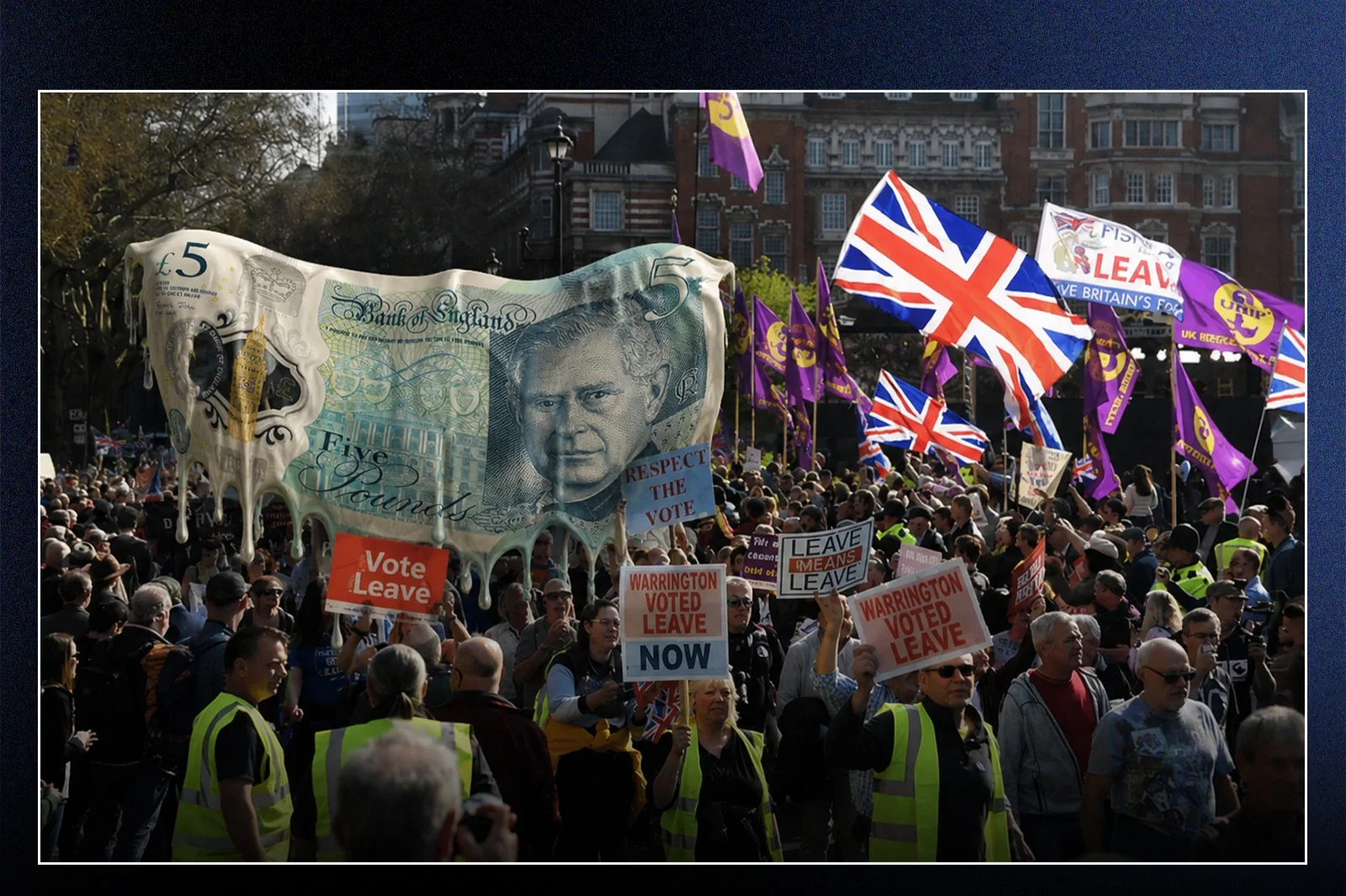

Ten years after Brexit, now they're after your wallet.

Ten years after Brexit, now they're after your wallet.
Imagen de Editorial Team
porEditorial Team
Argentina

The United Kingdom was the only one that dared to break from within the centralized control of the technocrats in Brussels. A decade later, that power has continued to grow: today it encroaches upon the last bastion of individual freedom, currency.

Nuevo
Agregar La Derecha Diario en
Compartir:

This June marks ten years since that referendum in which 17.4 million Britons —the largest vote in the history of the United Kingdom— decided to leave the European Union. The anniversary invites less nostalgia than a question that almost no one wanted to answer honestly back then: what was really voted on that June 23, 2016?

The answer fits in the most resonant slogan of the campaign: take back control. It was not a vote against Europe, its cathedrals, or its literature. It was a vote against a caste that does not tolerate losing power.

Brexit as a rebellion against the anointed

It is important to name that caste precisely. Thomas Sowell called it “the anointed”: that enlightened minority that claims superior knowledge, believes it has the right to decide for millions of people, and when reality contradicts its plans, does not conclude that it was wrong but that the people are too ignorant to understand it. The distinctive trait of the anointed is not that they govern, but that they never submit to the verdict of the governed. The dissenter is not treated as mistaken: they are treated as immoral. Those who object to uncontrolled immigration are xenophobic; those who defend their currency and traditions are dangerous nostalgics; those who vote differently are manipulated without criteria. That is the grammar of the anointed, and Brexit was, above all, a heresy against it.

Because the European Union deserves to be observed beyond its own narrative. It was born with legitimate goals of commercial integration and cooperation among nations that had just gone through two devastating wars. But as the integration process advanced, the logic of the common market gave way to increasing regulatory and political centralization. What began as a project of economic openness ended up evolving into a bureaucratic structure increasingly distant from the democratic control of citizens.

The United Kingdom was from the beginning an uncomfortable partner: when the integration project started in 1957, the British preferred to stay out; Churchill himself had said that European peace required moving towards a United States of Europe that should not include Great Britain. Its membership was always transactional, never identity-based. And as decision-making slowly but inexorably shifted from London to Brussels, the British discovered that their democracy was being hollowed out from above.

The EU presents itself as the great exercise of free trade, but its practice is different: no space for business experimentation and institutional competition, protectionism, and a bureaucracy that regulates everything from permitted working hours to the storage of olive oil. Its Commission —the most powerful arm— is elected in conclaves of heads of government with little or no reference to voters. The euro also contributed to shifting fundamental decisions from the realm of democratic deliberation to the domain of technocratic administration. More and more aspects of economic policy became subject to rules, bodies, and negotiations far removed from the direct control of voters. The

British saw this drift before anyone else. That is why, when the anointed announced that Brexit would unleash apocalypse, they deduced, with common sense, that such fear could only hide a threatened privilege.

The Brexit they never let be completed

What came next was proof that control is not given up without a fight. For years, the anointed did everything to neutralize the vote. Theresa May, who had campaigned for remaining, negotiated an agreement known as BRINO —Brexit in Name Only—: it kept Great Britain out of European decisions but still subjected it to a good part of its rules. The People’s Vote campaign filled the streets of London demanding a second referendum, that is, to vote again until the people got it right. The exit that was supposed to take place in March 2019 was kicked down the road time and again.

And when, later, a conservative prime minister dared to propose tax cuts and deregulation, the International Monetary Fund publicly reprimanded her with unusual harshness. Her defenders argued that she was reacting to an inconsistent fiscal program. But the episode revealed something deeper: to what extent international institutions consider it legitimate to intervene when a government tries to deviate from the dominant economic consensus. The sabotage, moreover, was never just from Brussels: it came from within, from the very managerial class that runs the West. Today, Labour leader Keir Starmer crowns that trend with his “reset”: a dynamic alignment that will copy much of European legislation on energy, electricity, and food standards. If Brussels says “jump,” Great Britain will ask “how high?” From competitive partner to satellite market, and without true democratic scrutiny, against two consecutive majority votes.

It is also worth remembering what Brexit really promised. It was never a promise of automatic prosperity or a shortcut to growth. No institutional reform produces miracles on its own. The bet was to regain decision-making capacity to define its own regulatory, trade, energy, and migration policies. Judging Brexit solely by the evolution of some aggregate indicators is like evaluating a privatization by looking only at the GDP of the following year: it loses sight of the fundamental issue, which is who decides and to whom they are accountable.

That is why the balance of this decade must be read carefully. The United Kingdom has not fared badly, but it has not done as well as it could have, and the reason is simple: it never fully implemented the Brexit it voted for. Where it was allowed to breathe, it worked: British lamb exports grew strongly, beef exports reached record levels, and the genetic editing sector flourished thanks to the regulatory liberalization following the exit. But those achievements are often reported with the condescending asterisk of “despite Brexit,” while it is silenced that broad sectors of the economy remain tied to a regulatory architecture designed for another political scheme. It is not that Brexit has failed. It is that it was never allowed to fully assess what a completed Brexit would have meant.


And yet, the democratic genie does not go back into the bottle. In May of this year, the English local elections certified what the anointed believed impossible: the end of the old

duopoly between Labour and Conservatives. Reform UK, led by Nigel Farage, won more than 1,400 local seats, conquered governments historically dominated by traditional parties, and altered a political map that had seemed immutable for decades. It was not a protest vote: it was a political reordering. And who are those voters? They are, once again, the Brexit voters. Analyst John Curtice showed that support for Reform systematically grows in areas where Leave obtained its highest percentages in 2016. The continuity is statistical, not poetic. The new political fracture no longer pits workers against bourgeois, but the people against technocratic-managerial centrism; and the contempt of the elites and their media is not aimed only at Farage, but also at his voters, who are accused of being racists or reactionaries for the crime of loving their country and their customs. It is the contemporary version of a very old phenomenon: the disdain of those who consider themselves morally or intellectually superior towards those citizens who dare to question their dogmas.

The new frontier of control: money

It would be a mistake to believe that this dispute revolves solely around national sovereignty. The underlying conflict has always been another: who controls the fundamental decisions of social life. First it was laws. Then borders. Now the discussion is moving towards an even more intimate sphere: money.

But the anointed do not retreat: they advance. And their new frontier is the most personal of all. The European Union has already approved its anti-money laundering regulation, which will take effect from July 10, 2027: it prohibits cash payments over 10,000 euros and requires customer identification —the so-called know your customer— for any cash transaction from just 3,000. In parallel, the European Central Bank is preparing the digital euro, with a pilot planned for the second half of 2027 and full issuance by 2029.

Cash as the last refuge of freedom

It is worth saying this without stridency, because the argument is strong enough not to need hyperbole: cash, anonymous, is one of the last real limits to the power of the State over the individual. Whoever controls each transaction potentially controls every behavior. A digital currency, programmable and traceable by definition, alters the historical balance between citizen and political power. It is no longer just the citizen who uses money: money can also become a tool for observing the citizen.

There is no need to attribute sinister intentions to anyone to notice the direction of the path; it is enough to observe where it leads. Political systems that aspire to exhaustive control of society have always viewed private exchange spaces with suspicion. From the underground economy that survived for decades in the Soviet Union to the sophisticated contemporary financial surveillance mechanisms deployed by the Chinese Communist Party, the possibility of conducting transactions off the state radar has been perceived as a threat to central power. Those who cannot transact privately cannot dissent seriously.

And here appears the true historical novelty. For centuries, even the most interventionist governments found a practical limit to their capacity for surveillance: physical money. A person could buy a book, make a donation, help a relative, attend a

political or religious meeting, or simply spend their savings without leaving a permanent record of every move. Cash functioned as a small sphere of autonomy against power.

A free society does not surveil everyone just in case

Defenders of these measures often invoke a perfectly reasonable argument: to combat the financing of terrorism and organized crime. These are legitimate goals. The problem arises when it is concluded that any limit to surveillance must disappear because there is a possibility that someone may commit a crime.

Free societies have never operated that way. We accept that the police pursue criminals, but we would not accept that an agent permanently stationed at the door of every home records who enters, who leaves, and what each family does. Undoubtedly, that measure would prevent some crimes. It would also destroy an essential part of freedom.

The question is not whether absolute surveillance could improve the capacity for state control. It probably would. The question is whether we are willing to live in a society where all legitimate activity is subject to permanent observation to prevent the illegitimate actions of a minority.

If legal tender ends up existing only in digital format, that limit disappears. Not because it needs to, but because it will be impossible to conduct transactions without being monitored.


La Derecha Diario logo
ESX logoInstagram logoYouTube logoTikTok logoFacebook
ARGENTINABOLIVIAECUADORISRAELMEXICOURUGUAYDERECHA DIARIO TV
  • ES
    XInstagramYouTubeTikTokFacebook
  • DERECHA DIARIO TV
  • Secciones
  • ARGENTINA
  • BOLIVIA
  • ECUADOR
  • ISRAEL
  • MEXICO
  • URUGUAY
  • Países
  • La Derecha Diario logoLA DERECHA DIARIO
  • La Derecha Diario México logoLA DERECHA DIARIO MÉXICO
  • La Derecha Diario Uruguay logoLA DERECHA DIARIO URUGUAY
  • La Derecha Diario Ecuador logoLA DERECHA DIARIO ECUADOR
  • La Derecha Diario Bolívia logoLA DERECHA DIARIO BOLÍVIA
  • La Derechadiario República Dominicana logoLA DERECHADIARIO REPÚBLICA DOMINICANA
  • La Derecha Diario Israel logoLA DERECHA DIARIO ISRAEL
  • La Derecha Diario Estados Unidos logoLA DERECHA DIARIO ESTADOS UNIDOS
  • Temas
  • GUERRA EN IRÁN
  • El Diario
  • QUIENES SOMOS
  • AUTORES
  • PUBLICIDAD
  • DONAR
La Derecha Diario logo
TwitterInstagramYouTubeTikTokFacebook
Derecha Diario TV

Nosotros

  • Quienes Somos
  • Autores
  • Donar

Privacidad

  • Protección de datos
  • Canales
  • Sitemap
  • RSS

Contacto

  • info@derechadiario.com.ar
PUBLICIDAD

Noticias relacionadas

Changes to the Cold Zones regime: why it is necessary to eliminate distortions in subsidies and energy rates

Changes to the Cold Zones regime: why it is necessary to eliminate distortions in subsidies and energy rates

The chilling way in which Agostina Vega's body was found in an open field in Córdoba

The chilling way in which Agostina Vega's body was found in an open field in Córdoba

The year Argentina stops being afraid of the future

The year Argentina stops being afraid of the future

The White House doctor released Donald Trump's physical exam: "His health is excellent and he is fully fit."

The White House doctor released Donald Trump's physical exam: "His health is excellent and he is fully fit."

The Trump administration disabled a vessel that was trying to evade the blockade in the Strait of Hormuz.

The Trump administration disabled a vessel that was trying to evade the blockade in the Strait of Hormuz.

The White House denied a 'fake news' story from the New York Times that fabricated an internal conflict between Trump and JD Vance.

The White House denied a 'fake news' story from the New York Times that fabricated an internal conflict between Trump and JD Vance.