The 2027 Budget, prepared by the Ministry of Economy, reaffirmed the direction of the economic program of the Government of Javier Milei towards tax reduction and budget surplus.
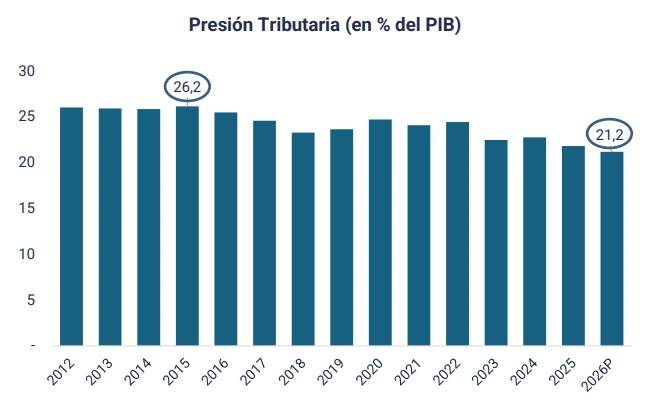
In this context, the project foresees the lowest tax burden in decades, marking a milestone in fiscal policy by decreasing from the peak of 26.2% of GDP, recorded in 2015, to 21.2% of the projected output for next year.
Tax Reduction
This relief in the tax scheme responds to the structural reforms implemented by Milei since taking office. The official document highlighted that the ordering of public accounts was achieved alongside the elimination of the PAIS Tax, reduction of export and import duties, tariffs on imports, and the gradual elimination of Personal Property Tax, as well as the implementation of the Labor Assistance Fund.
Tax pressure by year
Overall, the series of measures implemented represents a tax reduction equivalent to approximately 3 percentage points of GDP.
At the same time, the regulatory framework for 2027 relies on two key tools: the Labor Modernization Law and the Tax Presumption of Innocence Regime.
According to the official document, both initiatives stand as pillars designed to "relieve the tax and indirect burden on the private sector, promote the creation of quality formal employment, streamline labor relations, and encourage the formalization of Argentine savings looking towards 2027".
President Javier Milei
Fiscal Surplus
The 2027 Budget states that the goal of maintaining public accounts in balance will continue to be a fundamental pillar of the libertarian administration and projects a new positive financial result for the fourth consecutive year.
According to the project, the National Public Sector would reach resources of $219,300,991.9 million in 2027, equivalent to 15.5% of Gross Domestic Product (GDP), while expenses would amount to $216,000,316.5 million.
Thus, a financial surplus of $3,300,675.4 million is estimated, equivalent to around 0.2% of GDP, and a primary result of $18,439,871.9, equivalent to 1.3%.
Finally, this fiscal order is framed within a macroeconomic context that foresees a GDP growth of 4.0% annually and a deceleration of year-on-year inflation to 18.0% by December 2027,